
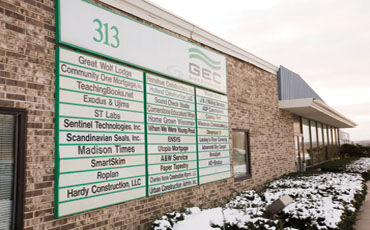

The financial difficulties of the Genesis Enterprise Center, a business incubator located on Madison’s south side, were the subject of a February 2008 article published in IB. In that article, some tenants complained about substandard tenant service and about the responsiveness and management of former Executive Director Richard Harris and former Facility Director Richard Brown. The article, which noted that GEC reported a loss of nearly $235,000 in 2005, charged that Harris was spending too much of the facility’s revenue on management and too little on tenant services.
Due to monthly interest charges assessed by Dane County, the financially troubled Genesis now owes $107,247 in property taxes for 2007 and 2008, according to Dane County Treasurer David Worzala, and that figure is likely to exceed $160,000 when the 2009 property tax bill is added this month.
In addition, US Bank and other public and private entities that have lent Genesis money have asked Dane County Circuit Court Judge Shelley Gaylord to appoint a receiver to make sure the facility is maintained and to better track the center’s finances. After two hearings on the receivership request, Gaylord has agreed to the appointment of Park Towne Management as a temporary receiver, but she has not made a final ruling on the lender’s request.
Genesis, 313 W. Beltline Highway, was founded 11 years ago at Mount Zion Baptist Church, which acquired the incubator facility in 2002. The facility is now managed by Rev. Richard Jones, president of Genesis Development Corp. and pastor of Mount Zion Baptist Church, and a new onsite manager, Toya Robinson. Jones recently claimed that the facility is 90% occupied and capable of paying its delinquent taxes with rental income, but IB was unable to verify occupancy rates and the extent to which tenants are up-to-date on their rents.
In addition to delinquent property taxes, sources contacted for this article indicate that Genesis has a fairly sizeable accounts payable list, and has yet to establish a sinking fund that would be used to pay off investors and take control of their property when New Market Tax Credits mature in a few years. Under the federal New Market Tax Credits program, individual and corporate taxpayers receive credits against their federal income taxes in exchange for making equity investments in community development entities. The tax credits are designed to encourage private sector investment in local communities, and financial institutions have participated by lending to Genesis.
Foreclosure Filed
In October of 2009, a foreclosure was filed in Dane County Court by a nonprofit entity that loaned Genesis $3 million in 2005. That entity, the Wisconsin Community Development Legacy Fund, is comprised of three economic development organizations: the Wisconsin Housing and Economic Development Authority (WHEDA), Legacy Bancorp in Milwaukee, and Impact Seven. It filed the foreclosure because Genesis has allegedly failed to comply with covenants in its loans, citing delinquent property taxes and failure to make loan payments when they come due. The requirement to remain current on property taxes is a common provision of any mortgage.
Contacted last week, WHEDA spokesperson Kate Ben said the organization is unaware of any payment made to lower or satisfy Genesis’ property tax liability.
At the time of the foreclosure filing in October, Jones has said publicly that the delinquent property taxes are a result of past mismanagement, and that Genesis would fix the problem within the six-month window in which it is allowed to address defaults.
IB tried unsuccessfully to contact Jones for comment on the center’s financial situation. Robinson also declined to comment on the center’s finances.
Sinking Fund
In addition, Genesis has deferred loans in the amount of $23,404 from the city’s Community Development Office, and $1,093,100 from the New Market Tax Credits program through Forward Community Investments (formerly the Dane Fund). Those loans come due, respectively, at the time they sell or transfer the property, and when the New Market Tax Credits roll out in about three years, at which point the parties involved would have to refinance the entire package, according to Barbara Constans of the Community Development Office.
“When they [tax credits] mature, then what happens is there is whole structure for how Genesis should have what’s called a ‘sinking fund’ that they would use as their basis of capital, to borrow to basically pay off the various investors and take control of their property,” Constans explained. “One of the issues is not only have they not been paying property taxes, or their creditors, or their staff to some extent — they haven’t been putting money into the sinking fund, either.”
At the end of the deal, Constans said it’s hard to know how Genesis can essentially buy out its loans, as it is supposed to, because management hasn’t been putting any money into the sinking fund.
Constans added that lenders wanted to put the receiver in place to make sure the Genesis property is being maintained and that its financial condition improves after two and a half years of slippage.
“What we do with our loans, typically, is we write them for the actual dollar amount, or the percent of fair market value that those funds represented in the property at the time we made the investment, whichever is greater,” Constans said. “So what they will owe us, when they pay us back, is $23,404 or 0.73% of fair market value at the time that they are paying us back, whichever is the higher dollar amount.
“If the property had gone up in value, then they would owe us more. Obviously right now, we’re just concerned about maintaining our investment, much less getting our money out.”
The Clock is Ticking
While Genesis’ financial statements for 2008 have yet to be posted on the GuideStar Web site, its 2007 Form 990 reports total revenue for that year at $451,940, and a budget deficit of $5,314 for the year. With a negative fund balance of more than $24,000 coming into 2007, the organizations carried a negative fund balance of $29,559 into 2008, according to the statement filed with GuideStar.
Time may be running out for Genesis on several fronts. Another deadline looms with Dane County. Worzala indicated via e-mail that if Genesis is delinquent on 2007 taxes as of Sept. 1, 2010, the property would be subject to the tax deed process, which is akin to foreclosure. The latest county records show that Genesis still owes $53,732 in property taxes from 2007 alone, but the county would not necessarily take control of the property right away if the taxes remain delinquent. “As one would expect, there are numerous legal actions that must be taken, and it would take at least six months to carry out,” he wrote. “The Personnel and Finance Committee would have to act to sell the property, but the Treasurer has the authority to take the deed if it gets through the process.”
Before that happens, there is a practical consideration, Worzala noted. Since Genesis has financing, and since the financial institution would lose all interest in the property if the County were to take it, “it would be extremely surprising if the financial institution did not pay the taxes and proceed with foreclosure before letting the county take the property. While I have not looked at the details of this property, I would be very surprised if the County ever got this property as it is not in the best interest of several stakeholders.”
As for the temporary receiver, Mary Feldt, president/CEO of Park Towne Management, informed IB that she is not in a position to talk about Genesis at this time.
Fighting Receivership
Constans said the lenders had been assured for the past two and a half years that everything was getting better. Several months ago, there was involvement from Rev. Jones, who indicated that he was going to be stepping in and helping with Genesis. “To his credit, he did step in,” she said. “To his credit, he did try and help, but clearly many of the things that he thought he would be able to do have been much slower in coming than any of the lenders anticipated when we first met with him last February.”
According to Constans, Jones indicated that he had some large donors that would probably be coming forward to help pay off the tax debt from the prior year, which hasn’t yet happened. He also said he would be taking over day-to-day management of the facility, which didn’t immediately happen. Toya Robinson was hired in early fall, Constans said. Prior to that, Richard Harris was still involved, although the lenders had been told that Harris would no longer be involved after early February, she said.
“Many of the things that Rev. Jones said that he would be able to put in place, he has now, according to his testimony at the receivership hearing a week and a half ago, but they literally were put in place within a week of his first meeting with the judge for the receivership,” Constans said. “So things that we thought would be happening for six or eight months were not happening then.”
Constans also indicated that Genesis is fighting receivership and interested in reconstituting its board, and that Judge Gaylord is taking testimony from both sides to determine whether Genesis can be righted without receivership. “Frankly, I don’t think anyone expected that [fight], given the condition it [Genesis] was in and given where things were as related to management, et cetera,” she said. “The lenders didn’t really expect that letter that [indicated] there was going to be this fight.”
Worthwhile Endeavor
Despite its troubles, virtually everyone involved with the center, past and present, sees a need for a business incubator on Madison’s south side. Former Genesis board member David Locke, CEO of McFarland State Bank, noted that Genesis has paid back in full a $1.9 million loan made by his bank. As a business incubator, Locke said its initial challenge was dealing with the high failure rate of start-up businesses.
“The concept in South Madison is a good one,” Locke stated, “but it’s all about management and people — who is running it and how they are running it.”
Sign up for the free IB Update — your weekly resource for local business news, analysis, voices and the names you need to know. Click here.

