
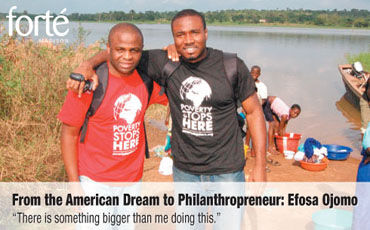

Admittedly, the term “philanthropreneur” is made up, but it’s an accurate description of the 25-year-old successful engineer from Nigeria who gave up the archetypal American dream to establish the nascent non-profit organization (NPO), Poverty Stops Here (PSH). After graduating from Vanderbilt with a degree in computer engineering and landing a well-paying job with National Instruments, Efosa Ojomo planned to turn his newly-purchased Madison home into an “MTV Crib” and to buy, with cash, a BMW to go with it.
But a nagging voice in the back of his mind kept asking, “Why do I need these things?” He realized that they were simply status symbols — and he wanted to show off his success. “When I pulled up to a light in my BMW, you would look and say, ‘wow.’” At the tender age of 23, Efosa had a mature epiphany: He didn’t want this part of the American Dream. His home is now “modest“ and he drives a Toyota.
Efosa’s epiphany prepared him for the book, The White Man’s Burden, by William Easterly. As Efosa read about a 10-year-old Ethiopian girl who arose at 3:00 a.m. every morning and trudged several miles to collect a heavy load of wood and carry it back home. He admitted to “crying, because I remembered where I was when I was just 10. I was in a completely different lifestyle.”
And so Efosa’s values evolved — he and several friends and family around the world launched PSH, with the mission to “provide local assistance for people in third world countries.” The organization completed its first project last September: installing a water well in an impoverished Muslim village in Nigeria. Other projects to improve the health and economics of poor Nigerian villages are in the works, as well as fundraising activities to support future activities.
“It is not as easy as I thought [it would be],” Efosa admits. This short-of-tooth “philanthropreneur” is learning how hard it can be to lead and motivate unpaid NPO volunteers. “Everyone looks to me for answers. Unlike my job, when I cannot answer questions, I have tech support backup. In this I do not. It takes getting used to,” he acknowledges. Efosa has had to learn how to listen to the ideas of others and to compromise, which he found to be “not as easy as it sounds.” This engineer is learning people-management skills on the fly.
Then there are business details, like the application for 501c3 tax status, which were an unexpected distraction from the primary mission of helping people in extreme poverty. But he is learning to “be patient. It is taking longer to get going than I wanted it to.”
“I am humbled that I have been given such a passion for this…issue. It is (now) second nature for me. It is what I think about when I wake up in the morning. I can’t wait to go back home and visit some villages. And that is a heart transformation from the MTV Crib and BMW. There is something bigger than me doing this,” Efosa explained.
By the way, in Nigerian, Efosa means, “God’s riches.”

