
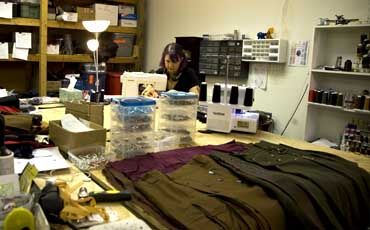

Regina Davan probably never dreamed of becoming a kilt-maker as a child. After all, who outside of the Scottish highlands does? But when some friends of hers were looking for affordable contemporary kilts, they pressed Davan, who at the time was studying costume technology at the UW, into service. She found she had a knack for it, and a new outside-the-mainstream Madison business was born.
From that point on, she says, her business (now dubbed Alt.Kilt) “took off like wildfire.” The only problem was, she didn’t have the resources she needed to navigate it in the direction it seemingly yearned to grow – further into the “highlands.”
Davan called on the Wisconsin Women’s Business Initiative Corp. (WWBIC), and with an initial $5,000 loan and some priceless guidance, turned her one-woman shop into a five-person operation that was able to nearly double its sales in a the span of a year, hitching its fortunes to a traditional Gaelic garment that has seen renewed interest among the “geek community,” sci-fi aficionados, followers of the steampunk craze, and even firefighters and policemen.
“My entire business up until that point had been bootstrapped from nothing, and I was at that very crucial point of ‘I need to grow, but I don’t have the money to do any growth, and I don’t even know how to grow past just me,’” said Davan. “And so working through the loan process with them got me to really finalize a business plan and to also sit there and for the first time really think, ‘Where do I want to be in five years, where am I going, what am I doing?’ And they were really helpful in helping me tailor those down to goals that they could help me reach with the loan.”
Now, says Davan, she’s better able to focus on the nuts and bolts of her operation – simply manufacturing kilts – and has the resources to move more product out the door.
“One of the major things I needed was to be able to buy fabric in bulk, and the hard part about that is you have to start with $2,000 worth of fabric to get that process going, and so I never had the ability to get the raw materials to make my business more efficient until I had a chunk of money at my disposal to suddenly reach into that market.” – Regina Davan, Alt.Kilt |
“One of the major things I needed was to be able to buy fabric in bulk, and the hard part about that is you have to start with $2,000 worth of fabric to get that process going, and so I never had the ability to get the raw materials to make my business more efficient until I had a chunk of money at my disposal to suddenly reach into that market,” said Davan.
Of course, if it sounds like Davan is a poster girl for the importance of seed capital and financial guidance, it’s also refreshing to note that she’s far from the WWBIC’s only success story. Among the local companies the organization has helped are Engaging Results Communications, The Green Owl Cafe, Cupcakes-A-Go-Go, Rock-A-Thigh Baby, and Good Style Shop. And while the statewide organization will soon be celebrating its 25th anniversary, the WWBIC’s mission has never been more vital, with a lackluster economy making access to capital a tricky proposition for many would-be entrepreneurs.
Not surprisingly, the WWBIC has seen an upsurge in both its lending activity and the number of loan applications it receives.
Its total loans have surged from $2.25 million in 2008 to $3.4 million so far this year. Even more remarkably, the number of loan applications it has received has jumped from fewer than 100 in 2009, to 316 in 2010, and to a projected 500 in 2011.
“We’re seeing many more people who traditionally would have been what we call bankable – which is able to receive financing from a traditional bank or credit union – have to look at alternative services like WWBIC to get their financing either in full or in part,” said Ruth Rohlich, director of the organization’s South Central Region office. “So we also do partnership loans with banks, and that type of loan has also increased, where maybe the banks are saying they’ll do 20% or 40% of what the business owner’s asking for, and [the owner] will come to WWBIC or an alternative group like WWBIC to get the rest of the funding.”
Lending money and time
WWBIC’s stated mission is to promote economic development through direct lending, business assistance, and business education. It also places an emphasis on serving people of color, people of lower wealth and incomes, and women – though it does not discriminate by gender when considering loan applications.
The loans range in size from $1,000 to $100,000, and loan terms are typically one to six years in length. The organization works with start ups and growing businesses, and its loans are generally used for machinery and equipment, supplies, furniture and fixtures, inventory, and working capital.
Funding comes from low-interest government loans (the organization is an SBA lender), investments from private individuals, and investments from banks. For instance, PNC Bank recently announced a $500,000 equity equivalent investment into the WWBIC’s statewide loan fund.
“We work really closely with banks and credit unions, almost all of them in the state, and I think that they are really trying to get money out there, but they have different requirements internally within their organizations and from the government and so on,” said Rohlich. “And what we’re seeing is that they’re really looking at organizations like WWBIC, and so a lot of the major banks and credit unions donate money into our loan fund. …
“They love partnering with us now, too, because no matter how much we lend, every loan client of ours is assigned a business assistance person who basically just works one-on-one with that business throughout the term of that loan to just check in on them, check their financials, make sure they’re doing well.”
Financing also comes from unusual places – a fact that perhaps reflects the urgency of getting working capital into the hands of small business owners.
“I think people are really just looking at economic development as a sort of important charitable giving thing,” said Rohlich. “We get some donations from, like, groups of nuns, where they might want to invest $300,000 into our loan fund at a lower interest rate. So they’ll get a lower return rate than they might if they were playing the market, but it’s a socially conscious investment in their mind. So that has increased a little bit, too, in the last couple of years – so it’s just that new focus on economic development and helping small businesses.”
Still, the organization is quick to point out that it’s not a charity. While it serves lower-income individuals, applicants still have to have their ducks in a row.
“We are still saying no to people as well,” said Rohlich. “I think the last internal number was that we’re saying yes to one out of four, so there is still a need out there. We can’t say yes to everybody.”
The WWBIC currently uses an underwriting program that was developed by the national microlending organization ACCION. Designed for groups like the WWBIC, the program does an initial underwriting check of potential borrowers.
“So you’re looking at individuals who might not have perfect credit or are lower income and don’t have maybe a lot of savings or assets, and so it’s able to kind of look at an application from a person like that and look at other variables like the projections of the business plan, and it’s just a little bit more about who this person is” said Rohlich. “And that’s something that we’ve always done, but now that so many people are finding themselves in a situation where, maybe their houses aren’t worth as much as they were before, they can’t borrow against them, or one person in the family has lost a job and so their income is down and maybe their credit has taken a hit as a result – there are a lot more people who fall into that category than maybe did before.”
Sign up for the free IB Update – your weekly resource for local business news, analysis, voices, and the names you need to know. Click here.

