

In the event business owners still haven’t discovered every possible way to lower their operational costs, they can achieve greater energy efficiency through Focus on Energy business programs.
The FOE programs, funded by energy utilities that serve Wisconsin, offer financial incentives to hold down installation costs and bring a faster payback. Several of the programs offer contractors both prescriptive (defined) and custom incentives for the installation of energy-efficiency equipment, but the end customer gets an energy-saving gift that keeps on giving.
Small business, big savings
Focus on Energy’s Small Business program offers free, on-site energy assessments to businesses with an average peak monthly demand of 100 kilowatts or less.
Most installations involve replacing incandescent lamps with compact fluorescent (CFL) lights, which use one-fourth the energy of standard incandescent bulbs, or light-emitting diodes (LEDs), which are even more efficient and last five times longer than CFLs. Installations also might include water-saving shower heads, faucet aerators, or the replacement of neon “Open” signs with LED “Open” signs.
Free energy-efficient products are available to a variety of small businesses, including farms, independent gas stations and grocers, restaurants and bars, and private schools.
In addition to the basic, free package, customers can also choose to pay more under copay packages of $129 and $295, respectively. Troy Rindy, owner of Pandora’s Spa in Columbus, opted for the $129 package to convert his old T-12 lighting fixtures, which featured fatter, less energy-efficient tubes, to the more slender and efficient T-8 fixtures. (T-12s can also be replaced with LED fixtures, a newer product that Nathan Baer, program manager for Focus on Energy’s small business program, expects will generate a lot of interest.) The project also included the installation of an occupancy switch that turns the bathroom light on when people enter and off when they leave, and the placement of insulation on some hot water pipes.
Rindy hasn’t separated out the savings, but given the 20 overhead fluorescent light fixtures with four bulbs in each, he believes the 80 new energy-efficient bulbs the spa received are worth the investment. Given the energy needs of his tanning beds and spa services, which have their own unique power footprints, he thinks $129 is a small price to pay for companies hunting for savings.
“In 2013, we paid over $5,000 for energy [gas, electric, and water],” he noted. “All it would take is a 3% improvement in energy costs to have the program pay for itself from the savings in one year. Then if you factor in the cost of not having to replace burnt-out light bulbs, the return on investment is even greater.”
Program incentives actually go to the electrical contractor, or trade ally, while the end customer receives the energy-saving benefit over the life of the product. “Typically, the customer pays about 30% of the actual cost for the installation and the product,” Baer says.
Incentivizing business
All Focus on Energy programs offer incentives, but the one with the word incentive in its name serves facilities using up to an average of 1,000 kilowatts a month in the past year, so it applies to a broad range of customer segments. Under the business incentive program, financial incentives are provided for many different types of equipment, including HVAC, lighting, compressed-air systems, and irrigation systems for agriculture.
Among the organizational types taking advantage of these incentives are small- to mid-sized industrial facilities, agribusinesses, commercial spaces, K-12 schools, and municipal buildings. Customers usually work with their contractor and the Focus program to determine whether the equipment qualifies for incentives. In some cases, a project might require pre-approval, but the contractor usually handles the application process and other paperwork, and receives the incentive check upon approval.
The prescriptive incentives are outlined in a set list that’s available on the Focus on Energy website. There is a corresponding incentive amount, depending on the technology, and then there are custom incentives. “If a project doesn’t qualify for something prescriptive, they can work with us to find out if there is an opportunity to do a custom incentive, and that is based on a number of different calculations,” noted Katie Mueller, associate marketing manager for Franklin Energy Services, one of the implementers of Focus on Energy.
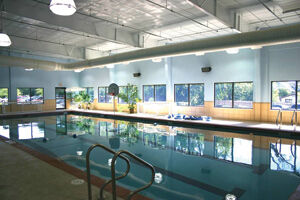
Harbor Athletic Club in Middleton needed a custom incentive to replace an existing dehumidification system for two of its indoor pools. They included a lap swimming pool for competitive-style swimming, usually kept at 82 degrees Fahrenheit, and a warm-water therapy pool maintained at 92 degrees.
(Continued)
Harbor Athletic Club ultimately chose North American Mechanical as the contractor, and the incentive was about $100,000 per pool, according to Todd Passini, the club’s general manager and co-owner. The dehumidification system in each pool will save an estimated $12,000 to $15,000 a year in energy costs. “We haven’t been through a full-year cycle yet, so it will be a while before we can get a real gauge, but I can tell you that it’s pretty substantial,” Passini says. “It’s already noticeable on the bill.”
A summary of retrofit and new-construction incentives for energy-efficient equipment is available on the Focus on Energy website (focusonenergy.com) under the business and then the efficient equipment tabs.
“We encourage folks to work with their contractors to make sure they are installing projects that qualify,” Mueller says.
Big gulp savings
Focus on Energy’s larger users program offers prescriptive and custom incentives to facilities using more than 1,000 kilowatts a month in the past year, 100,000 therms of natural gas per month, or that have a utility bill that is $60,000 or more in any given month. Many of the companies served are manufacturers with energy-management teams that collaborate with contractors and Focus on Energy.
Craig Schepp of Leidos Engineering, which manages the large energy users program, serves as the program’s operations manager. He noted that prescriptive incentives are available on a range of technologies, including lighting, heat-recovery units, large chillers, and compressed-air systems.
When considering whether to incentivize a project, Schepp looks for big energy-saving opportunities and motivated customers. The impact on a single project can be significant. With a $60,000 incentive from Focus, Mercury Marine invested $1.85 million in a new central compressed-air system and achieved $541,000 in annual savings, and the project payback took 2.6 years. “When a large energy user implements a new technology and process, usually it brings in a ton of savings,” Schepp noted. “There is a bounty of savings still out there, even though we’ve offered this program for 13 years now.”
Closer to home, Webcrafters accrued about $100,000 in annual savings with the installation of an IVEC (intelligent ventilation energy controls) trimmer that takes waste trim into its baling system. The system features variable-speed blowers that allow the company to use the energy it needs, when it needs it, replacing a fixed-speed fan that didn’t offer the same flexibility.
John Filsinger, senior vice president of production for Webcrafters, says the investment was about 3.5 times the annual savings, and the Focus on Energy incentive helped the project meet payback parameters. “We’re typically looking to fund paybacks within three years, if we can,” he stated. “The Focus grant enabled us to bring payback down into that three-year window, where we felt we could pay for this in a reasonable time frame.”
The large users program has an incentive cap of $200,000 per project and $400,000 per customer, per year, and it doesn’t buy down projects below a 1.5-year payback because with such a quick return, it would be logical for companies to invest in the equipment on their own, without an incentive.
Schepp believes he will be able to justify more projects by sharing with customers the cost of a product assessment incentive, which studies savings potential and technical feasibility, and quotes vendors on the cost of installation.
Energy boost
Additional business programs are available to serve various niche markets, and many of the same incentives apply. Here is a rundown:
Design assistance program: Using an energy model, the design assistance program provides energy-saving recommendations to design professionals. The model serves as a decision-making tool, using comparative analysis to influence building design. There are incentives of 9 cents per kilowatt hour and 55 cents per therm saved, and there is online modeling for certain buildings, says Program Manager Adam Niederloh, a project manager for the Weidt Group.
Retrocommissioning: This program offers incentives to upgrade rather than replace existing energy-using equipment used by commercial, industrial, school, or government facilities. Think of it as a tune-up in situations where a building’s tenancy, operation, or usage changes but the occupants don’t adjust as those changes occur, leading to inefficiencies. This may involve motors or drives or temperature and pressure settings. Focus on Energy typically finds out about “retro” candidates through trade allies, energy advisors, or utility account representatives. “Hopefully, through those relationships, we’re able to find where retrocommissioning opportunities are,” Schepp explained.
Multifamily energy savings: Under this program, Focus on Energy will assess the energy “performance” of residential buildings with four or more dwelling units — apartment complexes or condominiums. It includes a free, direct-install program for lighting (CFLs and, starting in 2014, LEDs), energy-efficient shower heads, bathroom and kitchen faucet aerators, and insulation for hot-water pipes. The assessment takes about five minutes per residential unit, and common-area lighting improvements are offered under a new program in which the customer receives up to $2,500 worth of lighting products for $179.
Chain stores and franchises: This program serves customers who have five or more facilities or franchise locations within the state of Wisconsin. Chains and franchises must be retail-, food service-, or food sales-based to qualify, so it’s not unusual to see restaurants, gas and convenience stores, grocery stores, and retail stores take advantage of the incentives. Given the nature of chains and franchises, program managers are accustomed to working with out-of-state business owners. “Customers working with this program, just because of the nature of their business, tend to apply for food service equipment, lighting, and refrigeration incentives,” Mueller says.
(Continued)
What’s in an audit?
Bob Connor acknowledges that the term audit, even when it applies to energy, has a negative connotation. But whether you refer to energy consumption reviews as audits or assessments, it’s never a bad time to have one. That’s especially true when the City of Madison is considering a proposed Energy Benchmarking Ordinance for certain businesses.
Larger businesses can afford comprehensive assessments, either in-house or provided by engineering firms, but there is a free option for smaller businesses courtesy of Connor’s employer, Madison Gas and Electric. MG&E provides free assessments to customers who want to get a handle on their energy consumption.
Connor, director of commercial and industrial marketing for MG&E, says the utility can provide in-depth analysis that includes services like infrared scanning, but the vast majority of its 500 or so annual business assessments involve simple walk-throughs. Connor’s group works specifically with commercial and industrial customers, and its reps specialize in specific industries such as health care, manufacturing, or retail.
“If a customer calls us with a specific question or a problem area in their business, or they are looking at a new piece of equipment, that might be more of a walk-through,” Connor says. “All of our assessments include a report. We will always get back to the customer with something in writing and tell them what we find and what our recommendations are.”
Recommendations are developed with an emphasis on projects that have faster paybacks. “Obviously, we can give them recommendations on items that have longer payback, but typically we don’t see customers react to items over a three- to five-year payback period,” Connor noted.
MG&E also brings various resources to bear, whether it’s Focus on Energy, MPower Business Champions, or its shared-savings program, where it helps finance projects of more than $5,000 with low-interest loans.
MG&E may not end up serving the city’s benchmarking program, but the utility has its own benchmarking service. If a business customer wants to find granular details of its energy consumption and cost per square foot, it can establish a login password at mge.com. Energy usage data is automatically loaded and can be tracked over time and compared against similar buildings (retail, for example). “If they are using more per square foot than other customers, we’ve got information on how to reduce those costs,” Connor noted.
(Continued)
CNG conversion immersion
With the move to more affordable transportation fuels, many roads lead to compressed natural gas. The United States is building an infrastructure of public and private CNG fueling stations, more businesses are converting their fleets with purchases of new vehicles dedicated to CNG, and companies are having existing vehicles converted for dual use (gasoline and CNG) with aftermarket conversion kits.
Even though the cost of gasoline has dropped closer to $3 per gallon, the volatility of petroleum still compares unfavorably with the relatively stable $2 per equivalent gallon cost of CNG. If a vehicle stays in the fleet over several years and accumulates enough miles per year, the conversion has a reasonable payback.
The calculation is not lost on Mark Barnes, president and CEO of Barnes, Inc., a Madison-based landscaping company that has established a subsidiary to install conversion kits. Barnes is gradually converting his own fleet of light- and medium-duty vehicles to CNG, a move that eventually could save up to $200,000 annually once all vehicles are outfitted.
Barnes says the cost of converting depends on the vehicle, model, and other factors but ranges from $10,000 to $13,000. In 2013, government grants cut the cost in half up to five vehicles, but there is no word on how much grant funding will be available this year.
Aftermarket conversions make sense if the vehicle model is relatively recent, the company plans to keep it for several more years, and it is driven at least 20,000 miles per year. CNG calculators are available on the Internet, and some ask for more detailed information than others, but they can help you calculate payback.
“Our payback is between four and six years, and that is a perfectly acceptable number,” Barnes stated. “We keep our vehicles between eight and 10 years now, so I don’t need the payback tomorrow.”
If conversion isn’t to your liking, investing in new CNG-dedicated vehicles comes with a higher cost over vehicles powered by conventional gasoline. “It varies,” says Debbie Branson, business ally manager for Madison Gas & Electric. “For light-duty vehicles, incremental costs are about 30% more. There are different configurations for medium- or heavy-duty, so those can be between 30% and 50% more.”
The refueling infrastructure is growing right along with the number of CNG fleet vehicles. Lorrie Lisek, executive director of Wisconsin Clean Cities, notes there are 644 publicly accessible CNG fueling stations and 646 private stations nationally. Wisconsin has 35 public sites and 10 private fueling sites, and “there is [CNG) infrastructure along the I-94 corridor, in Chicago, and in northern Indiana along the I-65 corridor,” Lisek noted.
Click here to sign up for the free IB ezine – your twice-weekly resource for local business news, analysis, voices, and the names you need to know. If you are not already a subscriber to In Business magazine, be sure to sign up for our monthly print edition here.

