
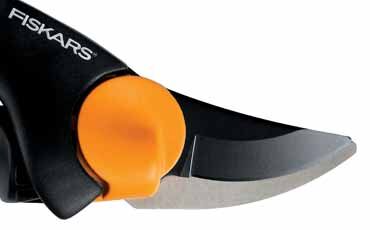

Fiskars is perhaps best known for its signature product, the durable, orange-handled scissors coveted by crafters and scrapbookers and even gardeners, but a cutting tool of another kind has enabled the company to trim its product line so that its bottom line could continue to grow.
Some might call it an 80:20 exercise, but Fiskars — a global supplier of consumer products for the home, garden, and outdoors — prefers the term “SKU (stock-keeping unit) reconciliation.” The exercise requires “letting go” even when people remain emotionally attached to products — however unprofitable — but Fiskars Americas president Paul Tonnesen is well versed in the required diplomacy.
Tonnesen was recruited to Fiskars Americas, the North American hub of the Helsinki, Finland-based company, in 2007. It was a time when thousands of SKUs, a unique identifier for each product, were bringing in a small percentage of Fiskars’ business yet commanding an inordinate amount of time and effort to design and supply.
In 2007, Fiskars had more than 8,000 SKUs, but the company is well on its way to finishing at 2,000 by the end of 2010 — all while withstanding a devastating global recession and making room for new product innovations.
Baking the Cake
In the past 15 years, Tonnesen’s business background has involved taking over challenged businesses. He compares SKU rationalization to baking a cake, but the recipe involves paring down the number of ingredients. “When you first come in, you have to look at how much inventory am I carrying on each one of these SKUs?” he explained. “In most cases, you look at it and say, ‘Well, 20% of my SKUs are doing 80% or 90% of my business. So why am I carrying the rest?’ These are the questions you have to look at.”
The profitability of each SKU was examined closely, with intense focus on the “consumables,” the stickers and the stamps that could be found at various retailers. They were branded under a number of different names, including some Fiskars brands, but the main reason the company got down to a certain number of product lines was that it got out of the consumables business. There literally were thousands of SKUs that, combined, were responsible for that aforementioned small piece of Fiskars’ business.
The decision to discontinue them brought some heartache because retail customers considered some of them “must-haves” for their customers. At that point, Tonnesen’s thought process turns to substitutability. “What SKU can I substitute that’s most like that [discarded] one?” he asks. “It might have less bells and whistles, but it’s going to meet that retailer’s need, or 90% of the need.”
Even though retailers coveted these products, the problem was that last year’s Halloween stickers quickly became obsolete because retailers insisted on newer, fresher designs. Every quarter, Fiskars would have to mark down existing products and come up with new designs, creating a ton of inventory. “Trying to keep 4,000 SKUs alive was such an uphill climb, and there was no profit in it,” Tonnesen said. “For me, it was a no-brainer.”
At the time, Fiskars’ productivity per SKU was under $10,000, but now it’s several times that. So not only did the reconciliation process cut inventory, freeing up working capital to run the business, it reduced costs for materials handling, labor, and distribution. That, too, plays a role in withstanding a recession. “If you don’t have that amount of product, you have fewer fixed assets, less racking, less materials handling equipment, and you need less space,” Tonnesen noted. “It simplifies the wholesale process. It simplifies the ordering process.”
Addition by Addition
That’s not to say Fiskars won’t add new products, but anything new has to prove its bottom-line worth. The streamlining has freed designers to work on next-generation product innovation. The 360-year-old business may be Finland’s oldest company, but the Madison location has engineers that are constantly evolving its brands, identifying customer issues, and problem-solving.
The latest example, one of several new eco-friendly products that were produced as part of Fiskars’ innovation program, is a newly designed push lawnmower that addresses the clogging and jamming of past models, with a fly wheel strong enough to drive through grass easier, push it forward, and avoid the metal-on-metal action that dulls the blades. The early sales returns are encouraging, even though the product introduction is limited to Lowe’s retail outlets.
Tonnesen said Fiskars must have intellectual property built into its projects, which is why it still rolls out more than 100 new products each year. “If you look at the ratio between new products and your total sales, the sweet spot for me has always been in the 30% range,” Tonnesen said. “So new products, ones that are new in the last three years, are about 30% of our business. Anything significantly more than that, if you’re up to 40%, that adds a lot of churn and you have a lot of close-outs. Anything under that and you’re going to lose space to competitors.”
According to Tonnesen, the U.S. retail market is so homogenized by Walmart, Target, and other big boxes, anyone that can introduce a product into them becomes a millionaire. Since those accounts are incredibly attractive, and there is so much competition for any given product line, companies must develop great brands. “You have to be innovative, and you have to be innovative every single year,” he explained. “If you have a great product, that’s great, but if you’re not reinventing yourself every year, then you can get bumped off by your competitors.”
While Fiskars has announced the closing of its Sauk City warehouse and its Wausau distribution center, the reconciliation program is paying dividends. Fiskars’ net sales and operating profit increased by 2% and 8.6%, respectively, in the first quarter of 2010, according to its May 4 interim report. The company reported $663 million (Euros) in sales in 2009 and employs 3,600 people worldwide, including 210 at its Madison location.
It now views SKU rationalization as a constant, rather than occasional exercise. Every year, the company establishes a new set of targets, and last year’s goal of reducing the SKU count by 16% was met. “We make it every year, but the key is to only carry those items that hit a certain productivity level,” Tonnesen stated. “Say our productivity was $100,000 per SKU; the new goal might be to hit $120,000 per SKU in productivity.”
Tonnesen emphasized the importance of understanding the difference between the way Fiskars looks at SKU rationalization, and the way the retailers look at it. “If we know we have a ‘dog,’ you want to get rid of your dog item before the competitor takes your space,” he explained. “So if we have something that’s not turning well, and we have the 80:20 rule at the retailer, it’s the same thing. We look at that and say, ‘If we have our last 10 SKUs, we should be looking at those, too, to refresh those items so they continue to do better, or replace those items.’ If you don’t, somebody else will take that space.”
Sign up for the free IB Update — your weekly resource for local business news, analysis, voices and the names you need to know. Click here.

