
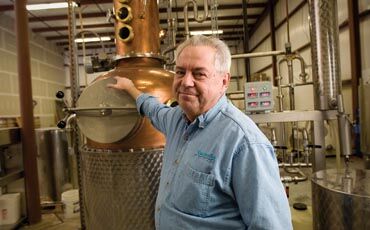

Paperwork covers a large table in the warehouse location of Nick Quint’s craft distilling business, in addition to newspaper clippings and a large volume of the Code of Federal Regulations.
These reams tell the tale of Quint’s dream of producing small-batch spirits using local ingredients, and how he believes current regulations work against artisan distilleries like his.
“As a small distiller, we have to go through it the same way the big guys do,” Quint explained. What’s more, distilleries have more rules to follow than microbreweries or small wineries.
Since starting Yahara Bay Distillers (yaharabay.com) in October 2007, Quint has encountered more red tape than he could imagine. After nearly a year as Dane County’s first legally operating distillery, Yahara Bay hopes to be through a federal review of its permit and practices by spring.
The Alcohol and Tobacco Tax and Trade Bureau (or TTB) regulates distilleries from within the U.S. Department of Treasury. Unlike beer and wine, it’s illegal to make liquor as a hobby, or in small batches. According to the TTB, “You cannot produce spirits for beverage purposes without paying taxes and without prior approval of paperwork to operate a distilled spirits plant.” To make any kind of distilled beverage, producers must adhere to requirements — which, the bureau notes, include paying a special tax, filing an extensive application and a bond, keeping detailed records, and filing reports.
After his cousin, Jeff Quint, set up Cedar Ridge Winery and Distillery in Cedar Ridge, Iowa in 2005, Quint saw an opportunity here to launch the area’s only craft distilling business. He joins Great Lakes Distillery in Milwaukee, 45th Parallel Spirits in New Richmond and AEppelTreow Winery in Burlington.
Quint jumped right in, studying at Michigan State University and attending conferences on distilling before purchasing a German-made Christian Carl still.
His first product, vodka, hit the shelves in February 2008. Other spirits followed: gin, white rum, lemoncella and Calvados, a German-style apple brandy made from the juice of Honeycrisp apples grown in Gays Mills, Wis.. Yahara Bay also distills Death’s Door brand vodka and gin, using Washington Island-grown wheat.
Yahara Bay imported and bottled spirits sold at Vom Fass’ first U.S. store on University Avenue in Madison. Since last spring, Vom Fass’ spirit sales have been on hold while store owners work through importing issues with the TTB.
“We haven’t been able to put any new (liquor) product on the shelves since April 1, 2008.” said Justin Gibson, who owns and runs Vom Fass with his father, David. “There’s beauty in the beast. We’re the first, and unique. The problem is, we have obstacles to overcome.”
The Madison shop had been using Quint to import 30 artisan spirits from its parent company in Germany to be vended from casks, or “vom fass” in German. The government requires that imported alcohol be shipped directly from producers, not Vom Fass AG, Gibson explained.
Vom Fass USA contacted Wisconsin Sen. Russ Feingold to help speed the process, after it took TTB eight months to make an initial ruling on their permit. Now, Gibson hopes to have the issue resolved within six months and have the spirits back on the shelves again.
Quint’s own permitting review ensued because of his apple brandy production. The brandy is made with apple juice fermented in 300-gallon tanks, a process that, technically, is wine making.
“I’m a distillery, not a winery. Now I have to be a bonded winery” Quint said. “I’m redoing all of my permits, primarily because of being bonded as a winery. It’s a daunting task.”
Yellow tape on the floor of a 15-foot by 12-foot section of the warehouse designates where Quint’s winery begins, and the distillery ends. By law, Quint is required to document product transfer in and out of this small square. He said he understands that the industry he has chosen needs regulation, but he believes there’s a better way to do it.
It all comes down to political muscle.
Much newer than craft beer or wine making, artisan distilling is an up-and-coming business lobby. There is a small trade group, the American Distillers Institute, in Hayward, Calif. that keeps track of industry happenings, but institute President Bill Owens said that lobbying needs to happen on the state level.
Owens said about 15 craft distillers opened last year, and the institute counts 160 nationwide, up from 60 producers 10 years ago. He predicts the industry will add 10 to 15 distilleries annually going forward, as others discover the fun and fascinating work of creating artisan spirits.
“A lot of foods have been through a renaissance and have reinvented themselves. We’re reinventing the spirits business now,” Owens said. “We’re a small industry, but we’re very, very interesting.”
Owens recommends having your ducks in a row before working with the TTB. Having a lawyer or consultant review permit documents saves you in the long-run.
Quint, 62, who sunk his retirement savings into Yahara Bay, worked to quickly get his distillery up and running, “but we’re paying for it,” he acknowledged. He never really wanted to involve consultants or lawyers in his business. If the paperwork gets much heavier, however, he may need to hire someone.
A family-run operation, Quint on many days is a one-person shop. Friends and family volunteer to help bottle, label and ready products for distribution. Frank Liquor Co. recently signed on as Yahara Bay’s local distributor, due to a law change that prevents Quint from wholesaling his own products. Capitol Husting Co. handles Yahara Bay’s Milwaukee distribution.
Sales average 50 cases a month, with some months as few as three cases and others as many as 400. Vodka is Yahara Bay’s best-selling product. Quint aims to sell a steady 500 cases monthly. Bottles retail on store shelves for $26 to $29.
“I see a nice, steady growth with a complete product line,” Quint forecasted for Yahara Bay. “I like the support I’ve been getting. I also like being able to use Wisconsin state products and make something out of them.”
Quint’s wife, Catherine Forde, who owns Basketree Gifts in Madison and has been an artist for 40 years, this spring plans to have a gallery space open in the front room of the warehouse. In time, Quint hopes, the gallery can host tasting events for his products as well.
But that will require changing another state law that prevents liquor samples at the facility.

