

Farmers, in the colorful words of Pam Jahnke, aka The Fabulous Farm Babe, got shortchanged “seven ways to Sunday” in 2009, but with just a little luck 2010 could be an entirely different story.
Wisconsin farmers weren’t quite prepared for what hit them last year. The state’s farms and agricultural businesses generated $59.16 billion in economic activity and provided jobs for 353,991 people in 2007, and they enjoyed record prices for milk and crops n 2008. However, the combination of collapsed prices for milk, cheese, and crops, and high input costs helped 2009 farm income drop 56%, to $1.1 billion, according to a report by UW-Madison farm economists.
Milk prices dropped from a robust $18 per hundredweight in 2008 to around $10 per hundred weight last summer, although the annual average was just below $14.
Crops didn’t fare much better than milk. In 2008, before the full extent of the financial crisis became known, corn growers were getting upwards of $7 per bushel, but in 2009 the per-bushel price was just above $3.
Foreign markets also took a nose dive, which impacted agricultural exports.
A perfect storm of perfectly unfavorable weather, including the lack of a genuinely hot summer followed by a very wet autumn, meant corn crops did not reach maturity as quickly as they normally do, and left them overly saturated with moisture.
Wisconsin dairy farmers continued to be productive, increasing both the number of cows and the level of milk production, but they did so against strong headwinds. “Farmers went through 2009 with the greatest distress we’ve seen in dairy since the early 1970s, maybe ever,” said Dr. Robert Cropp, a professor in the UW-Madison College of Agriculture and Life Sciences (CALS).
Dairy blues
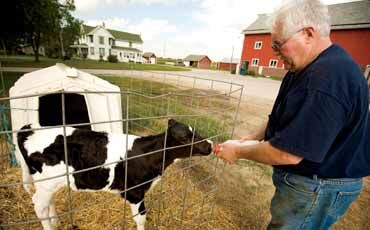
Pat O’Brien runs a Fitchburg dairy farm in partnership with his brother, Tom. The 600-acre family farm has about 240 cows and raises corn, alfalfa, soybeans, winter wheat, and winter rye to use as feedstock. O’Brien’s break-even point is somewhere between $16 and $17 per hundredweight of milk, and he might approach that in 2010. He noted that Cropp has forecast an average milk price of about $17 per hundred weight this year, but in mid February O’Brien still wasn’t seeing that reflected on the Chicago Mercantile exchange, where it was about $15. That’s better than it was last year, but O’Brien knows that prices may never reach the high-water mark of 2008. “The prices we received for milk were really kind of unrealistic,” he acknowledged, “and I think we had to realize that we couldn’t bank on those prices forever.”
Compounding things was that input costs for fertilizer, pesticides, and fuel rose right along with milk and crop prices, but remained at high levels even when the price of milk and corn came down.
That’s starting to change a bit for O’Brien, who sees lower prices for fertilizer and stable prices for diesel fuel. “We’re looking to lock diesel fuel in the $2 to $2.50 range this year,” he said.
An average annual milk price of between $14 and $17 is not a panacea, but it’s enough for most Wisconsin milk producers to meet their cost of production, according to Brad Pfaff, state executive director for the U.S. Department of Agriculture’s Wisconsin Farm Service Agency. “In and of itself, it means an awful lot because you’re not losing equity every time you go to the barn,” Pfaff said.
Frost warning
With farmers, there are a lot of hidden considerations, like the amount of frost in the ground when the spring thaw comes. That determines whether snow melts into the ground, providing needed moisture in the field, or whether it runs off to the low spots. “We’ve had what I consider a pretty good winter,” O’Brien said. “There is not a lot of frost in the ground, but weÃÂÂÂve had a lot of snow. When things start to melt, the snow is going to be a source of moisture.”
On his dairy operation, every crop is placed in storage for livestock feed. In 2009, O’Brien was one of the fortunate farmers who was able to harvest everything before the onset of winter, but given the unusual weather, the corn was wetter than normal. The moisture level of the corn was in the low 30s, which is abnormally high and potentially unhealthy for cattle. A diet composed of very wet feeds is one factor that can lead to acidosis, a condition in which there is excessive acid in a cow’s body fluids. If acidosis reaches an acute level, it can cause dehydration and death.
O’Brien is feeding his herd with other byproducts so that he can cut down on the amount of corn in the ration.
Jerry Bradley, a Sun Prairie crop farmer, (corn and soybeans), said a cold, wet spring caused late planting, and an unusually cold and wet autumn caused the crops to fall behind. Fortunately, Bradley got his crop harvested before the first frost — “Barely,” he noted — but he had the same wet-corn problem O’Brien did. He was taking corn out of the field with a moisture level of between 25% and 30%, when the preferred level is 18% to 20%. As a result, it cost more to dry it down to the optimum level of 14%.
“The corn did not have the heat units to dry down,” Bradley explained. “Corn needs enough heat units for it to mature naturally; because it could not mature naturally, we harvested early and then had to dry it.”
Bradley farms with his brother, Mark, on a family farm that dates back to 1848. In 2008, Bradley could get $7.30 and $15, respectively, for corn and soybeans, but that market collapsed in 2009. He would be happy to see the per-bushel price of corn and soybeans rebound to $4, but so far the markets have been tumbling. He also saw input prices rise, but unlike O’Brien, he says the situation isn’t correcting itself.
From 2003 to 2007, the per-bushel cost of corn was roughly $2, and input costs also remained flat during that period. Now, having seen his input costs more than double — in the case of fertilizer, nearly triple — Bradley needs corn to reach $4 a bushel to break even. In February, he could only command about $3.20 per bushel. “With the cost of our inputs today, and our land costs, if that market does not stay above $4, that’s going to hurt,” he stated.
Brian Gould, a Renk professor of agribusiness for CALS, expects continued price volatility for grains. He also forecasts record global production for soybeans and strong demand for corn due to a resurgence in exports as the dollar weakens relative to 2009 — plus large amounts of corn going into the feed market, and increases in corn-based ethanol production. “The ethanol industry is still struggling but we’ll produce more ethanol than we did last year,” he predicted.
Where’s the green?
In terms of financing, O’Brien still had not spoken to his banker when IB contacted him. He had been concentrating on getting his year-end tax work done, as farmers typically file by the end of February. His bankers will be interested in his year-end balance sheet.
“We have some accounts payable built up, as I think most farms do,” he said. “I talked to our banker back in December, and he’s aware of the situation. I’m hoping that our equity picture is strong enough for him.
“Admittedly, most farmers have been borrowing money and we’re mortgaging what we have even further.”
O’Brien is aware that some farmers have turned to guaranteed Small Business Administration loans. Increasing reliance on the SBA might be due to stricter credit terms. Julie Wuthrich, vice president of Citizens Bank in Amherst, Wis., said traditional agricultural lenders have money to lend, but factors like equity position, cash flow, and credit bureau score influence lending decisions. “The availability of credit is not the issue,” Wuthrich said. “The issue is borrowers aren’t as credit-worthy as they once were.”
Seeds of optimism
Farmers can pass off 2009 as a peculiar year because they are by nature optimistic. “It would be nice to have an early spring,” Bradley said. “The groundhog [Jimmy X] lives just up the road from me, and he says it’s going to be an early spring.”
“I guess, by nature, you have to be optimistic to stay in this business,” O’Brien summarized, “or there wouldn’t be many of us doing what we do for a living.”
Sign up for the free IB Update — your weekly resource for local business news, analysis, voices and the names you need to know. Click here.

