
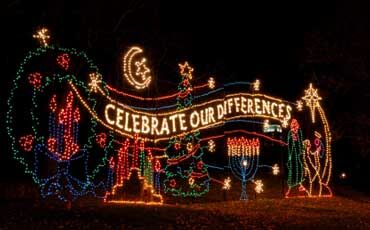

With Christmas, Hanukkah and Kwanzaa in the air, among other lesser known holidays year-round, there’s no doubt the United States “melting pot” is responsible for a rich diversity of employees in the workforce — many bringing with them a myriad of religious beliefs and celebrations. Those we are most familiar with during the latter part of the year are just a few of many celebrated annually.
Has this influx over the years of various cultures and religions caused a change in corporate decorations and HR policies in relation to religious practices? December is, after all, typically considered the “holiday season.” Vacations are planned around it, businesses and schools close because of it.
But what if an employee’s personal religious holiday falls in October, as Diwali does, for people of the Buddhist or Hindu faiths? Would that employee still get the Christmas holiday off in December? (Contrary to some opinions, OktoberberFest is not a religious holiday!) And can an employer truly feel comfortable erecting that Christmas tree in their lobby, without fear of a lawsuit?
Pick a Persuasion
There is a movement afoot in the country of New Zealand urging legislation to allow employees to swap their own religious holidays with those traditionally celebrated, such as the Christian celebration of Christmas each December. The idea would allow employees the freedom to select one holiday over another, meaning, for example, that a person of Jewish faith could take Yom Kippur off, and opt to work on Christmas Day.
The idea raises a host of logistical questions based on U.S. standards, and has its critics. For instance, with many businesses closing down on Christmas day, would a company have to remain open if one or two employees opted to work that holiday, for example? How much work could actually be accomplished, particularly if a job requires interaction with other businesses that might remain closed?
In the United States, the long-standing Title VII of the Civil Rights Act of 1964 prohibits employers from discrimination in hiring, firing and other terms of employment based on religion. It also requires employers to “reasonably” accommodate employee requests related to religious practices or holy days, which would cover issues such as those being discussed in New Zealand. But is it fair, these days, to close a business on religious holidays that may not be practiced by all?
John Komosa, the Chief Operating Officer at QTI Human Resources in Madison, Wis., said many of QTI’s business clients defer to bank holidays, choosing to close “on days when banks are closed.” He admits, though, that those dates often coincide with traditional religious holidays. At the employee level, more and more companies, he said, are adopting Paid Time Off models, floating holidays or a personal day off to accommodate special requests, which might include religious holidays.
Kristin Jacoboski, manager of employee relations at TDS Telecom in Madison, Wis., has no qualms with the 1964 law. With hundreds of employees, Jacoboski said TDS remains largely uninterrupted by religious controversy. “We are seeing more and more requests from our employees for certain days off, especially around the holidays,” she said, “but it is not a controversial issue. We are an employer of choice. We work with our employees. These issues are handled by human resources and are consistent.”
Jacoboski said the telecommunications company must often be staffed at all hours, so special time-off requests occur frequently. But because of its larger staff size, the company can usually accommodate those requests. “An employee puts a request in writing, and we meet with them,” she said, saying these decisions are typically handled at the department level. “We call it bi-lateral communication,” she said. Accommodations the company might provide include a job-day-swap, a schedule-swap or dress-code requests. “We don’t have issues. Employees can take vacation, personal days, unpaid time or even a leave of absence if they so choose.”
A Legal View
Troy Thompson, Partner, Labor & Employment Practice Group for Axley Brynelson in Madison, agrees that workplace diversity related to religion has not, for the most part, been controversial.
There was a case, in 1991, where an employee of Woodman’s Food Markets sued her employer for allegedly discriminating against her because of religion. Woodman’s was, at the time, paying a premium to workers who were able to accept work schedules at any time and day. But three days a week, the woman attended church meetings and said she was unavailable to work, so she did not receive the company’s premium pay. The state, Thompson said, ruled in favor of Woodman’s because its policy was neutral as to religion.
When ruling in such cases, Thompson said courts will consider whether employees can satisfy their religious obligations outside of work time, and if not, whether a reasonable accommodation exists that would not result in undue hardship to the employer.
“Employers are generally not required to bear more than a de minimis cost in order to accommodate an employee for religious reasons,” Thompson said. Courts will also consider the cost of a proposed accommodation, the impact on the business and other employees, and whether the accommodation would conflict with any existing policies or collective bargaining agreements.
Thompson said that while private sector employers can be exposed to liability for excessive proselytizing, they are generally entitled to exercise free speech and display traditional religious symbols and decorations on their premises. While he cautions employers to be sensitive to employee objections, Thompson said as long as those expressions are not directed at employees who find them unwelcome, the decision to decorate an office for Christmas, for example, is not unlawful.
Body piercing as a religion?
Employees, too, should be accommodating, and not take advantage of policies in place. Thompson referred to a recent case where an employee sporting body piercings tried to avoid an employer’s dress code by claiming the piercings were required by membership in the Church of Body Modification, a California-based church which supports the piercing and alteration of body parts for religious reasons. On the Church’s Web site, a Statement of Faith reads, in part: “We assert and protect our rights to modify our bodies and to practice our rituals. We believe our bodies belong only to ourselves and are a whole and integrated entity: mind, body, and soul. We maintain we have the right to alter them for spiritual and other reasons.”
Thompson said some employees try to use fair employment laws to avoid reasonable performance expectations and work rules. “Fair employment laws are not meant to be used as swords by opportunistic employees to leverage from their employers’ benefits to which they are not entitled,” Thompson said. “Most area employers are good at heart and would likely try to accommodate an employee’s needs, when able, even in the absence of fair employment laws requiring them to do so.”
The Language of the Holidays
Many employers are simply following the rules dictated by their corporate structure. For instance, over the years, there have been widely publicized movements by some large retailers to eliminate references to religious holidays altogether. Stores such as Walmart, Target, Kmart, Best Buy and Lowe’s have tried banning the use of “Christmas” in advertising and marketing campaigns, preferring, instead, to use the word “Holidays.” Some of those corporate decisions backfired, been explained as simple miscommunications, or caved under pressure from organized groups, such as the American Family Association.
No matter what the holiday — whether it’s Christmas, Kwanzaa, “Festivus for the rest of us,” a tongue-in-cheek title made famous in prime-time television, or Winterval, another term being floated in place of the Christmas season, Thompson said an employer can still call a Christmas tree a “Christmas” tree without the fear of a lawsuit. “I think it is important for employers to be mindful of the duty to accommodate [employees]. It’s not an onerous burden. Employers need not do away with all Christian or religious messages at this time of year. Our country was founded on Judeo-Christian values,” he said.
Sign up for the free IB Update — your weekly resource for local business news, analysis, voices and the names you need to know. Click here.

