
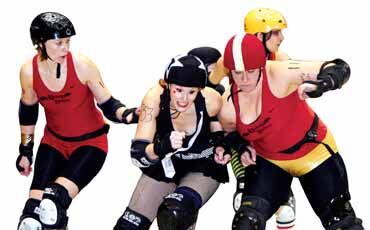

They have alter-ego names such as G.I. Hoe, Little Bo Bleep, Cha Ching, and Sugalumps; four competitive home teams: The Unholy Rollers, The Vaudeville Vixens, Reservoir Dolls, and Quad Squad; two inter-league (travel) teams: the Dairyland Dolls and Team Unicorn, and a league slogan, “Hurt in a Skirt.” But more importantly, the Mad Rollin’ Dolls (MRD), Madison’s women’s flat-track roller derby league, has a keen identity, a growing fan base, and money in the bank.
On Valentine’s Day afternoon, fans of all ages pour into the Alliant-Energy Center Coliseum to watch Madison’s tramps of the track duke it out on wheels. In pro-wrestling fashion, the Coliseum sizzles with hot music, an ever-present announcer, and dozens of female derby skaters donning fish-net stockings, flashy get-ups, and loads of panache.
At the Coliseum’s center, four teams, including one visiting from Appleton, Wis., prepare for competition, gliding on four-wheeled roller skates around an amazingly small (88 ft. long) track outlined by tape on the concrete floor. Each sports a helmet, mouth guard, elbow pads, wrist supports, and knee pads in anticipation of the mayhem about to begin.
With a “take us or leave us” attitude that is both refreshing and in-your-face, the Dolls make no excuses for minor snafus in the day’s agenda. “Would someone start?” pleads the announcer, looking for someone to sing the National Anthem. Several team members then step up to the mic to lead the crowd of about 1,200 in an impromptu a cappella version. Then, with a whistle, the bout begins.
Women’s flat track roller derby originated in Texas in 2004. Its governing association, the Women’s Flat Track Derby Association (WFTDA) establishes rules, regulations, and holds regional and national tournaments. Currently, the WFTDA has about 80 leagues, including leagues in Canada and England, though hundreds more exist worldwide.
MRD, one of several leagues in the state, was the sixth in the nation to form in 2004. Now, nearly 80 area women regularly shed their nine-to-five personas in favor of some slapping, slamming, jamming, and scoring. By day, they are scientists, doctors, lawyers, project managers, Web designers, stay-at-home moms, deputies, actuaries, teachers, and business owners, among others. They come in all shapes, sizes, and ages (21 to 50-ish), and each has survived tryouts, apprenticed first as a “Baby Doll,” and was later drafted in a manner similar to an NFL draft.
But unlike the NFL, nobody gets paid. This sport, league, and national organization operates and is sustained by little more than a ferver to play, and unlike the choreographed Roller Derby of old, these women strive to win, and the hits — and bruises — are very real.
Actually, being a Doll can be costly. MRD skaters pay dues of $30 per month and must purchase their own skates, averaging $200 and up. While basic uniforms might cost around $50, members spend more to individualize their look with other (often amusing) add-ons.
At halftime, MRD General Manager, “Kill Billie,” or rather, Stephanie Oyler, who works in the city’s Affirmative Action Division by day, leaves the track with a broken finger after taking a tumble. This is her fourth year with MRD, and her first as GM.
Major injuries, she said, are rare. In six years, there have been just a few knee injuries and one broken leg. The league encourages but does not require members to carry primary insurance. “We don’t want to restrict people that way, but we do offer secondary insurance through the WFTDA,” for about $50 a year, she said.
A skater’s moniker, raucous (though harmless) as it may be, is entered into a national registry of names. Thousands of names are already registered, and names are only reused if a skater leaves or retires from the sport. “It’s a gentlewoman’s agreement,” Kill Billie said.
Membership can be time-consuming. Seven home bouts are scheduled January through May, but tournaments and other travel dates can extend into October. With several two-hour practices a week and charitable commitments throughout the year, skaters can spend 20 hours a week on league activities.
So why become a Doll?
“Darling Nikki,” 30, a project manager for a small Madison biotech company, is in her fifth year and loves the physical workout, as well as the camaraderie.
Kill Billie admits she had never been athletic, yet when she first saw the aggressiveness of the sport, she was intrigued.
“As a woman, you don’t get that many opportunities to participate in something so unique as this. When I learned it was all league- and skater-owned, that there was no owner controlling this, and knowing that the members had the power to make decisions, I was interested. This is more of a community than just a sport.”
“Mauly Tov,” 27, a communications manager for a UW research center, is a fourth-year Doll and two-year member of the Dairyland travel team. She has spent upwards of $2,000 in out-of-pocket expenses, but she’s not complaining. MRD, she said, “allows you to get involved in managing a team, a league, learn skills, and take on projects. It’s sisterhood.”
During its first four years, MRD called Madison’s Fast Forward skate rink “home.” But in 2008, after the Alliant Energy Center hosted the WFTDA Eastern Regional tournament, things changed in a big way.
“The first time I saw them (MRD) at an event, it was jaw-dropping,” said Ted Ballweg, Assistant Center Manager-Sales and Marketing for the Alliant Energy Center. “Then they came to me with the idea of playing here, but some of my concerns were: Would we have their dates? How many people could they draw? And could they manage the crowds?”
He soon realized this was not a fly-by-night operation. “They’re excellent street-marketers,” Ballweg said. “They’re visible, they’re active. I think everyone in their organization has marketing in their blood.”
This is MRD’s second season at the Alliant Energy Center. “They’re not paying rack rate,” Ballweg said. “We have the right to bump them if a big act comes in within 30 days of their dates, but they’re very flexible.”
The Mad Rollin’ Dolls is a for-profit, self-governing entity guided by 30 pages of rules. As GM, Kill Billie works with six executive board members, including a rep from each home team, one from the volunteer support staff (referees, timers, photographers, etc.), and one representing the travel teams. Another member, an accountant, handles the books. With the exception of the GM, all league members vote on issues.
The league’s $120,000 annual budget is spent mostly on marketing, with small stipends for individual, team, and travel expenses. Visiting teams also receive a small stipend. To offset costs, the league sells sponsorships and trades for some services, but it is the dedication of the league’s 85 volunteers that truly makes things click.
Currently ranked 11th in the nation in Derby News Network’s Power Rankings, MRD pays the Alliant Energy Center about $4,500 per home date, and Fast Forward about $1,000 a month for practice rink time.
January’s bout — MRDÃÂs largest to date — drew almost 2,500 fans, grossed $22,000, and netted about $16,000. Most of the money will be reinvested into the league, which dreams of owning its own venue.
“It’s very exciting,” Kill Billie said. “We’ve never really been in this position before.”
Sign up for the free IB Update — your weekly resource for local business news, analysis, voices and the names you need to know. Click here.

