
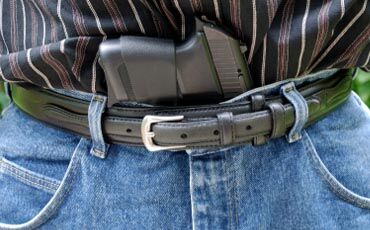

Decision time: Should your business allow guns on the premises when Wisconsin’s concealed-carry law takes effect?
Of all the myriad decisions business owners must make each year, whether to allow their employees and customers to carry guns is probably among the most sensitive they’ll ever have to face – and face it they will when Wisconsin’s new concealed-carry law goes into effect on Nov. 1.
Thanks to the law, which allows Wisconsin residents 21 and over to get concealed-carry permits after passing a background check and receiving training, every business in the state will be forced to decide whether to allow guns on their premises.
“The law affects every employer,” said Tom Godar, head of the Labor and Employment Team at the Madison office of Whyte Hirschboeck Dudek, which is sponsoring a seminar on Thursday at the Madison Concourse Hotel titled “Wisconsin’s New Concealed Carry Law: One Size Does Not Fit All.” (Godar will be one of the presenters.) “There are plenty of laws that have impacts that are different for smaller or larger employers – for instance, the Family and Medical Leave Act only kicks in for employers with 50 or more employees – but this law will affect every employer.”
Of course, employers can decide to punt on the decision by simply doing nothing, which means they would be implicitly agreeing to allow guns on their property. But according to Godar, most employers will want to consider the ramifications of whatever decision they make – and if they don’t want their employees or customers carrying guns, they’ll need to take steps to prevent them from doing so. In short, says Godar, a lot of factors go into deciding whether or not to allow the carrying of concealed weapons.
“I think that as you sort of take a look at this, you’re going to want to find what impact you believe allowing concealed carry would have on your workplace, on your business, and what impact prohibiting it would have,” said Godar. “And by allowing the carry, what other sorts of policies you might have. For instance, right now, many handbooks, virtually all of them, [discipline employees] for bringing a weapon to work. If you allow concealed carry, you’ll have to change that policy.”
“If you’re going to prohibit, you’re going to have to make sure that your policies are consistent, that your signage is up to date, that you identify where in parking lots or in entrances to your workplace you’re going to have signs, and what particular signs you’ll use.” – Tom Godar, Whyte Hirschboeck Dudek |
According to Godar, businesses that want to prohibit concealed carry will also have to notify anyone coming on the property – not just employees – that guns are not allowed.
“If you’re going to prohibit, you’re going to have to make sure that your policies are consistent, that your signage is up to date, that you identify where in parking lots or in entrances to your workplace you’re going to have signs, and what particular signs you’ll use. You’re also going to have to notify your vendors, for instance. If you’re involved in a retail trade, how are you going to make it an attractive and positive experience for your customers? So all of these things make this both a little bit unique as well as sort of that general first question, do I or don’t I? And to be honest with you, I think a whole lot of people are struggling with that general first question.”
The Legislature made saying yes to concealed carry a little more palatable for employers by granting them a level of immunity from lawsuits in the event that violence does erupt in the workplace. The law says that individuals who do not prohibit the carrying of concealed weapons on their property are immune from any liability arising from that decision. However, according to Godar, the law does not necessarily provide blanket immunity.
“Let’s assume for a moment that an employer allows concealed weapons, so that decision alone, the fact that someone brought a weapon onto the premises and ultimately caused damage because of that, is likely to be immune … the employer is likely to be immune from a lawsuit. However, if the employer is aware of threatening behaviors by an employee and takes no steps to correct them, and then the employee comes in with a weapon and causes damage with the weapon, could that still allow the family of the person who is injured to bring an action saying, ‘Well, it wasn’t the fact that you allowed concealed carry, it was the fact that you did not prevent this assault from occurring even though you had knowledge of a threat’? So how broad that immunity will be isn’t clear, but I would be very loath to suggest that it prevents any sort of lawsuit that has to do with a weapon in the workplace.”
How to decide?
Of course, whether or not one decides to allow concealed carry depends in large part on the nature of one’s business (i.e., one size does not fit all).
Exemptions were written into the law for places such as schools, police stations, and courthouses, but when it comes to other locations, decisions must be made that make sense for each manager or proprietor.
“You can think of it in categories,” said Godar. “If you’re a car dealership, if you’re a manufacturer, if you’re a resort, if you’re a medical facility. In each of those, there might be a different sort of evaluation you’re going to make as to whether concealed weapons are allowed.”
That evaluation may have a lot to do with what the business does or the types of customers or clients it caters to, said Godar.
“I could imagine that if you’re a retail establishment and your customers – some small percentage, I suppose – have chosen to go through the rigors of licensure for concealed carry and decided for their own safety perhaps that they want to carry a weapon, and they want to shop, whether it’s a big-box store or an exclusive boutique or a grocery store down the street, do you want to send a message to that group of people that they’re not welcome at the establishment unless they leave their gun in their car? So there may be some who would find that inconvenient or an affront to their Second Amendment right perhaps. … So you’ve got those kinds of questions. You’ve got questions as to, if you’re a health care provider, whether it’s consistent with your mission to have weapons in your facility.”
Of course, with the passage of Wisconsin’s law, 49 states now allow concealed carry, so fears about our state turning into the Wild West are clearly overblown. But Godar notes that states always have their own variants of boilerplate legislation, and so seeking advice and preparing oneself for a new legal frontier might not be the worst idea.
“We certainly hope that folks will look carefully at what the law and its ramifications are, look carefully at their own place of employment and make a thoughtful decision on it,” said Godar. “I think that at a certain level, possibly legal advice is going to be helpful, from generally understanding what decision you’d like to make to specifically implementing it.”
Sign up for the free IB Update – your weekly resource for local business news, analysis, voices, and the names you need to know. Click here.

