
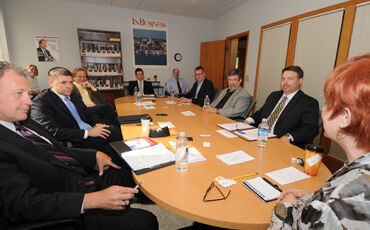

Perhaps no industry has been impacted more by the recession and subsequent slow recovery than construction and development, but despite the ups and downs of the recent past, an expert panel convened by In Business expressed optimism about the next several years. In this Industry Roundtable on construction and development, our experts talk about recessionary lessons and their hopes for a project that never ends – building Greater Madison.
GLYNN PATRICK: The first question is about weathering the recession. It’s the survival story, really. Is there any business practice you’ve changed?
ALEXANDER: Everybody learned a lesson of deleveraging, which was a good one, and we’ve started outsourcing some things that we previously did in-house, which lowers our overhead, lowers our health care costs, and those proved to be good practices that we’ll continue. Previously, we had a full architectural staff. We decided to focus on finance development and property management. We still have to focus on overseeing architects and general contractors because they need to be monitored, but we’re not going to be cranking out design documents.
GLYNN PATRICK: In the past, we saw everybody moving toward a one-stop shop. Are people starting to break out their less profitable components?
ALEXANDER: It’s still a good business model to be a one-stop shop, but you can do it through federal oversight of folks that you contract with. You don’t have to do everything yourself.
KOSTICHKA: The reason we’ve weathered the storm is that we looked at our business model, really figuring out how to do more with less. We’re set up so much better now. It wasn’t tough for us, a medium-sized company, to get all the jobs we needed to fulfill our overhead costs for the year and to still make some money. Now those jobs just aren’t out there, so we’re figuring out how to bring more value to the owner. Competition is still really tough, especially in the Madison market. There are so many great developers here and businesses doing cutting-edge stuff, but for a company of our size, it’s still extremely competitive because we’re dealing with the $100 million-a-year guys and then also the $5 million-a-year guys, so it creates a lot of competition. We’re just trying to figure out how to separate ourselves in that regard.
Getting involved with developers from the front end and figuring out a way to help protect them and provide accurate budgets – teaming – that’s been the concept that’s really allowed us to keep doing jobs for the same developers. They just come to us just by providing accurate budgets and really approaching these projects like a team.
GLYNN PATRICK: How many employees did you have in your heyday and how many do you have now?
KOSTICHKA: I would say we had 90. We were down to probably 45 two years ago, and now we’re back up to 70.
GLYNN PATRICK: Joe, what about yours?
ALEXANDER: We were about 55. We dropped to 40 and we’re back to 50.
KOSTICHKA: Just this last year, we’ve been ratcheting back up but being very cautious in how many people we bring on because there’s still so much uncertainty out there. There’s much more coming through the door, and some of these guys will talk about financing and stuff like that, but it seems like it’s still taking so long for these projects to get going. We’re pricing stuff out, locking in with some of our subcontractors. Then the delays, whether it be at the municipal level or the funding level or whatever it might be, are just .… and then we’re required to hold our price because there’s only so much money in the budget. We’re taking some risk, and it’s challenging.
HERL: We’re a little different. We’re not a builder or anything of that nature. What we do is latch onto developers and bring out that entrepreneurial spirit. I love working with them because they’re true gamblers in life. They’re the ones who, even in a down economy, we should be shaking their hands. My goodness, in this economy, to go out and do what these guys are doing, and they need partners like us to find the tenants, to find the opportunities that are out there, and that’s what we do. I’m out constantly digging and scratching, finding opportunities and piecing it together, doing my homework, and then taking it to a developer and convincing that developer that we can do this, and then go through the entire process of getting people signed up and helping them take it through the Planning Commission and then the city councils and things of that nature. Then it’s off to the banks to see what we can do.
GLYNN PATRICK: The pre-lease requirements have changed drastically.
HERL: Huge, huge.
GLYNN PATRICK: Joe, how important is it to you to know that everything is buttoned up before you go to the bank now versus in the past?
ALEXANDER: It’s important to us for our list purposes, but the bank won’t even let us in the door unless you’re about 80% full, and they have to be credit tenants, so it’s a much greater challenge.
GLYNN PATRICK: In 2005, for example, what was the requirement, 40%?
ALEXANDER: You could build on total spec in 2005. And there’s an issue there, and it’s a chicken-and-egg thing. It’s hard to get a Starbucks, a small tenant, into what will be a big building without a building there.
HERL: It is teamwork. What I like to do is go out and get it all locked up, and then take it to the developer that I would choose to work with, or possibly has the land tied up or already owns the properties, and deliver as much on a silver platter as I can. Then, between myself and the developer, we take it to the bank and we go from there. But it is very difficult, very difficult in this market.
We have managed to get a couple of nationals. Nationals were 80% of our business five years ago. Now it’s only 20% of our business, but what’s wonderful now is you have a lot of mom and pops that are resurging. Developers, shopping center owners, are willing to take chances now on these mom and pops and totally change their business plans from five years ago.
Relationship negotiations
GLYNN PATRICK: Todd, working with the village board in Waunakee, have you seen any change in who’s approaching who or how competitive you need to be to get jobs?
SCHMIDT: Not a dramatic amount of change in terms of approach. My approach in economic development is establishing the relationships, so when the opportunity is there for the builder or the developer, they know the eyeballs to look at when starting to work through the process. And if there’s anything that we’ve done during the quiet time of development, it’s continuing to foster the relationships, so when the tide turns, and it’s bound to in the cyclical pattern, the relationship is stronger coming out of it. Hopefully, that makes the process easier. You add trust, which generally makes things work easier despite all the process involved in government approvals.
GLYNN PATRICK: I think one thing we heard Aaron say very clearly is that time is money, and every time there is a delay, that’s a burden the builder and the developer bear directly. How is the village of Waunakee positioning itself in terms of process and time compared to the other suburbs or to Madison?
SCHMIDT: I turn that question back to others in the room because the answer depends on how well prepared the development team is to take the project and move it forward. We could spend several months just in concept review if the concept isn’t fully thought out on the development end before we get into the nitty-gritty of the deal. So it really has to start with a sense of mutual appreciation for both parties. I don’t want to use the words mutual respect, because that seems like both parties are demanding it, but more a sense of appreciation for the role that each plays. Mike said it very well, that developers are true gamblers these days. I see my colleagues in economic development really appreciating the risk that developers take, and also the risks small business people take, because there’s no golden parachute for a small business owner. They either make a buck, or they’re gone.
If a community comes in with an appreciation for the risk and the challenge to the folks on the development side of the table, and the small businesses, you’re a step ahead because it goes to building some of the trust that you need to make a project move. I did review what Madison is proposing to change; it’s very much like what smaller communities are able to do by virtue of how easy it is to have direct contact between decision-maker and developer.
In Madison, there are a lot of processes. It’s bigger. It’s a bigger machine, and they’re implementing things that have been, in a lot of cases, the regular course of action for a Sun Prairie or a Middleton or a Waunakee, historically.
GLYNN PATRICK: Theran, I want to ask you two things: number one, your survival story, because a large part of your practice also is around construction real estate transactions. You’re in a position to advise businesses, and the number one risk that consultants tell a business owner typically is don’t own your own building because then you’ve got all of your eggs between the building. If you’re going to own a business, and you own a building, rent it to somebody else so that the two aren’t connected. What advice are you giving business owners right now, and how has your practice changed?
WELSH: I sit on the other side, like Arlyn does. We have a chance to look at a lot of report cards for companies in this room. This last probably 36 months, those companies have done a tremendous job of cutting costs. So the spouse’s salary is out the door, the spouse’s car is out the door, the country club memberships, all that. The watchdog is not on the payroll anymore, so they’ve done a tremendous job of cutting costs.
The second trend is that we see the true equity in that company right now, and the challenge for all organizations is we have this much equity, but we need some capital. We’re going to the bank to get capital to grow that shareholder equity again. Most of the conversations we are having with our customers today are really about that equity base, and how are you going to leverage that to take advantage of opportunities?
Companies have done a very good job of getting better at that. In regard to the question about the related construction of the land, owning the land, there are a lot of good opportunities and reasons why you should do that. Again, it comes down to the capital base and how much can you support, and if the earnings for the company aren’t there to support it, maybe it’s time to let that go. But companies have done a very good job of cutting the excess so they have a better cost structure going forward.
STEFFENSON: We also see the report cards and make base decisions as we partner with our clients. You want to not only look at what’s happened in the past, but where are you going in the future? A lot of that involves decisions about revenues and expenses. Where revenues are headed is very tough to see in a clear fashion, but one thing that is certain is your expense structure. We’ve seen a lot of line-item cutting to ensure the companies survive, and generally speaking, the development community and people in the construction trades have no choice but to do that because of the revenue side and the margin side.
GLYNN PATRICK: Have you felt that banks have become the public fall guy in this equation? You’ve got so many constraints on the bank right now.
STEFFENSON: I would say we feel a little slighted. We view ourselves as a very important component of economic development, growth, and jobs. We’re a key cog. That banks aren’t lending is the misnomer. That’s what we do. For us to make money, we want to support good customers, good projects. Just to go out and lend money, and do some of the same things where mistakes were made in the past, isn’t going to do anybody any good. So in today’s world, our commission is a little bit tighter, meaning more equity in projects, things like that.
I like to think of it as a reversion back to the fundamentals because every time you stray from fundamentals, it ultimately comes back. If you’re overleveraged, if you don’t keep enough liquidity, eventually we all know there are economic downturns. When they come, they’re harsh if you haven’t at least stockpiled some equity, some liquidity. Frankly, that’s what’s gotten – along with cost-cutting measures – a lot of companies through the process of getting from point A to point B in this downturn.
That sometimes involves re-leveraging some assets that companies have equity in, fortunately, because they’ve had a good, long track record. Banks are in the position of trying to support, plug a hole, and figure out how we fund losses at the company. We work with customers to evaluate their risk-management practices. How are they going out, and what are they looking at in the future? How are they going to react to it and evaluate not only their historical record but also their vision for the future?
So yes, I think we are painted with the broad brush, especially in the community bank world. With that local aspect of knowing the market, knowing customers, we can be more hands-on and understand the details that give us an advantage in building relationships and making deals happen.
GLYNN PATRICK: In the last deal that George Gialamas was involved in, he told me his bank would not give him the money until he gave them a driver’s license. He wasn’t very happy about that.
SCHMIDT: I will shove that one off to the regulatory world, and as you’ve all heard, there are regulations in many cases that are well intentioned, but they have a lot of unintended consequences.
GLYNN PATRICK: Well, they’re getting in between the relationships of the banker and their clients.
SCHMIDT: Absolutely. You started the conversation mentioning that the bankers seem to be the fall guys. A project that Ron’s aware of, a relatively large commercial, potential commercial project in which the developers were saying that they couldn’t get the financing until they had two more tenants. They’re very specific. We need two more key tenants. That project teetered for a while with that being the situation. We can’t find the other two tenants.
STEFFENSON: Then it goes to speculation. In large part, that’s what got us in trouble. Let’s say the bank makes that loan, and we can’t find those tenants. Two years goes by, and we still can’t find those tenants. Do we have a default situation? Does that do the municipality, the developer, the owner, or the bank any good?
TRACHTENBERG: Where the banks, at least where the local banks got in trouble is not necessarily their Madison-based investments or Dane County-based investments. It’s when they went either to the far ends of the state or out of state into markets they didn’t know, and bought into projects that were way overleveraged in markets they didn’t know – that’s where they got their tail feathers trimmed.
The most important thing in working with the bank is having a local banker who actually has some authority. One of the problems I have dealing with national banks is you have people who have no common sense in the local market and no authority. I had a client who got a cell tower lease, and it was $3,000 a month for use of a roof on a brand-new building in Madison. The cell people wanted a right-of-prior possession in case of foreclosure, a very common provision. I was talking to a young lady down in Atlanta, and she was very concerned whether or not the use of the roof for cell towers was the highest and best use of the roof. I suggested to her there wasn’t a really great market for nude sunbathing in Madison in February, at which point she hung up on me. But that’s what you need. You need a banker, a local banker, who knows the local market.
STEFFENSON: Exactly. We’re risk managers.
WELSH: I’d like to follow up with the shortage of the tenant’s right to make it happen. We, as a consultant, are getting lots of conversations about whether contractors should be putting equity into these deals with the developers, and then that would help fill part of that gap. I’m curious to hear from Joe and get Aaron’s perspective. Are those conversations on the table these days?
ALEXANDER: First, we’re not gamblers anymore. Everybody is taking very educated risks. But local communities have come together to a far greater extent. We all know each other. We know each other’s track record and areas of expertise. There are certainly large national banks that came into our market through the acquisition of others; as they’re facing their own pressures, they’re exiting and that vacuum is being filled very much by smaller, mid-sized and local banks.
Regulations have probably swung too far to some extent because a lender should be in a position to take some educated risks, just like their client, to get that done. If they don’t have the opportunity to be a patient investor or an investor who takes educated risk, then you can’t get anything done. Having everybody be a little smarter and a little more cautious, including business owners that we might develop a building for or that McGann might build a building for, is not a bad thing.
But it also means, and you see this, that banks are actually more competitive amongst each other. Municipalities understand that to get a deal done, they have to be true partners because the deals are fewer and further between. So there’s some good competition amongst local banks that know their clients. There’s healthy competition amongst local communities that want the new jobs that come, but less frequently than they came before. So governments are getting more nimble. All of us are getting a little scrappier, and that’s what you’ve got to do to hit fewer opportunities in the marketplace.
Streaming revenue
GLYNN PATRICK: Joe, was the decision by the Alexander Co. to do a lot of public restoration of buildings – and there’s money still in the public sector – was that a decision made in an area that you were going into? Because people are fishing upstream or downstream, and we’re losing track of where everybody is fishing. We’re seeing some companies actually topple, and the successful ones seem to be the ones that said we’re going to remake ourselves in this fashion.
ALEXANDER: We decided not necessarily to create new business streams but to really stick with our bread and butter, which is adaptive use of historic buildings in urban areas. We know how to do that really well. Some of the projects we do like that are small. We know we can get them financed. The risk is a little less. It takes the same amount of work to develop a 20-unit building as it does a 100-unit building. Those are the things that you can do in this environment. One thing that was a problem for a lot of businesses is they got away from what was really their standard bread-and-butter, go-to expertise and tried to do too many things that they didn’t know enough about. We’re actually focusing on what we’re good at.
TRACHTENBERG: One of the things that developers are very acutely aware of is the economy. The municipal people are very determinedly aware of the economy and cost of doing business and all the things that go into it. By municipalities, I mean staff. The problem that I see in a lot of cases is trying to get the development through the political part of the process because I’m not too sure that the politicians fully understand the economics of projects, whether it’s from the developer’s side, the banker’s side, or even staff side.
I’m not too sure that the citizen members of some of these boards understand the economics. I was before the Urban Design Commission, and somebody said, “We don’t want four stories over here. You have five here. Just make it six, not under,” and then she said, “We know it’s more money, but it’s only money.”
So it’s not only saying the cost differential from going five to six, but what it does to the economics of the project. So there’s that basic problem and, to me, there’s a fly in the ointment of understanding the basic economics, and it’s at the political level.
SCHMIDT: Well, it definitely depends on the makeup and expertise of those sitting in the political seats. I’ve got folks who are development professionals in one way, shape, or form on my village board. In some ways, they know more about it than I do. They’re very aware of it. Unfortunately, I can’t speak to other communities. One thing I have noticed from my village board and also the planning commission in Waunakee is really a great focus that maybe wasn’t there before in design and creativity that’s put into a project and urging towards that.
HERL: Ron and I are working on a 60-acre development outside of Madison. And we reached out to the mayor and said, “Listen, we would like to do something, but before we present our idea, we want to hear what your idea would be to see if we can incorporate some of that.”And she was flat-out honest and said she would like us to build a 10-foot wall around the 60 acres and have two gates, and the only way you get in is if you’re on a bicycle or an electric car. [Laughs]. Well, we quickly realized this is going nowhere fast, and she was dead serious. So when you run into that type of personality, immediately you have to pull back and you have to look at the site and say, listen, will you wait until there’s a change in administrations and try to get somebody in there that does understand the development level? That’s what we ended up doing in the end. We had to back somebody else to get somebody in there that was a little more realistic about what you can do with a development site.
KOSTICHKA: I would like to touch quickly on what Joe and Arlyn said, and Theran mentioned it too, about the team approach and disbursing risk. The projects we’ve been involved with in the last five years, all the successful ones, are where that risk has been disbursed amongst all the people involved. Somebody mentioned gambling, and he doesn’t want to take all the gamble. We don’t want to take all the gamble. The city doesn’t and the banks don’t, and when you can bring everybody together early and walk through these things, you’ve got a budget, you’ve got a set of plans, and it’s all been talked through with the municipalities, those projects are the ones that are successful in the end. Nobody’s tearing each other’s hair out during the project, and having that integration from early on, all the way through project completion, seems to be the real key in this type of environment.
GLYNN PATRICK: One of things that we all have talked about is tradesmen. A few years ago, In Business convened a roundtable with industry experts, contractors, and builders. And we said, what is the number one thing facing you? It was labor, that they weren’t able to find labor, that they were starting to try to teach in the high schools a respect for the trades. We’re coming out of a period where we had 45% unemployment in the trades, and when we talk about success with your companies, one of the things that we’re talking about is right-sizing for a down economy. We can call it right-sizing, but people have lost their jobs, and it’s the tradespeople. What is the prospect for putting these people back to work in the next year?
TRACHTENBERG: First of all, when we talk about trades, some trades have lost. We also have a shortage of labor in other trades, some very skilled trades. One of the big success stories, at least in this area, is the area of college, and that’s the area of technical college, Madison colleges, of trying to set up training programs to train tradespeople in trades like welding, high-quality welding.
GLYNN PATRICK: I’ve heard they could hire 400 tomorrow if they had finished their certification and were ready to go.
TRACHTENBERG: Yep.
GLYNN PATRICK: Four hundred welders tomorrow could be employed.
TRACHTENBERG: While the economy has downturned and has affected some construction trades, technology has likewise affected those technology trades. We pull curb and gutter now with a machine. We don’t have people setting forms anymore. There are other trade areas that are booming.
GLYNN PATRICK: Who do you need, Joe? You mentioned that you’re starting to hire again. What specific kinds of labor are you looking for?
ALEXANDER: The best example is the building management, and it swings both ways. It’s very hard to find, in part because everyone is right-sizing and kept their best talent, so trying to go out and recruit the best talent is in some ways more difficult. The other end of the spectrum ….
GLYNN PATRICK: There’s a loyalty factor now built in.
ALEXANDER: Right. On the other end of the spectrum, there are specific industries, say architecture and engineering, where there is still hefty unemployment, and you can advertise for a building manager’s job and get an engineer to apply for it. So then your problem is, well, it would be wonderful to have someone with these qualifications around, but two years from now or a year from now after you’ve taken the time to bring them in the organization and train them in how you work, your ability to retain them is going to be much, much less.
KOSTICHKA: We’ve lost a ton of people that are just sick of how things went the last five years. You’re dealing with layoffs, you’re dealing with uncertainty, and a lot of people here have mentioned the risk management, and that’s tough in itself. But then, turning projects down and actually following through on your risk assessment when it’s not what you’d hoped, and not taking the job, it’s pretty tough when you’ve got all these people that are depending on the projects. And so you lose people, and they go on to other stuff because they have to support their family.
Right now, there are still a lot of tradesmen that are still unemployed, but my concern is where is it going to be 10 years from now because people aren’t going into the trades? Kids in college aren’t going into the trades or even kids in high school for that matter. It’s pretty rare that we’re picking up apprentices. It’s tough. You have to really recruit, and it wasn’t like that seven, eight years ago when things were good.
SCHMIDT: A carpenter in Waunakee was telling me that seven, eight years ago, he was earning upwards of $40 or more an hour, and now he’s taking jobs under $20. So if you’re looking to attract people to the trades, or at least those traditional ones, you can see how the environment has changed and what makes it attractive or not attractive.
GLYNN PATRICK: For our regular business reader that’s paying a wage, we also want to point out that a lot of the work here is seasonal, and that if they’re making $40 an hour, they’re not making that every week, week after week. It’s dependent on jobs, etc., but it sounds like a lot of money. It’s not that much money when you look at the duration of the year that they’re able to work.
KOSTICHKA: It really used to be 40 hours a week every week, and it was at this wage, and that’s the expectation. And then it’s not there anymore because we’re not getting any jobs if that’s the wage. We’re not competitive. So you have to adjust to what your competition is doing.
Fishing downstream
GLYNN PATRICK: Have you taken jobs in the last three years that you would not have taken before (due to low profit margins) just to keep people working?
KOSTICHKA: We’re avoiding that project that could be a catastrophe. That’s our main goal. We can take things on slim margins if we know it’s for a quality developer, it’s got financing in place, we know we’re going to get paid, and we know we’ve got subcontractors that all are financially sound as well. We’ve got our own trades and carpentry, finished carpentry, where we can really control the schedule, but we’ve got so many subcontractors out there that you just don’t know anymore. I mean, people you would think that were outstanding, that you’d never have to worry about. Some of these challenges that worked out seven or eight years ago are popping up all over the place now, so it’s just a matter of doing that due diligence on the front end. Once again, it gets back to the integration of being involved early on.
GLYNN PATRICK: How involved are you, Arlyn, with the bank looking at those subcontractor contracts?
STEFFENSON: Typically, when we’re looking at a project, a development project from the financing side of it, we’re not digging down into it, and at that point we don’t even have a list of subcontractors, but we do look at the general contractor below the developer. We never typically are going to know all the details because we’re not typically getting financials from Joe Contractor, but the other way to get a pulse on it is that when you think about all those XYZ plumbing and HVAC contractors, we bank those people.
So we get a general gauge on it, and you’re right, there are some people that have been around for a while, and they’ve had a very tough go of it. It’s all down the food chain, and it affects everybody. With those guys, it’s no different how they’ve right-sized their business and reacted to it, and some have done a better job than others. There’s no question some people have fallen by the wayside, and that’s another risk in getting these projects done.
When you have somebody that can’t complete a component of the project, it throws everything off, adds costs when there was already thin margins there, and timing, obviously, is a huge thing. You have tenants that need occupancy permits and the like, but it’s more of a general gauge from our side of things. It’s just still tough.
WELSH: There are a couple actions going in in different construction associations, and they all have put an emphasis on where labor is it coming from. So there are different career academies out there, and high schools throughout the state of Wisconsin are trying to address that. Now there may be a little time before that all comes to maturity, but the tech schools are doing well from that standpoint.
GLYNN PATRICK: They are trying to attract them into this gap area, but they’re also trying to retrain people too. Ron, as you mentioned before, on the one hand you’ve got a glut, and then on the other hand, you’ve got a shortage.
WELSH: The career academies are specifically just to get into the trade and understand that some companies have done well, there are profit-sharing plans, and you can have a very successful career in construction. So that’s very important, and they’re working hard on it. The second thing in regard to the capabilities of some of the subcontractors, there’s certainly a trend now with general contractors that are getting financial statements from subcontractors to see what that equity is in those companies, and whether they can sustain a hit.
KOSTICHKA: Before, we would maybe have one or two projects going, but now everybody wants a bond. So it’s our responsibility to protect our bonding capacity and really dig into these subcontractors. If we can’t get a bond on a project, they’ll move on to the next guy. As Theran said, it’s really digging into financials and doing things more in detail than we used to.
TRACHTENBERG: What percentage of the project is the bond cost?
KOSTICHKA: It all depends on the type of project, but it’s usually about a point.
GLYNN PATRICK: Ron, how has your business changed over the last five years?
TRACHTENBERG: Our firm is a relatively large firm. Like everybody else, we’ve cut back on perks. We’ve watched our pennies a lot more. One of the benefits of a larger firm as far as internal economics is you’ve got different segments. While I was putting together projects, I was trying to salvage projects, and we had a large corporate reorganization area. So while I was putting together projects, the corporate reorganization area was trying to salvage those businesses.
SCHMIDT: Last year, your public sector labor-relations team did pretty well.
TRACHTENBERG: Yeah.
GLYNN PATRICK: You mentioned more oversight of the financials and getting everything ready for bonding, and I’m thinking, ‘Well, that’s good for you even though new project work might not be in the works.’ Are you busier?
TRACHTENBERG: We have a large municipal section. Municipalities have been a lot more careful about what services they use from us. For example, we’re not doing as many development projects, so we were not involved representing the municipal side on those development projects. Where they used to want us to come to every meeting, now they’re able to say, ‘Well, there’s nothing critical at this meeting, why don’t you stay home? But two weeks from now, please come.’ So there’s a lot more selectivity.
Like everybody else, we’ve contracted somewhat. We haven’t had to dismiss anybody or fire anybody. People have left. We haven’t replaced them. The rest of us picked up hours from those people. We’ve also watched our pennies. The nature of our practice has shifted from growth to preservation as far as representing our clients.
HERL: With the firms that we’ve hired, they have come back to me a couple of times and told me that they are having a few problems in those areas, but where we sit, it’s actually their problem. It does eventually come to us as a delay and trying to figure out that, and rework the numbers because of those things. But for the most part, in the three developments that we’re involved with right now, that hasn’t been much of an issue. Our issues are more on the political end and not so much on the labor end.
ALEXANDER: I’ve got my favorite anecdote in terms of perks from our own experience because we had one of those great coffee makers with the little individual cups and 20 different flavors to choose from. One day, I happened to look at that bill – I had never looked at that bill before – and we were spending $700 a month on coffee. So now we have a much simpler coffee maker, and we all drink the same flavor.
GLYNN PATRICK: A little Filter Fresh.
ALEXANDER: That’s right, and it’s just fine.
GLYNN PATRICK: You outsourced it.
ALEXANDER: Everybody stays awake the same way as everybody used to, and coffee is $100 rather than $700.
GLYNN PATRICK: Yeah, I was looking at our Culligan Water Cooler here going, hmm. It gets down to that level for us all.
The final nail
GLYNN PATRICK: In summary, I want to go around the table quickly. Without those projects just waiting for someone to underwrite them and going through what you have to go through today to get a development completed, what do you think it’s going to be like three years from now?
WELSH: As I said, in the past 36 months, companies have really downsized. There’s a little bit of equity there. They’re trying to leverage it as best they can. That might involve some other outside gap along with the bank, but I don’t know … 36 months here. People have weathered a lot, and I can’t believe that the next 36 months won’t look good, especially with this community and the opportunities that are out there. Madison and Dane County is still a very attractive place to live, obviously, so I’m pretty upbeat about it.
SCHMIDT: You will see municipal plans implemented. When the tide was out on development, the Dane County region was really fortunate because you have virtually all the communities who decided, ‘Hey, we’re not going to lay off planners. We’re going to keep planning. Just because development isn’t happening doesn’t mean we’re not going to think about how our communities are going to change and how best to approach that.’ Today, for example, multifamily is where you can get a lot of financing.
Municipalities are looking at how best to fit in that component, so I relate it to Finding Nemo and that movie when Dory was swimming down into the black hole looking for the goggles, and she just kept saying, ‘Keep on swimming, just keep on swimming.’ Well, during the dark moments, our communities in Dane County kept on planning and thinking smart. What you’re going to see, as economic development activity returns, is those plans are going to result in implementation.
On top of that, we still face a population that’s very interested in a high level of scrutiny and a call for transparency, and that’s what impacts the political folks sitting in the decision-making seat, and that’s not going away any time soon.
HERL: You are being so polite. I’ve got to remember that one. That’s terrific. I’m an eternal optimist, and I love capitalism, and I love our system. And it’s in the down times that we become more educated, we have better business systems in place, and we cut the fat. Over the last three years, we’ve been well retrained. It’s time to move on. It’s time to be able to take those practices and keep that fat off a high level of maintenance within every company, and keep working with the communities and doing what we do and what we do best. The political environment is what it is. We do have a political system here. If you don’t like it, fight for change. We’ve found ourselves in that process quite a few times. So the system works, but like I said, I only see things getting better at this point, and I wish everybody at the table luck because we all need each other.
KOSTICHKA: I personally see it getting better. As a contractor, we had a serious reality check here in the last four years, and the developers all know the expectations that are going to be required of them to get these deals done. That probably takes some adjustment, too, to get through financing and municipalities and everything else, which ultimately comes back to us and when we’re going to get started and how we’re going to proceed. Madison is such a unique place, and there are so many great developers here and great businesses that to a certain extent, it’s a little sheltered from other areas of the country, so I’m optimistic.
ALEXANDER: In the next three years, things will get better. It was a year ago, and people would ask me that, and I said, ‘Well, things are less bad.’ The level of optimism is ticking up. We all learned a lesson. We’re going to be smarter as we grow again. A couple things there, particularly as you work with communities, is you’re going to go where you’re wanted so that your upfront costs aren’t … we have done projects where our upfront costs, before you could put a shovel in the dirt, are $1 million. We’re not going to do those anymore here. You’re going to go to communities where you’re wanted and where you know you can get the job done, and you’re going to do the types of jobs that you know you’re good at and can execute most easily.
TRACHTENBERG: I use a very scientific basis. I count the number of times the phone rings during the day and the number of emails I get, both of which are significantly on an uptick. And so for that reason, I feel optimistic on uptick. My concern is that the politicians will do something really dumb on the economy, either in the area of budgeting or in the area of regulation. I don’t know whether this is the beginning of another city incline or 1936, when the politicians did something really dumb. So that’s my concern. If the politicians maintain what they’re doing, and if we’re able to stay on a stable, level course budget-wise and regulation-wise, I think we’re on the uptick. If somebody pulls the plug on the government or the government pulls the plug, then I think we’ve got a problem.
STEFFENSON: I, too, am cautiously optimistic. There are certainly some good trends. You know, existing home sales have started to come up. Foreclosure activity is down. Banks are healthier. You just hope that we can get a sustainable trend moving. It’s still a little choppy, and this may take a little while to get through, but in Dane County we’re going to fare much better than the rest of the country, as we always seem to. The aggregate demand out there is still a big indicator of what we can do. GDP is still slow. The Fed is still concerned about it. You know, employment is startlingly high. Are they going to stimulate the economy more? There are just a lot of structural issues out there. We’re a nation of doers, and you can only sit on the sidelines so long. You have auto sales coming up. People deferred expenditures, so as time moves on, people will get back into housing. So again, I’m optimistic that we’re headed in the right direction.

