
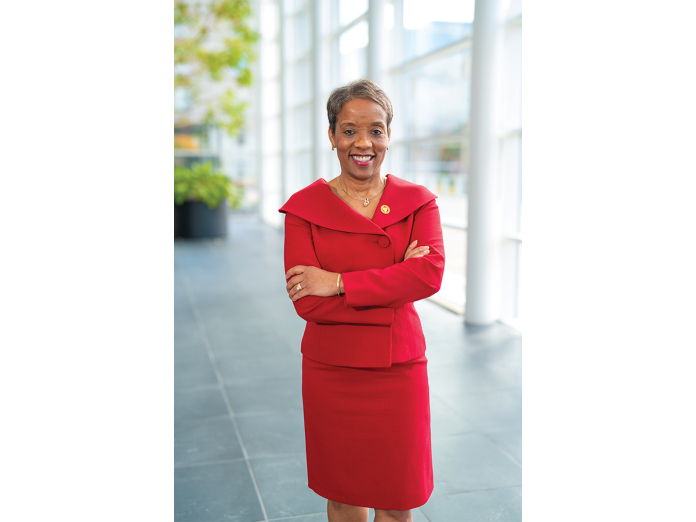

As the 2025-26 president of the American Bar Association and a woman of color, Michelle Behnke has worked not only to uphold the rule of law, but improve law as a profession and ensure that the legal system — in Wisconsin and across the U.S. — recognizes diverse voices.
A lifelong Madisonian who earned her undergraduate degree in economics from the University of Wisconsin-Madison and Juris Doctor from the UW Law School, Behnke is familiar with the professional setbacks that often disproportionately affect individuals from underrepresented populations, but she also believes Madison has come a long way.
Behnke joined Madison’s Boardman Clark in 2024 with a practice focused on business, real estate and estate planning after more than two-and-a-half decades as principal of her own firm. In addition to her presidency and several other roles with the ABA — the world’s largest voluntary association of lawyers, judges and other legal professionals — she served as president of the State Bar of Wisconsin from 2004-2005.
After decades of solving problems for clients, Behnke said her current role allows her to reshape the legal field to be more inclusive for the next generation of professionals while celebrating the progress that she and others have made already.
Growing up, were you inspired by anyone to pursue a future in law?
When I was in high school — I was here in Madison at Edgewood High School — I had a guidance counselor.
She threw out, “You should consider being a lawyer.” In hindsight, I’m not sure she meant that as a positive thing, but that was the first time I even gave any thought to that. She said, “You like to talk, you like to argue and you like to write,” and all of those were true.
So I kind of took that on as my future (path).
Did you always plan to stay in Madison?
Back when I was in high school and starting to think about college, I actually wanted to go away. I think it’s a typical thing — you want to go away, explore the world, spread your wings.
After I went through undergrad and law school, being in Madison was absolutely my top choice. I wanted to make my career here. Madison has had its challenges in terms of diversity, and one of the things that I thought was really important is, if you want to see change in a particular place, then you have to be willing to be part of that change.
I have seen a lot of change. The university brings in a whole host of people, so we get the opportunity to have that kind of diversity and variety of experiences, but lots of people want to stay here, and sometimes it’s hard for people to find their place.
And sometimes it is still very hard to feel included in Madison. Some of that is, there are parts of Madison that are very small town, so if you’re the new kid on the block, so to speak, and everybody else in the room knows each other, that’s sometimes a hard hurdle to get over.
But I have seen lots of change — everything from the kinds of places that you can go for meals, the entertainment that you might see at the Overture Center. It has become more diverse at least in my lifetime.
Tell us about the experience of building your firm.
Right out of law school, I was with a medium-sized Madison firm, and that’s where I kind of cut my teeth in the business practice. But we were having our family at that time, and work-life balance was a little tough.
My husband is also an attorney, so (we were) juggling children and day care and somebody sick — all of those things. So I was looking for something that might give us a little more balance. I went in-house at what was then Cuna Mutual, and … our daily lives had a little more routine in them.
But I really missed serving individual clients, and that’s what drew me back to private practice. I decided to go out on my own. I opened my doors in February of 1998, and on day one, since I had been in-house, I had no clients!
But I had been in the Madison community since my youth, so my involvement in lots of community organizations brought me in contact with people who were able to kind of spread the word, and the next thing I knew, I had a thriving practice.
What barriers have you faced professionally?
There are some practice areas that are more or less gender-dominated. Business is actually one that has tended to be more male-dominated, so as I started in practice, being a woman, being a woman of color, I often was the only person in the room that was a female, or the only person in the room that was a person of color.
In the early days, I could walk into a room, and somebody might ask me to go get some cups of coffee without recognizing that I was actually the lawyer for the other side. So those were some early challenges.
But, I will say, I had the good fortune to have been involved with a lot of community organizations, so I think fairly early in my career, I had the benefit of perhaps more credibility and more familiarity with people in the business community than somebody might at my stage in practice.
So that longstanding community involvement actually was one of those things that benefitted me early in my practice.
How have your roles with the ABA or the State Bar of Wisconsin made your work more fulfilling?
What I’ve ultimately come to understand is that, when lawyers come together for problem-solving, it is just — in my mind — one of the most energizing things that I experience.
You get lawyers from small firms, or large firms, or big cities, or small towns, and you put them in a room to solve some issue — it’s just amazing. They come together, they bring all of those different perspectives and everybody is there trying to do the same thing: solve for “x.”
That solving for “x” could be improving the profession; it could be serving underserved populations; it could be improving new areas of practice — learning and understanding and trying to figure out how that impacts the profession. I get a lot of fulfillment from that.
Over the years, both at the state level and at the ABA, some really meaningful work has been (done regarding) diversity, working to ensure that lawyers have an opportunity to engage both in the work of the bar association and to serve clients.
I love my clients. I love figuring out and solving problems for them, but it is also really rewarding to be solving problems for the profession, or opening doors for the next generation of lawyers, or figuring out where our profession is going in the next 10 or 20 or 30 years.
What are you most proud of in your career so far?
In Wisconsin, we (the State Bar) created the Diversity Outreach Committee. It was the first time in Wisconsin that we had started to look at what it was like for diverse people to practice law, what did they experience.
I gave you that example of people asking me to get a cup of coffee when I was the lawyer. If you haven’t had those experiences, you don’t necessarily know what it’s like, how it impacts somebody. But (it’s important) to stop and think about, what are the barriers, what are the challenges that somebody else experiences, and how does that affect our legal system?
What can we do to ensure that the system is fair, and that everybody has a fair shot at having their issue heard, or having the representation that they want and need?
So I think that kind of work is fundamentally the thing that I’m proudest of. I got the opportunity to start it here in Wisconsin, and I got the opportunity to continue to do that on a broader stage as I moved into work with the ABA.
Outside of work, what brings you the most joy?
Family. As I mentioned, my husband is also a lawyer. We met in law school. We have two adult children who are smart and funny. I often say to them, I both love them and like them. I like them as people, and I’m super proud (of) them.

