
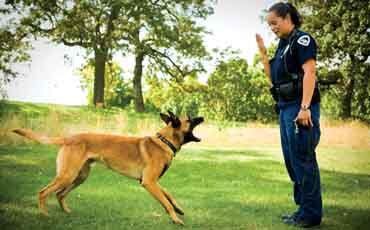

Stop! Or I’ll send the dog!” With this warning, a Madison police K-9 officer must immediately assess, with split-second timing, the severity of the crime at hand, the danger to citizens and/or officers, and whether the suspect will intentionally elude arrest. Woe be to the individual on the other end of that encounter.
The transformation of a dog from a friendly pet to a menacing attacker happens with a lifetime of training, and it’s the responsibility of Christine Boyd, Sergeant of Madison’s K-9 and Mounted Patrol Units.
“These dogs don’t have to be mean,” she insists. “They are quite capable of separating work from play.” The perpetrators might disagree, but Boyd would have it no other way.
A Madison police officer for nearly two decades, Boyd has worked with the program since its inception. On this day, she watches keenly as K-9 handler, Officer Rose Douglas, works with “Martie,” a 22-month-old Belgian Malinois. With a nearly undetectable hand gesture and a one-word command from Douglas, Martie gets to work, nosing around the perimeter of a parked vehicle searching for traces of drug activity. If he detects a positive scent, he’ll be rewarded with a toy. For Martie, it’s all about that toy. For the police, it’s about so much more.
“The presence of dogs [in police work] provides an alternative to using deadly force,” said Boyd, adding that the use of working police dogs often results in less violent episodes.
Madison’s K-9 unit includes two Belgian Malinois, two German Shepherds, and one Dutch Shepherd, though Boyd’s heard of other breeds such as Cocker Spaniels, Golden Retrievers, and Jack Russell Terriers being used as well.
“It’s all about how crazy the animals are for their toys,” Boyd said. “Will they tear up a chair to get to a toy? Are they so motivated that they just won’t quit until they find it? That’s the motivation law enforcement looks for.”
K-9 units work in teams, one handler per dog. Because the relationship lasts a lifetime, the bond between an officer and their four-legged crime fighter is significant. They usually live with their handlers, becoming family pets as well. During an officer’s tenure in the K-9 unit, they might work with as many as three dogs, and Boyd prefers it that way. “We always say they make all of their mistakes with the first dog,” she said.
The critical working relationship between a K-9 officer and their canine partner is fostered through training. The team develops a language consisting of visual and verbal cues that translate an assignment, whether it is to search for drugs, for items, or to track or chase a human being. “So much is contextual for dogs,” Boyd says. “They’ll know, by what the officer wears, says or does, exactly what’s expected of them.”
Most Madison K-9 dogs are bred for police work, and purchased from vendors or schools when they are about two years old. Boyd researches the schools and selects the dogs, preferring calmer, more social animals. After all, a well-behaved police dog is as important to the program’s PR as it is for fighting crime. Only one dog was returned to the vendor due to aggressive behavior, she said.
Martie, on his best behavior this day, and Douglas are the newest team in the K-9 Unit. Originally from Czechoslovakia, Martie was pre-trained and purchased at a school in North Carolina, where he and Douglas spent five weeks in training before returning to Madison. Upon their return, the team spent an additional three weeks training with Boyd. That’s still not enough in Boyd’s mind. She’d like to expand training to 12 weeks. “There is just so much [to teach],” said Boyd, who also helps teach the rest of the police force how to interact with the dogs.
K-9 teams typically assist in vehicle pursuits (which often result in a foot chase); robberies, or anything with guns; when contacting known offenders, particularly those with a history of running; hostage situations, where they are used for outside cover; and in vehicle or building clearances.
In the latter, Boyd said a dog can detect behind which wall a suspect might be hiding, allowing for a quicker police response. “Their sense of smell is extraordinary,” she said. When a team is not on a specific K-9 call, they assume regular patrol duties.
Madison’s K-9 unit was established in 2004, thanks to the lobbying efforts of Boyd and her captain, Vic Wahl, and the first team hit the streets in 2005. The department now has one narcotics dog, and five K-9 teams with dual-purpose dogs trained in both drug detection and patrol. Drugs needed for narcotics training are provided to the program by the Drug Enforcement Agency. As a result, the dogs can quickly identify the odor of marijuana, cocaine, crack, heroin, and methamphetamine.
Boyd also coordinates two full days of mandatory K-9 training each month because, in her words, the dogs always need to be retrained. And, she said, “they love it.”
A recent training day involved lessons in tracking (for chasing and apprehending fleeing criminals); conducting area searches (finding a lost subject); range (gunfire) work with the S.W.A.T. team; building searches under various light conditions; and control, where handlers work on basic commands and practice the essential “down,” “stay” and “bite” responses.
Decoys, or human volunteers sporting protective equipment, are an essential part of “bite” training. “A really good decoy can make a dog great,” Boyd said, adding that dogs are taught to hold, and not to chew, on a subject. “We want punctures, not tearing.”
Fielding a K-9 unit is not cheap. The cost of putting one team on the street is $50,000. The majority of that cost ($35,000) goes toward a team’s specially-equipped vehicle, which includes radar, a computer system, rifle, a high-performance engine, and a dog compartment replacing the back seat. An additional $10,000 covers the cost of the dog, the schooling, and off-site team training.
Recognizing the expense of the program early-on, Boyd helped establish Capital K9s in 2004, a nonprofit that now serves as the funding arm of the K-9 unit. When she identifies a need, she submits a request to the agency where it is voted on by an eight-member board comprised of citizen volunteers. The arrangement keeps the program’s costs out of the city budget, and isolates it from budget cuts. While the nonprofit funds everything related to the dogs, the handlers, paid hourly, remain on the city’s payroll.
Madison’s K-9 program and Capital K9s work hand-in-hand. The agency works with Boyd to plan community appearances and events and solicits donations, sponsorships, and in-kind gifts. [Its largest annual fund-raiser, the Dog Paddle at Goodman Pool, grossed $11,300 last month.]
Boyd’s supervision of the K-9 unit is largely administrative. “My role is to stand back and evaluate what the dog or a handler might need to be successful, like a coach,” she said. She must also keep highly detailed notes on the activities of every team, every dog, and the health of each animal. The program has proven so successful that she was recently appointed to supervise the Mounted (horse) Patrol as well.
But this day, it’s all about the dogs.
“There’s a saying we have in the police department,” she remarked. ‘When people are afraid, they call the police. When police are afraid, they call the dogs.”
Sign up for the free IB Update — your weekly resource for local business news, analysis, voices and the names you need to know. Click here.

