
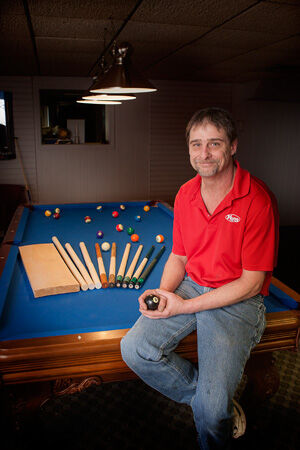

In any other industry, talk of crotches, butts, and shafts or snooker, shots, and pot might result in a visit from some of Madison’s finest. But billiards (or pool) aficionados will quickly recognize these as terms used in variations of the tabletop game that dates back to the 15th century.
At Viking Cue Manufacturing in Madison, Rick Rolli, 48, has carved out his own long history in the pool cue trade. Rolli, vice president of manufacturing, has worked at the cue manufacturer for nearly 30 years, and there isn’t an aspect of cue-making he doesn’t know. “I spent about seven years of my time here just studying shafts,” he said, “watching how they dry, trying different cutting procedures.”
Behind the 8 ball
Rolli has seen the best and the worst of days. The company, under founder Gordon Hart, closed in 2010 under the weight of a tough economy and stiff international competition from China.
But less than a year later, Mark Larson of Middleton, who also owns Midwest Prefinishing, purchased Viking’s assets and a scaled-down Viking Cue emerged. “When we came back, we brought every one of those shop employees back with the exception of two,” Rolli said with pride.
Damage control also ensued.
“Obviously … there were some hard feelings. People were uncomfortable with a company that went out of business. The lifetime warranty doesn’t mean anything if the guy’s not there next week to service the product.”
That was then.
Catching a break
Under Larson’s ownership, Viking Cue now rents its building on Syene Road, inventory has been reduced, and budgets have been tightened. Built decades ago, the outdated building – recognized locally by the huge cue balls outside – is much more than the company needs. “We also have two empty lots here that we don’t use that we’re paying rent and property taxes on,” Rolli said. The company is looking to relocate to a better-organized building with a smaller footprint and lower overhead.
Viking Cue’s current non-union staff of 12 also has downsized to just a fraction of what it was in its heyday, right after the movie The Color of Money (1986) gave the industry a huge boost. The sport’s popularity surged, and in Madison, nearly 100 Viking employees worked around the clock to feed a demand of about 600 cues a week. But demand has fallen since, and the Great Recession hasn’t helped.
Currently, the company manufactures about 150 Viking-brand cues every week that retail between $190 and $1,600. Computer technology now makes it possible for the company to churn out 1,000 cues a week. “We used to cut cues two at a time, now we’re doing 30 at a time,” Rolli said, “and what took an hour for inlays, we can now do in a few minutes.”
The company also produces a smaller, high-end line from master cue designer Anthony Two Feathers that often uses exotic woods, genuine turquoise, and ivory. Two Feathers’ designs can sell for as much as $5,500, but a very limited-edition cue still in production will be priced at about $10,000 on the retail market. Chances are, the buyer will never play a game with it.
A while back, when international competition increased, specifically from China, Viking began offering a line of Valhalla cues made in Taiwan that retail between $39 and $225. The lower-priced line was more appealing to younger players, which wasn’t necessarily a bad thing, Rolli noted. “If we don’t get people involved at a young age, our industry will fall to the wayside.”
The company sells around 600 Viking and 600 Valhalla cues each month.
Making the grade
With a precise mix of science and art, Viking cues are made entirely in-house, except for the leather tips, rubber bumpers, and weight bolts.
The company only makes two-piece pool cues, consisting of the butt – the thicker, decorated end that a player holds – and the shaft, which extends down to the tip.
Typically, the butt and shaft are the same length, most commonly 29 inches each. A standard taper is “12-14,” meaning the taper will hold its size for 12 to 14 inches from the tip toward the middle before thickening to match the joint.
A pool cue begins from a plank of wood, usually a variety of maple, cut into 1.5-by-1.5-inch square lengths for butts or 1-by-1-inch squares for shafts, which are then rounded by a lathe. Butts and shafts are made separately.
Turning (trimming and shaping) the wood with CNC (computer numerical control) machines is done many times over the year-long process, with curing and drying time in between, which helps season the dowels. Each time a cue is turned, tension in the wood is relaxed, reducing the possibility of warping.
“If it’s straight by the time we do our last pass on it, it will never go crooked unless someone does something silly to it,” Rolli said, noting that this is one reason the company warranties its products. “Twenty years ago, if you would have offered a lifetime warranty on a cue stick staying straight, you’d be laughed out of the industry.”
Production is always well ahead of schedule. “The rack of dowels I’m cutting now has been here since about 2002,” said Rolli. By having wood dowels at the ready, Viking can easily turn an order around in as few as eight hours or as long as 10 weeks, depending on the order size and customization.
(Continued)
Inspiration for designs can come from anyone on staff. “Many times, before we make a cue for a line, it will go through seven to 10 different variations until we find a balance that works out well. I have about 250 ideas that we’ve drawn out but never used,” Rolli said.
Cue designs are graded out of the wood. “Most people assume the design work on cues are stickers or decals,” Rolli said. In fact, all Viking designs are inlays.
There is an industry trend toward performance shafts designed to provide more or less spin, more solid hits, etc., and Viking has designed two since reopening in 2011. “We just wouldn’t spend all this money on R&D and getting patents if we were going to go out of business,” Rolli assured. “This is not a temporary thing.”
Last shot?
In fact, nobody was happier than Rolli when his friend Mark Larson decided to purchase the business. “When I left here, it was heartbreaking,” he admitted. At that point, he’d worked at the company for 27 years and had watched it grow from a couple of employees and 500 square feet to its current footprint. He thought he’d take a year off, but after just six weeks, he was going stir-crazy.
He found a job at Midwest Prefinishing, where he and Larson became friends, and he suggested that Larson visit the idle pool-cue business. “When I brought Mark through, it looked like an atom bomb went off, like a ghost town stopped in motion. It was sad,” he said.
Though it took a while to restore the business, rebuilding and maintaining client confidence is an ongoing goal. As for Rolli, he’s excited about his job, the company, and its renewed future. “It’s easy to find someone you like working with, but finding someone you really like working for in an industry that you really like is next to impossible!”
Each morning, he checks on orders, then determines what everyone will be doing that day. The company has about 76 different models of cues, and the most frequently requested colors, he said, are blue and white. “I’ve [been here] since we turned [wood] with planes and files, to machines now that are repeatable to two-tenths of a thousandth of an inch,” he said. “It’s phenomenal how [the business has] changed.
“I love taking a raw piece of wood and turning it into artwork that amazes people and [in many cases] becomes an heirloom,” he said. “It’s amazing how some people take care of their cues. Like a pet.”
Sign up for the free IB Update – your weekly resource for local business news, analysis, voices, and the names you need to know. Click here. If you are not already a subscriber to In Business magazine, be sure to sign up for our monthly print edition here.

