
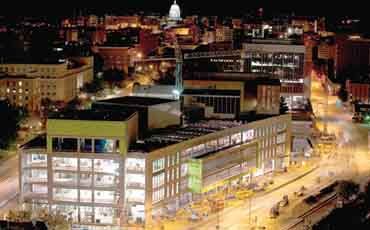

The financial chain reaction set off by the Lehman Brothers’ bankruptcy has put the commercial construction industry in a downward spiral that may not be reversed for years. The health of the commercial real estate development industry in Madison has never been more precarious, thanks to a financial and credit-induced recession that has directly impacted virtually every type of business and indirectly put the commercial real estate market in a funk.
“I think it’s probably as challenged as I’ve seen it in the past 10 years,” said Mark Meloy, president and CEO of First Business Bank. “I think it can be fairly apparent to anybody that drives down Mineral Point Road or East Washington Avenue and sees a number of empty commercial spaces.”
“Empty” is the word to describe the state of local commercial real estate. Developer Terrence Wall, president/CEO of T. Wall Properties, cited Madison’s unemployment rate, which at 5.9% is about double what it normally is during a recession. “This is coming from the outside and impacting on Madison,” Wall said. “Large companies like GE have layed off huge numbers of people in town. Famous Footwear left town, and Rayovac filed for bankruptcy with plans to come out of it, so there has been a big impact from the outside on Madison.
“The general economy trickles down to the real estate environment, and the commercial real estate industry is usually the last to feel it.”
Just in case there is any doubt about how tough things are for commercial developers and construction, consider the following:
- Before the recession, the market wide occupancy rate was 94%, and now vacancies are projected to be in the upper teens marketwide. Nationally, unemployment in the construction industry stands at 18%.
- According to Wall, businesses that have excess space are trying to get rid of it but can’t — either because their leases are not set to expire, or there is no way to delineate the space without violating fire codes.
- The majority of construction activity is now in the public sphere, including the Wisconsin Institutes for Discovery, which is on track for a December 2010 opening. About the only commercial projects underway in 2009 are the new Johnson Bank building at American Center, a private dormitory built on Johnson Street, and a boutique hotel on the corner of Monroe and Regent streets, across from Camp Randall Stadium, so they literally can be counted on one hand. “I know there are projects that want to go ahead, but haven’t been able to,” Wall said.
- Since the recession has put businesses, and therefore the office market, in a cost-cutting straight jacket, certain adjustments in business strategy have been essential, and companies like T. Wall and Mortenson Construction are adjusting on the fly. T. Wall is taking a very cautious approach by temporarily suspending active development activity until it sees some economic traction, while Mortenson, a building contractor, is switching gears from an emphasis on commercial development to state government building.
Jeff Madden, a construction executive with Mortenson, said the switch has occurred during the past 12 months. A year ago, the company’s primary target was private companies that needed development in the form of new buildings. “Now, that’s a completely secondary focus simply because the people that have building needs, and have the capital, are second guessing whether to spend it or not, simply because they are uncertain of the future,” Madden said. “The folks that don’t have the capital and need to access the market to get it either can’t get the loan or can’t get a competitive rate.”
Mortenson Construction’s new focus is on public work, primarily UW-Madison building projects. “There is a lot of [university] building going on now,” noted Madden, who works on the Wisconsin Institutes for Discovery project as part of a joint venture with J.H. Findorff & Son, and was involved in the widely praised reconstruction of the Marquette Interchange in Milwaukee. “If you go around town, UW-Madison’s building program is continuing to build and is not showing any slowdown whatsoever.”
Credit Markets
Wall said credit is very tight today, and banks have only just begun to curtail lending and credit. Up until now, he said banks have been working with problem borrowers, even placing them on life support, but he suspects that starting in mid-2010, many banks won’t have a choice but to start to pull the plug on such businesses
Why? Because despite what the news media and the politicians are saying, Wall believes that banks are “severely curtailing” credit at the guidance of bank regulators, specifically the Federal Deposit Insurance Corporation and other agencies. In addition, he said banks are looking for more equity up front on commercial projects, and they are being forced to increase their capital ratios, which results in a reduction in lending.
This, combined with the lack of any conduit lending market and the likelihood of more bank closings in 2010, means substantially less credit for commercial real estate, Wall asserted. “Previously, the banks cut back on residential lending,” he noted, “but in the last few weeks the banks have started to cut back on commercial lending.”
In his discussions with developers and with family members in commercial lending, Madden is picking up the same vibes. “The regulation at the federal level is starting to intensify,” he said, “and there’s a lot more criteria on lending. That’s happening in the commercial world and obviously in the residential world, for good reason.”
In addition, Wall said banks now demand a pre-leasing rate of about 85% before committing capital to a new office project. That wasn’t the case a year ago, when he completed financing on the Johnson Bank project, which was 65% pre-leased at that time.
He said the only reason T. Wall started construction on the new bank building is because it had signed enough leases to ensure positive cash flow, meaning the signed leases would produce enough rent to cover debt service and other costs associated with the property. “We’re being told that you have to pre-lease to the point of being break-even cash flow positive, which means you’re going to have to be somewhere in the 85% pre-lease range,” Wall said. “You are not going to go out there borrowing with a 50% pre-lease and expect to lease out more, because businesses are shrinking.”
Meloy (First Business Bank) declined to comment on what regulators are saying or not saying, but he didn’t pour water on new pre-leasing qualifications. “I would say that’s consistent with what we’ve seen,” he said. “I’d also say that every deal has its own characteristics, but we’ve always looked at a pre-leasing qualifier on transactions that weÃÂÂÂve done in the past and we’ll continue to review that on every transaction that we look at funding in the future.”
Meloy said bankers have to be good business people first. When looking at the available commercial space in any market, they must answer the question: Does more development, or adding capacity, make sense?
“I think the outcome of some of this is going to be that development is not going to stop. It certainly has slowed, but the counter-balance is that development is probably going to be less leveraged than it has been in recent years. The developer is likely to have more of their own capital in it, which means less bank financing on a proportionate basis.”
According to Wall, the losers in the credit game will be businesses that can’t secure credit to rollover existing property loans; they will be forced to sell their properties.
The winners will be developers that prepared for the crisis in advance by reducing leverage and having the cash on hand to make offers on distressed properties.
Once the impact of credit tightening takes hold, which Wall expects to occur over the next 12 to 24 months, T. Wall Properties intends to acquire office properties at a discount. At the moment, property sellers are mostly large Fortune 1000 corporations, but Wall said the Madison market is seeing a floor under pricing and a seller can find an owner-occupant to buy the building.
Wall is amazed to see a few what he called “non-professional developers” still trying to develop speculative buildings, only to discover the precarious situation they are now in. They were more prevalent in the market in 2006 and 2007, when lending terms were more relaxed, but they added office space that wasnÃÂÂÂt filled. Overall, however, he said Madison developers avoided over building of space following the 2001 recession, or the problem could be even worse.
T. Wall Properties has felt the impact of the current economic downturn, but it has the advantage of having 2.7 million square feet under ownership and management, giving it a rental revenue stream from core tenants, and ongoing management fees to weather periods of construction inactivity. Given the potential for millions in pre-building costs, and the high likelihood of low pre-leasing rates and high vacancy, Wall said the worst thing the company could do in this environment is take advantage of opportunities to develop new structures.
He said raiding competitors for tenants isn’t a realistic option because businesses are simply reluctant to move in this type of economy due to the potential cost, business disruption, and loss of customers. “They absolutely don’t want to move,” Wall stated, “but they might execute a short-term lease renewal for a year or two years.”
Commercial Comeback
Since commercial real estate (except for retail property) is the last to feel the effects of a recession, it could well be the last to feel the recovery.
Madden doesn’t pretend to know whether the Greater Madison commercial real estate market has hit bottom, but his development colleagues believe the recovery will be a tough slog. “They don’t think Madison has hit bottom yet in that regard, and that Madison typically is several months behind a lot of the other parts of the country with regard to that,” he said. “So it will probably get worse here before it gets better.”
In Meloy’s view, the first sign of a potential turn around in commercial real estate will be a rise in consumer confidence, which tends to drive the American economy. According to the Conference Board, the consumer confidence index ticked back up in August, but at 54.1 it’s still well below the 90+ reading associated with a strong economic expansion. At the moment, Meloy noted that unemployment is high and consumers are trying to drive down their personal debt rather than spend.
He believes consumers armed with the confidence to spend is what will start the chain reaction that leads to a healthy commercial office market, and he will look for signs that retailers are starting to enjoy an uptick in their financial reporting, especially same-store sales, as the precursors for businesses to expand in commercial space.
“I think the economy definitely plays a part in it [the development slump], but as much as anything we’ve enjoyed a consumer-driven economy for a long time, and consumers are, themselves, challenged,” Meloy noted. “They are not spending like they were, and in some cases they don’t have the spending capacity that they had before due to everything else going on in the economy.”
Reviving consumer confidence is one thing, but reviving business confidence is another hurdle. Wall said business owners he’s spoken to are very concerned about the direction of the federal government, including the health care bill and cap-and-trade legislation, which he expects to add significantly to energy and heating costs. With lending about to get even tighter, the commercial real estate comeback will take a few years, Wall predicted. “If you don’t have credit flowing through an economy,” he said, “you can’t have a recovery.”
Sign up for the free IB Update — your weekly resource for local business news, analysis, voices and the names you need to know. Click here.

