
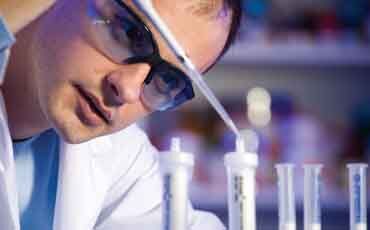

There is no question that Wisconsin’s biotechnology industry is one of the most highly regarded in the world. The state’s 608 biotechnology companies, many of them spun out of the University of Wisconsin-Madison, employ nearly 20,000 people. These companies have secured close to 2,400 patents, and they continue to attract federal research and development funding.
In the 12-month period ending March 31, 2009, 39 Wisconsin technology businesses raised a combined $29.3 million in R&D grants.
Wisconsin ranks 13th in total academic R&D expenditures, and 11th in higher education degrees in biotech fields. By itself, the University of Wisconsin-Madison, which gave the world the ability to isolate and culture human embryonic stem cells and played a key role in the development of induced pluripotent stem (iPS) cells [re-engineered adult stem cells that act like embryonic stem cells], now ranks second nationally in attracting federal research dollars.
That’s not to say the industry is worry-free. Bryan Renk, executive director of BioForward, the association that represents the biotech industry, said the economy’s lingering struggles are among his biggest concerns, especially for start ups. While Wisconsin’s angel networks and funds reported $15 million in investments in 53 deals in 2008, a 28% increase, the complete early-stage picture showed that Wisconsin saw those investments decline 33%, to $98 million.
While those with proven science have access to capital, “The biggest impact of the recession has been to start ups, the companies that don’t have revenue where they are cash-flow positive,” Renk said. “They’ve gone out to raise money and the availability of those angel investment dollars has been more difficult than in previous years.”
In this look at the biotechnology industry, we look not only at the science and potential impact, but also the business behind five companies.
Stem Cells: Cellular Dynamics
It would be understandable for the general public to assume that a company co-founded by stem cell research pioneer James Thomson would be working with human embryonic stem cells, but that’s really no longer the case. One of Thomson’s more recent co-discoveries, iPS cells, is now the focus of Cellular Dynamics’ work in advancing drug development.
CDI believes human cardiomyocytes, or heart cells, are more predictive of a drug compound’s affects than animal cell-based technologies. The company provides iPS-derived heart cells to pharma companies as a consumable reagent for drug testing. The cardiomyocyte product, for research use only, will be branded as iCell and undergo a full commercial launch in December.
As a research-only product, it does not require clinical testing. “These are human heart cells in a dish that beat and have the full functionality of a human heart,” noted Chris Kendrick-Parker, vice president and chief commercial officer for CDI.
iCell, already supplied to various pharmaceutical partners in early-access deals, are the first of several iPS-based products CDI plans to introduce. Thus far, the human cell model has proven superior to other cell types used by CDI’s industry partners; this is especially true for cardiotoxicity testing because drugs that carry a toxicity risk still get into clinical trials, costing the pharma industry hundreds of millions of dollars in failed attempts to get drugs to market.
For CDI, the future may hold much more because there also is a “personalized medicine” aspect to its work with iPS cells derived from adult blood. Cellular therapy tailored to a person’s individual genetics is really the power of the iPS technology, Kendrick-Parker said.
“Having the ability to represent anyone’s stem cells, and having the ability to differentiate those cells into any cell type in the body, opens up the door beyond the standard model testing system,” he noted. “The long-term potential is a situation where you can make someone’s iPS cells and be able to test a drug on those cells prior to that person taking the drug, eliminating a lot of the side effects people experience when they take drugs.”
CDI wants to industrialize the process of making iPS cells in what Kendrick-Parker called a highly parallel manner, taking samples from multiple individuals and making iPS cells from them. Rather than the clinical trial route itself, the company prefers to partner with pharma companies that have the regulatory experience to accelerate those activities.
Biomarkers: Isomark
Isomark has developed a patented device to monitor disease states by measuring and analyzing isotopic biomarkers through exhaled CO2 samples. The device, now the size of a computer processing unit, can rapidly measure breath biomarkers for non-invasively detecting the presence of infection in as little as two hours after the onset.
Isomark CEO Dave Kruse and founder (and board vice chairman) Warren Porter say the need for speed in detecting illnesses and diseases should make the device, which they would like to downsize into a hand-held unit, a must in hospital ICUs and other care settings. Their selling points to would-be investors not only include more rapid detection, but improved medical outcomes and the reduction in the cost of treatment that typically results.
The technology, developed at UW-Madison by professors Isabel Trico and Mark Cook, an Isomark co-founder, is about ready for prime time. “We have some good animal trial data, and also some on humans, but that’s casual,” Kruse said. “We’re at the point where we need to raise some [early-stage] money, and do some trials in the hospitals.”
Porter said the company has been flying under the radar because it wanted to make sure the technology is bullet-proof. There is a certain ratio (delta value) of Carbon 13 to Carbon 12 in the breath, and the general population in this country tends to have a certain delta value. Porter said if he sees a delta value on the order of one to two points down from the norm, that would suggest immediately the patient has an infection or the onset of an infection. With continued monitoring, “We would know if it’s continuing to go down and whether there is a significant onset of a bacterial infection.”
In hospital settings, the post-operative onset of sepsis could make Isomark’s technology especially valuable. According to the company, about 1.7 million hospital patients contract infections annually, and nearly half of those infections (750,000) will lead to sepsis, resulting in more than 200,000 patient deaths and more than $33 billion in treatment.
Since the general U.S. population tends to have a certain delta value — given dietary influences, it can vary by country — some say there is less need for a healthy person to take a baseline measurement and have that placed in his/her medical record for comparison later on.
For the sake of precision, others believe a baseline reading will be necessary. “That’s why we think the ICU will be the target, because people tend to be in there for an extended period of time,” Kruse said. “If you walked into a clinic, we might be able to tell whether you have an infection or not, but we need more data.”
Regenerative Med: Stratatech
It would be hard to convince B. Lynn Allen-Hoffmann, CEO and chief scientific officer for Stratatech Corp., that 2009 has been a bad year for business. Stratatech is developing skin substitute products for therapeutic and research use. StrataGraft, its first product, is a patch of genetically engineered tissue identical to human skin and was the subject a successful clinical trial for safety (dose escalation) earlier this year. More trials on larger populations are necessary for the company to obtain FDA approval and commercialize StrataGraft.
The patch delivers an anti-infective to prevent bacterial growth that causes skin graft failure, and the cells within are genetically engineered to continually reproduce the patient’s own skin cells, promoting regrowth of the skin. To help treat wounds and burns, the patch, which has civilian and military applications, can be grafted onto patients with the use of surgical sutures.
“We don’t harvest skin tissue from the patient, we use epithelial cells that normally make up human skin,” Hoffman explained. “We grow them into patches in a petri dish.”
The timing of StrataGraft’s commercial launch will depend largely on financing for subsequent clinical trials, but the company might not need as much early-stage capital if it experiences healthy sales of StrataTest, a research-only product that does not require FDA approval and eliminates the need to test on animals. With StrataTest, the company could benefit from a new law passed by the European Union, which is effective in 2013. The statute prohibits any consumer or cosmetic product from being sold on the continent if it has been tested on animals. “We feel we have a good opportunity there,” AllenHoffmann said, “with very few competitors.”
More good news: Stratatech recently secured a $1.7 million grant from the National Cancer Institute to develop a new cell-based, gene therapy product to treat skin cancer, and it expects to share a $1 million grant to collaborate on the development of new skin therapies with Yale University and Transderm, Inc., a California company that develops treatments for skin disorders.
Drug Development: Centrose
Can a better understanding of sugar chemistry help improve the effectiveness of drugs? The Madison-based Centrose, through its CarboConnect technology, believes it has answered that in the affirmative, and is developing a pipeline of therapeutic products to prove it.
CEO Jim Prudent notes that the molecules of individual sugars — sucrose, glucose, and fructose — can be linked together to make carbohydrates, hence the name of its platform technology. The basis of Centrose is to look at more than the few naturally occurring sugars that exist and instead look at sugars that it can make synthetically to see whether those sugars, when placed on a small-molecule drug, can enhance the drug’s potency, solubility, and other characteristics.
Sugar’s impact on drugs has been known for a long time, but the drug enhancement process has proven to be long and difficult. The CarbonConnect technology simplifies it. “We can throw in 100 different sugars in a couple of week’s time, once we have the initial compound, and activate it,” Prudent said.
Centrose intends to remain in the drug discovery phase and license its drug candidates early on, leaving large-scale production for future industry partners. The company already has a broad set of patents to cover its platform technology and its drug leads, the first of which it plans to license out to drug companies in about two years. “We don’t waste our time digging for the gold,” Prudent said. “We spend all our time finding it.”
Centrose is initially focused on non-small cell lung cancer, one of the deadliest forms of cancer. Most patients who contract it don’t survive for very long, so the company is targeting an unmet need. At this point, it has a group of compounds that are very active for non-small cell lung cancer, and these are the types of drug leads it shows to prospective partners.
Centrose raised $2.1 million in angel funding earlier this year to continue the development of its lead drug candidate, and Prudent believes it has enough angel investors who are interested in putting more money into the company when needed.
Disease control: FluGen
Paul Radspinner, president and chief executive of FluGen, knew early on that the government wasn’t going to be able to produce enough vaccine for the anticipated H1N1 outbreak, but his company has developed an egg-free way to fast track the development of flu vaccines. A number of seasonal vaccines will be developed through FluGen’s CHO-cell-based production system, but H1N1 is the flu de jour. Since the traditional egg-based process of producing flu vaccines can take up to six months to deliver, FluGen believes its quicker, egg-free vaccine production method proves that eggs are no longer necessary to produce vaccines on a large scale.
Had the FluGen vaccines been commercially available, the company believes that its production system would have circumvented the 2009 shortage of H1N1 vaccine. “It takes a year, roughly, to get all the eggs prepped and ready because these aren’t eggs that you can pick up at the local farm,” he said. “You have to have fertilized eggs, and they have to be screened for contaminants and all kinds of things.”
FluGen raised $2.2 million at the beginning of 2008 and received a low-interest loan from the state. Radspinner said the company is in due diligence with an investment group for a Series A round of venture funding. “It’s been tougher to find money because of the economy, but given the field we’re in and the achievements we’ve had, it hasn’t been as hard for us.”
Sign up for the free IB Update — your weekly resource for local business news, analysis, voices and the names you need to know. Click here.

