
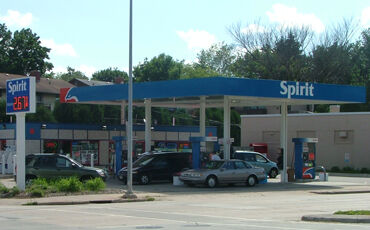

Jon Crawford literally has the Spirit, but not of ’76. His Spirit is a brand of gasoline that will attempt to out-price major brands.
He first hopes to pass the savings from a lower cost of doing business to Madison consumers, but he could well extend any at-the-pump savings to people in rural areas, too.
“My whole philosophy in trying to get the word out about Spirit is that people have been asking what the brand is,” said the vice president of Portage-based Crawford Oil & Propane, a distributor of fuel oil, gasoline, aviation fuel, and motor oils. “It’s important for people to understand that it’s an independently owned brand. I have no loyalty to a major oil company.”
Thus far, the Spirit brand is offered at an independent gas station on University Avenue, a major thoroughfare, where several major brands also reside. This station, the only Crawford Oil dealer with the Spirit brand at this point, once was low-volume and run down, and now it’s a bit of a proving ground.
Jobber Creation
In the oil and gas industry, a gas station owner is known as the dealer. A person in Crawford’s position is called a jobber, and his business serves as the supplier to the dealer. As a jobber, he receives product from his own supplier. He also can bring a site to Spirit, a brand that started in 2002, and the executives of Spirit either approve or disapprove.
“Where our business model comes in is that when my dealer is successful, then I can be successful,” Crawford stated. “We always try to provide the best possible solution to what a dealer needs in order to succeed in their market, because every market is different.”
Where Spirit has helped Crawford Oil’s business model is around the difficulty of “brand conflict,” with major brands having merged. In the 1990s, there once were 10 to 15 companies that a dealer could brand, but thanks to industry consolidation, there now are five major brands. With fewer brands, stringent policies as to location, and minimum annual volume requirements for dealers, Crawford said it’s become difficult for dealers to find a brand that will fit into their particular market.
Although majors offer brand recognition and image, doing business with a major usually includes higher credit card fees and higher product costs. It’s a dilemma that Crawford expects Spirit to resolve. “What Spirit provides is a recognizable, professional image without having to follow the same strict requirements of a major brand,” he said, “and it offers a lot more freedom in the way you operate.”
Back in the day, the station on University Avenue was called Gas-U-Save. When a new owner bought the site, Crawford convinced him to try Spirit. According to Crawford, he liked the Spirit image and more.
“He also liked that we could bring something to him at a lower cost, a lower cost of product, and lower credit card processing fees,” Crawford said. “The reason why credit card processing fees are lower is that you [as an independent] deal directly with a credit card processing firm.”
The major oil companies make a lot of their money on credit card processing, and major brand dealers have to process credit cards through the major oil companies. They cannot shop around for a different credit card processing company. For credit card processing, Spirit signed its own independent contract through RBS World Pay.
With a credit card processing company, the various credit cards are broken down into different fee structures, but majors lump everything into one percentage. “I’m not at liberty to give you what those percentages are, but you just do a lump percentage, independently, with every card that you pay,” Crawford said. “So they also add transaction fees and things like that on top. What it comes down to, and I’ve run the numbers, is that usually somebody can save on credit card processing fees.
“We’re going through this program with RBS and Spirit, which is a huge part of the business. I’d say close to 70% of our business is now done on credit card.”
Sign up for the free IB Update — your weekly resource for local business news, analysis, voices and the names you need to know. Click here.

