

In a year that seems to be rife with natural disasters, Bill Shager, 47, couldn’t believe his luck. While on cycling business in Kaohsiung, Taiwan in March, the VP of Madison’s Saris Cycling Group had just finished breakfast on the 43rd floor of his hotel and returned to his room on floor 29 when the world began to shake.
“My first thought was, ‘Geez, I don’t want to die in Taiwan!'” Shager said, flashing back to the armageddon-themed movie “2012” shown during his 28-hour flight over. “It was very loud,” he said of the temblor. “The building [built for events such as this] was swaying, creaking, and groaning.” He compared the feeling to being in a treetop on a windy day.
Of course, it seemed to last forever.
Looking out his window, Shager noticed a group of school children down below, filing out from their school in orderly lines in favor of the safer confines of an area park. “It was no big deal to them,” Shager noticed. “They obviously hold drills for this.” The children’s composure actually calmed his nerves.
Shager learned later that Taiwan had withstood a magnitude 6.4 earthquake. Obviously, he survived unscathed, as thankfully did most of the area. But the memory of the quake and its 14 subsequent aftershocks will last much longer. Now he’ s back on firmer ground in Madison.
Shager joined Graber in 1990 after a four-year CPA career with Grant Thornton. “I did lots of things back then: HR, purchasing, and accounting,” he said. Now all of production reports to him, as does purchasing, accounting, and human resources.
Chris and Sara Fortune purchased the small bike rack manufacturer from the Graber brothers in 1989. At the time, the business employed about 25 workers and was generating about $1.5 million in sales. But there was an inherent roadblock to substantial growth; Shager explained that bike racks (then) were primarily a seasonal business.
In 1992, the Fortunes combined their first names and the Saris brand was founded. In 1999, CycleOps, a line of indoor bike trainers, was added to the company’s mix, which helped fuel production year-round. To further diversify its portfolio, in 2001 Saris purchased a power measurement company and has since developed a state-of-the-art rear-wheel-mounted performance measurement tool that is quickly becoming one of the company’s fastest growing product lines.
Shager has been along for most of the ride, and his recent trip to Asia, which he said occurs about twice a year, was a chance to get in front of the company’s suppliers. Taiwan manufactures Saris’ indoor training cycles (stationary bikes), while China makes component parts for bike trainers and racks.
“If there’s significant labor involved, it is less expensive [to work overseas],” Shager said. “We’re competing with a factory paying 35 cents an hour, but ideally, we want to dual-source so we can have the same sources both here and abroad.”
Still, the company uses “Made in the USA” as a strategic advantage. “We want to make things in Madison, Wisconsin,” he said, “and the best way to do that is to have control here.” For that reason, 75% of its sources come from around this area.
Shager credits the Fortune’s strategic decision to contract with Italian designer Fabio Pedrini as the turning point that launched Saris into the high-tech, stylized, competitive bike rack market. Now with sales of over $35 million (2009) and a workforce of around 170, the company’s mission, “To own the rear of the car for cyclists,” remains the employee focus, while Shager’s challenge is to keep the momentum moving forward.
“My job, in a perfect world, is to help my people navigate the daily battles and stay on the strategic path as much as possible,” Shager said. “If I’m doing my job right, I’m letting them know where we’re headed and why, then letting them do their job.” A member of UW’s Quick Response Manufacturing consortium (QRM), Shager said the company is constantly looking for ways to save time and streamline its production process. To do so, communication is key.
“It’s maddening to me to see e-mails go back and forth instead of resolving issues face to face,” Shager said. To help facilitate communication, monthly staff meetings are held in an effort to be more transparent.
Overseeing about 90 production workers and 20 engineers, Shager constantly battles the issue of employee engagement. “I’ve watched people check their brain at the door, be unengaged for eight hours while they’re here, then recheck their brains when they leave at the end of the day,” Shager said. “We need to work on that and get better at recognizing our employees for jobs well done. That’s why I take ‘the walk,'” he said.
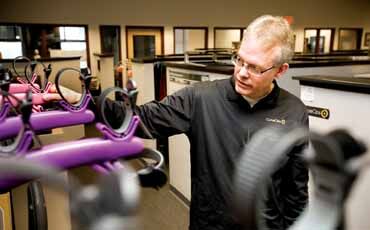
Twice a day, Shager tries to stroll through the production facility, observe the operation, and talk to employees. “Often, they just want to vent,” he said, “and that’s great.” Such exchanges have resulted in constructive ideas to make the manufacturing process more efficient. “You don’t have to spend a lot of money if you let [staff] be creative.”
Managing, he said, replicates another facet of his life. “I think I became a much better manager when I became a parent,” he said. “There are times when you need to push your kids, and times when you need to hug them.”
In charge of company financials, another challenge Shager faces is the fact that the company “outsold their forecast” on certain items last year, and therefore has had difficulty meeting its production goals of giving customers what they want, when they want it. “Our lead times on components could be 90 to 120 days — and in some cases up to five months — when you factor that shipping items from China can take six weeks,” Shager said, which means the company must purchase to a forecast even though it attempts to build to order.
“When your forecast is a guess, the more you can do to lessen your reliance on forecasting, the better. That’s why the vast majority of our components are sourced within two hours of Madison,” he said.
“Our electronic boards are now produced in China, but we’re trying to see how we can move that to the U.S. It costs 30% more to do electronics here than in Asia, so is it worth it? But if we can’t ship it … That’s the challenge of manufacturing anywhere.”
Luckily, with its diversified portfolio and five product categories, the sectors tend to balance out. Saris products include automotive bicycle racks for parking, storage, and display. The CycleOps brand includes trainers, the power measurement performance tools, and indoor stationary cycles. The company also licenses the Schwinn name from Pacific Cycle, and Trek is its largest U.S. distributor. It also sells direct to dealers, like REI, Dick’s, and Toys R Us.
A tour of the non-union Madison production facility includes a metal fabrication/welding area, assembly lines, electronics for its output measurement device, a repetitive motion testing area, and a shipping operation.
“We build finished goods,” said Shager, “and I believe our employees take pride in seeing one of our racks on the back of a car.”
Madison, not surprisingly, is an excellent market for Saris, as is Portland, Ore., Boulder, Col., and Dallas, Texas. But with 80% of its product sold in the U.S., growing the export market is next. Currently, Western Europe, Japan, and Australia lead Saris’ international sales.
Ironically, Shager is a recreational, not an avid or competitive cyclist. “I get a lot of grief for that,” he admitted.
Sign up for the free IB Update — your weekly resource for local business news, analysis, voices and the names you need to know. Click here.

