

“On a busy day, I’ll spend almost no time in the office,” says Josh Reindl, a service technician for Madison B-cycle. “Once I get coffee and get the van here, I’m out and about the whole day.” It’s no wonder he’s grinning from ear to ear. “I love it. I don’t know if I’ve made that clear yet or not.” It’s only the fourth time he’s said so.
Reindl’s job at Madison’s bike-sharing program is to keep things pedaling along smoothly, quite literally. That is, making sure there are enough bikes at each B-cycle kiosk (i.e., docking station), maintaining the bikes, and moving them from one station to another as demand dictates.
“Every day is different,” Reindl says. “I’m on year three now, and there are days when I do things I’ve never done before.” Earlier in the week, he helped test a new live GPS system under consideration. “I just rode up and down the bike paths until [the test] was done,” he says. “That was my job for almost an hour!”
Madison B-cycle is an alternative form of public transit for trips too short to drive and too long to walk, according to Claire Hurley, B-cycle program manager. It also provides the perfect job for the 24-year-old Reindl, whose ponytail nearly reaches his waist. He’s considered a full-time, seasonal employee because the program goes on hiatus each year between Dec. 15 and March 15. During the off time, Reindl sometimes travels with money he’s saved throughout the year. “I don’t complain,” he says.
Nuts and bolts
Initially, Madison B-cycle got off to a somewhat rocky start. Under former Mayor Dave Cieslewicz, a big B-cycle proponent, the city was set to pay $100,000 per year to help operate the program, but when Cieslewicz lost his re-election bid to Paul Soglin, all that changed. B-cycle’s contract with the city was renegotiated and extended to five years, and while the city now donates just $1 annually to the program, it also lends significant engineering, legal, and permitting support. Madison B-cycle pays the city for any station located on a public right-of-way and for any electricity used. Luckily, more than half the stations are solar-powered, Hurley explained, “and those that aren’t use about as much power as it takes to run a 60-watt light bulb.”
Since Madison B-cycle’s launch in 2011, its popularity has surged, and Soglin, Hurley says, is now a big supporter. It’s hard not to be, with the numbers the program has racked up: The number of annual members, who average 18 trips a year, has exploded since 2011, from 472 to 2,842 as of July 20. The number of casual users, who average 1.8 trips per year, increased from 6,437 in 2011 to 11,794 in 2012 and continues to climb.
Despite the cold, rainy spring, the number of B-cycle trips is up 77% over last season, and while the number of monthly trips peaked last summer at 11,574, it is on track to far surpass that this year.
|
Josh Reindl checks the gears on a B-cycle bike. At the end of the season, staff overhauls every bike in the system, which takes about an hour per bike. |
Madison B-cycle was started and is supported primarily by Waterloo, Wis.-based Trek Bicycle Corp., which provided $1.4 million for startup capital and continues to pay operational costs. UW-Madison is the program’s second-largest sponsor.
B-cycle was formed in 2008, with the majority share owned by Trek. The first B-cycle system to open was Denver Bike Share in 2010. B-cycle is now available in 25 cities nationwide.
Madison B-cycle operates as a separate LLC under Trek Retail Services. Its workers are employed by Trek and receive Trek benefits.
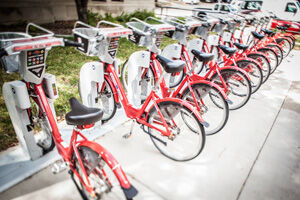
The bright red bikes are especially popular throughout the isthmus area, where people regularly take short jaunts around town. With 264 bikes on the move between 5 a.m. and midnight every day, bike tracking is key to the program.
Enter Reindl, who built bikes at the east side Trek store before applying for this gig and has been with Madison B-cycle since day one. He is one of a handful of Madison B-cycle employees who track, move, and repair the bikes and docking stations. Most of the 50-pound bikes are equipped with a passive GPS system that pings every 30 seconds, leaving “bread crumb trails” on the system’s computers. “We know what member took out which bike at what station at what time,” Hurley says. Just recently, live GPS — hopefully the wave of the future — was installed on three B-cycle bikes.
Because users release B-cycles from their secure lockup by swiping either a credit/debit or personal B-cycle card, thefts have been rare. Hurley says only one bike has been stolen thus far. It was spotted in Chicago but never recovered. When a bike is lost or stolen, a $1,000 charge is placed on the user’s card.
Bike mapping
Reindl’s typical day begins with a quick computer check of all B-cycle stations to ensure they are all online and functioning properly.
In the B-cycle office, computer screens display — in real time — a map of all 32 stations, which pepper the city’s landscape from as far west as UW Hospital to Olbrich Gardens on the east side of town. Each docking station is identified with a colored dot: Green means the supply of bikes at that station is good; yellow, not so good; and red, bad. One location, with nine docks and zero bikes available, becomes an immediate priority.
Bike sharing is most cost effective in 30-minute time intervals, before additional usage fees are incurred. “I find people are surprised at how far you can get in 30 minutes,” Reindl says, and if a docking station is full, a smart phone app or the kiosk’s computer will help locate available stalls nearby and credit 15 free minutes of travel time to get there.
(Continued)
Stations can accommodate as few as seven or as many as 23 bikes, and while reservations are not needed, a credit, debit, or unique B-cycle RFID card is required.
In a large Madison B-cycle van equipped with another computer and a few extra bikes, Reindl travels around town, moving bikes from one station to another as needed. It’s called balancing, and it takes up a good portion of his time, particularly on weekends.
“I’ll spend most Saturdays just moving bikes back and forth and taking customer calls, which go right to my cell phone,” he says. Someone might have a flat tire or be unable to operate the locking mechanism. “I can get out there right away and take care of that for them.” Ideally, each station should be at about half capacity. About 500 trips were logged the previous Saturday, which is considered average. Saturdays and Wednesdays are the busiest.
Changing gears
Each bike receives a maintenance check once every two weeks, and on average 30 bikes are checked each day. On this day, Reindl stops at the Tenney Park kiosk. Carrying a portable compressed air tank, he moves down the line, filling tires as necessary. “I’ve got a pretty good handle on what 65 psa looks like,” he says, adding shots of air to the tires that fall short. He then checks the pedals, the kickstand, and the crank bolts, makes sure the seats are not too tight or too loose, and checks the axle nut. “Seat-post clamps require a lot of maintenance,” he says. “Bell strikers also need help, and we replace them fairly regularly.” Evidently, people use the bells a lot.
He swipes his RFID card to release the bike from its slip, then rides it into some shade and cups his hand in front of the bike’s lights to make sure they’re operational. At the same time, he checks the bike’s three gears.
When maintenance is complete, he puts the bike into the slip and swipes his RFID card again, locking it firmly and closing out the service ticket for that bike, which is now ready for use.
Reindl is paid hourly and has Thursdays and Fridays off. Occasionally, there’s a need for some overtime, particularly in the summer.
The Sun Prairie native knows he’s lucky to have this job. It’s evident in his eyes. “I’m just a guy living in an apartment downtown. I’ve been riding to work almost every day since moving there last summer. I have a car downtown as well, and pay for parking.
“It spends a lot of time in that lot.”
Click here to sign up for the free IB ezine – your twice-weekly resource for local business news, analysis, voices, and the names you need to know. If you are not already a subscriber to In Business magazine, be sure to sign up for our monthly print edition here.

