
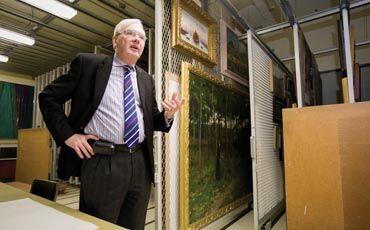

In a second floor corner office perched above University Avenue, M. Russell Panczenko, director and chief curator at Chazen Museum of Art, overlooks the dusty beginnings of what will become the museum’s adjoining building in an expansion scheduled for completion in 2011. Behind his desk, the walls bulge with renderings of the project for which Panczenko has been lobbying for years. To him, it’s a fulfillment of a dream.
Panczenko was hired by the Chazen, a nonprofit organization, in 1984; in his own words, his primary responsibility is to “preserve art for future generations.” In addition to running the museum, he is trained to recognize art, locate it, contact the collector — not always an easy task — then negotiate an arrangement either to purchase or to donate to the Chazen’s permanent collection.
This is a long, relationship-building process that often keeps him on the road. Collection owners are found through historical auction documentation, art shows, family estates, or simply after conversations with others in the field. Panczenko works with other museums as well, always striving to keep Chazen exhibits interesting and fresh.
The museum’s “flow” is carefully designed, displaying art chronologically from Greco Roman artifacts to modern times. A web of galleries along the way hold permanent or temporary collections, with each individual sculpture, painting, photograph, or textile strategically placed in relationship to those around it.
One particular piece, “Albany 7B,” was recently added to an upstairs gallery. To the layperson’s eye, it resembles a flat piece of yellow metal that was jigsawed into a nondescript shape. Perhaps sensing our reaction, Panczenko remarks, “There is a difference between liking something personally, and recognizing its quality.” Then he adds, “This piece is worth $3 [million] to $4 million.”
Say what?
Several factors determine the value of a piece of artwork, he explains. Namely, the age, the quality of the work, and of course, the artist — in this case, David Smith — and his cultural “milieu.” How important was he at the time he lived? How influential was his work? Panczenko studies the Albany piece with the precision of a surgeon. “[Smith] was playing with colors and shades, here. Really experimenting,” he says. The fact that the artist was recognized as a foremost talent in his day, as well as the condition and uniqueness of the piece, drives its value.
Albany 7B is one of more than 18,500 objects held at the Chazen Museum of Art, though only 4% (800 to 900 items) are ever on display, another reason Panczenko eagerly awaits the new wing. Some items, such as the museum’s collection of 4,500 18th to 20th century Japanese works on paper, will never go on permanent display, he says, because of their age and the risk of damage. In pristine condition, a Japanese print could be valued at $150,000, but only a couple hundreds of dollars if marred by human hands or other factors. To protect the museum’s collections, Chazen’s indoor environment is monitored year-round, hovering between 68 and 72 degrees with 40% to 50% humidity.
Basement storage rooms protect the balance of the Chazen’s collections. In one, paintings hang on sliding, movable racks much like carpets in a retail store. All of the Chazen’s artwork is either donated or funded through financial gifts or endowments, and Panczenko never knows from where the next request or donation will come.
In 1993, for example, a local couple simply dropped by his office one day on a mission to make a significant gift to the museum. Suddenly, Panczcenko was thrust into a very short, 30-day timeline and charged with locating an extraordinary statement piece. After repeated trips to New York, Switzerland, and England, he narrowed his choice to a Bernardo Strozzi painting he found in London — Christ’s Charge to St. Peter, which dates back to 1630 — from a dealer who owned it for 50 years. The Madison couple liked the choice, and their $1 million gift, prominently displayed at the Chazen, is now worth eight times as much, according to Panczenko.
The Chazen has an operating budget of $2.8 million (including about $200,000 to $300,000 earned annually from endowments) which allows for acquisitions, educational programs, publications, and more importantly, the ability to host about 10 temporary exhibits and four larger-scale shows each year. Exhibit preparations begin as much as 18 months in advance, depending on size, during which all details are planned — from shipping, to designing and mapping floor space, constructing walls, pedestals and mounts, and marketing.
With 15 employees and an art collection worth well over $100 million, the museum’s funding comes from a variety of sources; among them, the University’s College of Letters and Science, various grants, and the private sector. Fund-raising plays a significant role as well.
Still, Panczenko says the museum’s greatest advantage is its ability to attract major art from a large network of passionate UW alumni.

