

The recession has many printing clients pulling back. Publishers are ordering fewer advertising pages, which impacts printers. Bulk mailers are placing more of an emphasis on mailing list niches instead of volume, and catalogers (slammed by postal hikes) are cutting back. Most of the all-important youth market would prefer to receive content online, and the migration of content to non-print alternatives continues.
On the vendor side, the rising cost of paper has impacted printers, publishers, and catalogers, alike. Incremental increases in postage impacts printers – every time postage goes up, mail volume goes down – and fuel cost surges added pain, too. Then, the larger clients (huge publishers) are slower to pay.
John Berthelsen, president of the Waunakee-based Suttle-Straus, said, “I was just at a Printing Industries of Wisconsin board meeting, and the general feedback we’re hearing industry wide is that this [economy] hasimpacted the industry more strongly than at any time probably since the Great Depression.” Another source (wishing not to be identified) advised IB that it’s likely a 30% average drop in revenue for area printers.
Double-Sided Squeeze
While acknowledging the cost pressures, industry officials note that they have some arrows in their quiver.
Royle Printing of Sun Prairie has a diverse client base, with approximately 85% of its business coming from outside the state, but its sales projections are off by about 10% to 12%. The rising operating costs it has experienced doesn’t necessarily translate into offsetting higher prices for print jobs. From an internal cost standpoint, President and CEO Chris Carpenter said Royle’s per-thousand charge today – whether it’s for a 24-page or a 48-page job – is probably less than it was five years ago. [Though publishers’ print bills have continued to rise due to inclusive pre-press, paper and postal hikes].
“We’ve had to try and offset some of these other increases because at the end of the day, people just don’t want to pay more for goods and services,” Carpenter said. “It has really forced [printers] to get creative and make certain that we’re as efficient as possible.”
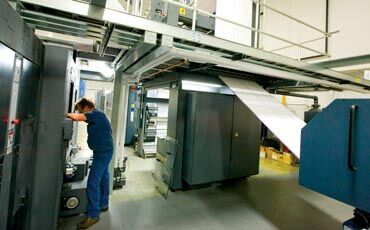
One example is Royle’s new press, which allows the company to do more with less energy consumption, less waste, and considerably less labor, Carpenter said. The company has invested $10 million in the new press, ancillary equipment to support the press, and a new building expansion.
“There is a ton of automation on the press, from changing blankets to the product that gets delivered off the press,” Carpenter explained. “We will run this press with 40% less labor, and while we’re doing that, it’s highly efficient compared to older technology. So what may have taken us 2,000 impressions to get to color that would be acceptable to a client, we might be able to do that in 60% of the impressions.”
Another way to cope with the recession is somewhat counterintuitive – continue to actively invest in marketing and advertising. Suttle-Straus’ Berthelsen said it’s important to continue a strong marketing program to stay in very close contact with customers and to explain the company’s value proposition. “Studies will show that the worst thing you can do in a down market is cut back on your advertising and marketing,” he explained. “We subscribe to the philosophy that you should maintain or even increase your marketing and advertising in a down economy, and that it will pay off for you.”
Going Postal
Although postal rates go up more frequently than they once did, they now are pegged to the Consumer Price Index. In the past, rate increases would be higher but would hold for two or three years. “Now what you’ll see is an adjustment every year as the United States Postal Service looks at their costs,” Carpenter explained.
Carpenter can’t envision the postal service deviating much from the CPI, but printers did gain a small victory recently when, after an industry uproar, the postal service decided to forgo a planned rate increase. “Nice to see that someone is listening because it certainly would have been the wrong time to put through a raise in the standard because that certainly isn’t going to incentivize mailers to mail more product.”
While legal reform limits overall postal increases to about the rate of inflation, people don’t realize that certain postal segments can be impacted to a greater degree. “They will say, ‘Well, first-class postage only went up two cents, which is three percent,’ but what they don’t realize is that last year “flats,” which is a huge portion of direct mail, went up between 25 and 30 percent,” Berthelsen explained. “So if you’re a catalog mailer or a bulk mailer that charged mostly flats, your rates went up 30 percent.”
For the purpose of boosting volume, Berthelsen said the postal service would be wiser to reduce the price of postage. “The post office is brilliant,” he said, sarcastically. “They’re losing money, so they raise the rates and they can’t figure out why volume goes down. So they go, ‘We have to raise rates again because our volume is going down, and we’re making even less.’ Brilliant thinking.” Circular thinking at best.
Royle has created partnerships with two companies in Chicago to pool its mail, or “weight.” These consolidators take the mail and pool it with other shippers, and then it gets dispatched to various postal distribution points around the country.
“Doing so expedites the delivery of the mail and it also mitigates the [fuel-related] expense to us and the client,” Carpenter said. “We also co-mail, which means we’re blending mailing lists through these same organizations.
“Those partnerships have been important for us because we can compete on a larger scale with much larger printers.”
Internet: Friend or Foe?
Computer-to-plate, or CTP, helped usher print into the digital era, but the printers that effectively used the Internet – once thought to be the dragon slayer for printers – have emerged as the real digital masters.
“For those that have embraced the Internet, I think it’s been a blessing,” Berthelsen said. “In fact, it’s rather interesting that 10% of my employee base is involved in the information technology area and supporting technology.
“So for a ‘printing company,’ it’s rather interesting that I have that high a percentage of employees that are based in the technology area.
“Now, if you haven’t embraced the Internet, then it’s a different scenario. I think it’s the companies that haven’t gotten into that area that are probably struggling the most at this point.”
For Royle’s catalog customers, the Internet has worked in tandem with print. “Large retailers know that buyers still like to see their products even if they are ordered on the Internet,” Carpenter noted. “If they then try to switch you to a pure Internet play, they see their orders go down, so cross-channel marketing is very important.”
In the digital age, Berthelsen said printers can’t just be printers because a lot of traditional printed products have gone by the wayside. For example, annual reports once were a big product, but very few companies do annual reports anymore. This increases the pressure to find new markets, or fish further upstream by offering new products.
“The majority of our customers come to us today, initially, for a technology solution that’s generally an e-commerce based solution that may lead to a printed product or a fulfillment product or something that gets mailed,” Berthelsen explained. “They don’t come to us because we have a six-color, 40-inch printing press. They come to us based on the technology solution that then leads to a further product or service.”
CTP is in a maturing phase, and is being replaced by computer-to-paper. “In the beginning, that was for relatively short runs and small formats,” Berthelsen said, “but as that process is maturing and growing, it’s getting into longer runs and larger formats. The whole digital revolution in the graphic arts field is going to continue to grow and erode conventional printing.”
An adjunct to CTP is soft proofing, which has largely replaced the contract proofs of pages. “I would say, today, roughly half of our clients don’t have contract proofs,” Carpenter said.
“We have an electronic workflow in place where clients submit files, and within minutes the pages are ripped on our computers, and then a soft proof is sent back to them. It’s a very efficient way to expedite the process, but it’s also driven some expense out of the pre-press side of it.”
While the Internet giveth, it also takes away. Niall Power, president/CEO of the Printing Industries of Wisconsin, is concerned that print customers may look to offshore alternatives, where they can leverage the Internet and lower labor costs. “We recently have been made aware that the Chrysler Corp. sent a lot of their printing to Korea,” he said. “That’s very worrisome.”
For print customers, Power advises being practical and fair when it comes to negotiationing current print prices.
“They have to understand that if a company is to maintain its viability, pricing has to be fair,” he stated. “It is of great concern to us that some customers may be asking the printer to cut pricing to a level that is detrimental to the operations of their print provider.”

