

In today’s business environment, busy executives are often in search of the perfect balance between staying healthy and keeping stress to a manageable level.
Here’s an idea many were already clued in to, but studies now confirm as a healthy antidote: pets.
A preliminary study by the International Journal of Workplace Health Management has found that dogs in the workplace help reduce stress as well as heighten the morale of the dog owners.
Another national study, from the American Pet Products Manufacturers Association, found that 17% of its respondents worked for companies that allow pets in the workplace, and 23% wish they did.
With tight budgets, skeleton staffs, and salary increases on hold, employers may be realizing that allowing pets in the workplace can be an inexpensive way to maintain staff and boost employee morale.
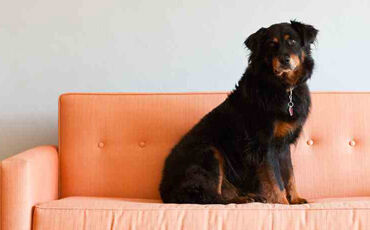
At Cricket Design Works in Madison, it’s clear that Annie, an 8-year old Gordon setter/border collie/chow mix, is considered just another member of the staff. Described as mellow and tolerant, the 50-pound dog is affectionately known as “Miss Annie Pants” or “Miss Pants.” She likes to participate in meetings and is a good judge of character, according to Kristin “Cricket” Redman, her owner.
A sign posted on the front door of the boutique visual communications firm alerts visitors to her presence: “Adorable dog on duty: She has a big girl voice but is really sweet.” Regular visitors, such as the mailman and UPS delivery person, have developed relationships with Annie, and especially look forward to dropping by.
“Annie provides comic relief and is a calming force in the studio,” Redman noted, “and she absolutely helps with creativity. You’re more comfortable, and therefore can be more creative. There are times when she’ll do something that will change your entire thought process, or lead to a creative breakthrough.
“You can’t not be yourself when you’re around an animal,” she added.
Finding a landlord willing to allow pets was an important contingency when Redman was originally looking for office space. “With the hours I work, having a comfortable work environment and a place that feels comfy and homey makes the long hours more tolerable.”
Annie, of course, has it made. She’s never alone, gets two walks a day, plenty of attention, and daily treats from office mates. “At home, we’ve metered down her breakfast and dinner to accommodate,” Redman admitted.
The laid-back Annie contrasts sharply with Izzy and Zoe, two pugs sharing the office and the affection of staff at Schmitt Technical Services, Inc. in Cross Plains. “It would be awfully quiet here if they weren’t here,” says Jim Schmitt, president and owner, who describes his business as “the CSI of construction.” The company has investigated flaws in concrete for the Department of Transportation and even the Panama Canal.
But the man who deals in stone has an unshakable soft spot when it comes to earthly creatures. “I love animals. I had a parrot for a couple of years, and I threaten to build a chicken coop and bring in goats. My kids call me Dr. Doolittle.”
Back in the office, 1-year-old Izzy and 6-year-old Zoe play and snort and brighten the workspaces of all seven employees in a workplace where meetings are virtually nonexistent. “Meetings are for people who don’t accomplish anything,” Schmitt said. “We have seven people [including several family members]. If we can’t talk to each other ….
“We’re a very unusual company,” he admits. “Very loose, very informal. Rules are for people that don’t work, and people who need all that [structure] usually don’t fit in here very well.”
And Izzy and Zoe help with the camaraderie, joining staff members for lunch. “They’re just comedians, really,” Schmitt says of the pugs. “They come into the office every day and have free rein. It wasn’t challenging enough to just have one dog,” Schmitt laughed, adding that the dogs also help reduce stress in the office and are great at breaking the ice, or breaking wind.
“They’re gassy,” Schmitt adds, and then laughs. “There’s nothing that brings a company together like a fresh poop!”
A self-described jokester, Schmitt is dead serious when he says he prefers dogs to people. “They love you unconditionally,” he said. “You just can’t put it into words.” His first pug, Max, is buried on his land.
“I wish I could be as good of a person as Max thought I was,” he said. “That’s what animals do for me.
“Now I’m thinking about a duck … or owls, or maybe getting involved in the rehabilitation of big birds.”
Speaking wolf
John Hecht, president and CEO of WPS Bank in Madison, comes from a long line of dog lovers and breeders. His grandmother once raised show dogs, winning several awards at the Westminster Dog Show in New York. His father was a fan of hunting dogs – pointers and Weimaraners. “We’ve always had dogs,” Hecht said.
Hecht has a 10-year-old German shepherd named Baylee. “I can’t imagine living without a dog,” he said. “I haven’t been without one since I was in college.”
Baylee is a former police drug dog, Hecht explained, which made life in the Hecht household interesting. “Baylee once reacted badly over one of my son’s friends. I told him his friend was no longer allowed in the house.” His friend never returned.
Hecht admits that owning large dogs was one thing, but training them was entirely different. “I thought, because I’d always had dogs, I knew everything about dogs. Turned out, I knew nothing!”
Before moving to Madison, Hecht and his wife had an opportunity to meet Cesar Millan (aka The Dog Whisperer). “We really wanted to talk to him because we really believe he helped save one of our more aggressive shepherds,” Hecht said. “After reading Cesar’s Way, we learned to speak the dog’s language – the language of the wolf pack – and we finally understood what it meant to be an alpha leader, 24/7. It’s been life-changing.”
Hecht takes Baylee out for walks every day, careful that the dog receives exercise, discipline, and affection, in that order. “My dog always walks on my left side. She’s not allowed to walk outdoors without me. I eat first, go through doors first, I tell her where she sleeps and where she can’t. There’s no jerking, just firm authority and leadership,” he said.
Millan’s training techniques have helped Hecht understand not only the human-animal bond, but human relationships as well. “People follow strong leaders,” he said. “You need to maintain that attitude – without puffing your chest. You have to be concerned with the welfare and benefit of the pack.”
“That attitude and training has helped me out in situations where [in the past] I might get nervous and want to shy away. It’s kinda neat,” he said.
On the hunt
Meanwhile, Tom Meyer, broker manager at Restaino & Associates Realtors in Madison, has a pack of his own. His three dogs, Doc, a 7-year old Chesapeake Bay retriever; Buddy, a 7-year old Brittany spaniel; and Max, a 1-year-old Boykin spaniel, accompany Meyer on hunting trips every year.
A waterfowl hunter raised in Antigo, Meyer has spent the bulk of his life hunting. “I got my first BB gun when I was about 6, and my first shotgun by the time I was 10,” he recalled. “I grew up in the woods.” Now, when he’s not transacting a real estate deal, he’s likely on his farm, spending time training the dogs.
“I train them for the types of behavior we need: sitting, retrieving, riding in a canoe, and bringing the bird back,” Meyer said. Each of the dogs also receives additional professional training. Unfortunately, Buddy is gun-shy, so while Meyer takes the other two dogs duck hunting, he uses a camera rather than a gun when training Buddy. “But he hunts and points, too,” Meyer said.
In anticipation of the approaching duck season, Meyer is working to refresh the dogs’ memories. “We’ve been working with quail and dummies, throwing and retrieving,” he said. “I’ll be taking Max up north soon to get him familiar with where we’ll duck hunt. I want him to be familiar with the area. It does help,” he said.
Meyer said there are several ways to train dogs, but he uses a combination of patience and attention. “There’s no yelling. It’s about being focused and giving them attention, and understanding that they have a mind of their own and they want to do their own things, too. It’s no different than working with clients,” he said. “You can’t force anything.”
Meyer said the most important aspect of dog training is connecting with an animal that has a mind of its own. “You can’t control everything,” he said. “Those dogs, just like humans, have ambition, plans, and ideas of their own, and they don’t always mesh with mine. I have to work on their timeframe.”
Working so closely with his canine companions has helped Meyer communicate more effectively overall. “I can give a wrong message to a client with my body language, just as I can a dog. It helps me be aware of the messages I’m sending.”

