
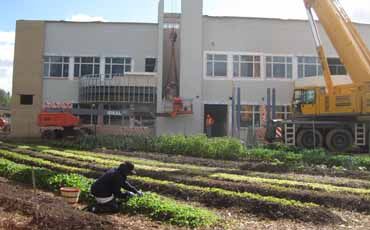

For someone who’s leading one of the most imaginative and innovative construction efforts in the state, Kate Stalker has seized on an unusual keynote, taken from a Walt Kelly comic strip character who preceded her ambitious project by a full 70 years.
“We have been so extremely fortunate, and I’m always reminded of that Pogo quote, ‘We are confronted with insurmountable opportunities,” said Stalker, the project director for the Resilience Research Center (RRC), which is transforming a blighted south Madison neighborhood (complete with a vacant school building) into a neighborhood support center, urban agriculture hub, and project-based charter middle school. “That is the quote of this building. It has been that way from day one.”
The Resilience Research Center, which is slated for a May 1 completion date, touts itself as a “multigenerational neighborhood hub for socializing, learning, training, research, and healthy, resilient living.” Part and parcel of that mission is creating spaces that are truly on the vanguard of sustainability and good environmental stewardship.
Indeed, in an age when environmental and social challenges continually grab headlines, Stalker seems effortlessly to be going against the grain – gracefully pairing “insurmountable” and “opportunity” in a way that appears to defy Kelly’s whimsical oxymoron.
Perhaps the most ambitious part of the construction effort involves the project’s LEED certification, which could make the center an international bellwether. For one thing, the center will use approximately 57% less energy than a standard commercial building.
“We began by making a vow to try to be the highest-rated LEED platinum building in the world, and that goal informed every decision we made throughout the process,” said Stalker. “So we began with that, and to the best of my knowledge the highest-rated LEED building in the world is in Turkey at 96 points, and we are on track to achieve 102 points if all goes well. The highest-ranked LEED building in the country is 95.”
“We began by making a vow to try to be the highest-rated LEED platinum building in the world, and that goal informed every decision we made throughout the process.” – Kate Stalker, project director, Resilience Research Center |
Dubbed as a “living laboratory,” the RRC will be the first facility of its kind in the nation, featuring a learning center that offers job training and middle school education; an intensive urban agriculture center; a neighborhood center; and mixed-use services that could include a coffee shop, market, or other businesses. The center will also be evaluated by a team of researchers led by Dr. Michael Bell, professor of community and environmental sociology at UW-Madison.
One of the focal points of the center will be the Badger Rock Middle School, which will feature project-based, hands-on learning and will allow kids to pursue the study of food growth, science, energy, and water use.
Of course, if there is an environmentally friendly stone that the project’s planners have left unturned, you’d be hard-pressed to find it. Everything from storm water management (rainwater from the building’s roof will be stored in underground tanks larger than school buses) to transportation (the front door will face the bike path instead of the street) is addressed.
Indeed, one feature is oddly reminiscent of Willy Wonka’s chocolate factory – if Wonka were more concerned about healthy eating than hawking candy.
“Our landscape plan is unique in my lifetime,” said Stalker. “Every plant on this site is edible. So in the city of Madison, we have planting requirements, it’s called buffer yard. It’s 10 feet between the city sidewalk and the building, the first 10 feet around the property line. … And we have to meet these requirements with a combination of trees, shrubs, and ground covers. But in this plan, those are fruit trees and blueberry bushes, and raspberries. So we’ll have cherries and apples and pears, and all different kinds of fruit, and then ground covers might be things like strawberries and rhubarb and cranberries.”
The business community’s vital contribution
It’s an ambitious project, to be sure, but it’s been guided along by a group of equally ambitious business partners.
That starts with the project’s contractors, led by general contractor Bachmann Construction.
“Our subcontractors are all very astute with regard to the LEED requirements, but we have asked each of them to rethink the standard ways of performing their work, and it’s been wonderful,” said Stalker. “We’ve really looked to them to provide us with solutions to things that they know about, and they’ve been great coming back to us, saying, ‘What if I did this? Maybe I could try this, maybe I could try that.’
“Unlike most developments where people really want to succeed in everything they do the first time, we are willing to take risks and measure the results to see if it was worth the risk we took and if in five years some of the technologies we installed may be obsolete – and the building has been designed and constructed so that’s it’s easily adaptable to new technologies.”
MG&E is also a major sponsor, donating PV panels for the roof and demonstrating a range of approaches to green, energy-efficient design, while other businesses have stepped up seemingly out of nowhere, contributing in unexpected ways.
“The business community has been really supportive,” said Stalker. “Physicians Plus has given the school some furnishings. Summit Credit Union, our neighbor down the street, has been absolutely wonderful to work with, donating a room in their building for us to have meetings, and they’ve offered to teach classes in the neighborhood center and with the school in how to work Excel spreadsheets, and do personal money management and investment. They’ve offered to give each of the children and the people in the neighborhood center $10 to invest, and they’d work with the kids over the course of the year and see how their investments have turned out.”
One of the more remarkable stories surrounding the project’s development involves the resourcefulness of both the project leaders and a local developer.
“We were told by our general contractor that Gorman & Co. had just purchased a middle school in Milwaukee, the Jackie Robinson School, and they were going to turn it into senior housing, so I made some phone calls to the company and they allowed us to come in for four days and harvest whatever we could take out of that building,” said Stalker. “So we got all of our signs, tables, we got all our chairs we need that are middle-school-sized chairs, we got overhead projectors and movie screens and large school maps and some science books and all sorts of things. It was wonderful.”
Of course, the energy and enthusiasm going into the project stretches beyond the business community into the community at large – and it promises to touch everything from the social landscape to the economy to the environment.
“The big component, the first and most important component, is social resilience,” said Stalker. “Through the community gardens and the sharing of food and the community kitchen and the neighborhood center, we are hoping to create a social resilience in that neighborhood that helps carry through in terms of personal finance, and people knowing their neighbors and helping their neighbors out in tough times and sharing food and recipes and cultures. And until you have economic and social resilience, you can’t have environmental resilience, because the environment is always the last thing people care about when they don’t have jobs or food or neighbors.
“So it’s a really exciting facility with so many components and so many opportunities, just like Pogo said.”
Sign up for the free IB Update – your weekly resource for local business news, analysis, voices, and the names you need to know. Click here.

