
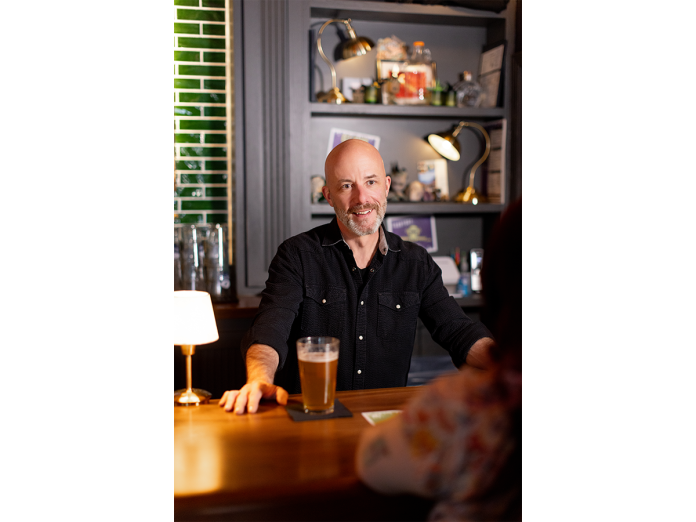

Otto Dilba, the co-founder of the now-shuttered Ale Asylum microbrewery on Madison’s east side, has carved out his own slice of Madison’s pizza scene as the owner of Molten Monkey, a moody “pizza lounge” tucked into the former home of Salvatore’s Tomato Pies on East Johnson Street.
The restaurant’s opening in December 2024 marked a new career chapter for Dilba, who closed Ale Asylum in 2022 after 16 years and sold the rights to brew and sell its products to another Madison brewery, Karben4.
Having worked in restaurants throughout his early career, Dilba is accustomed to the industry grind, and the self-proclaimed perfectionist said he has always been focused on creating and achieving at the highest possible level. Equally important, however, is the opportunity to feel connected to the neighbors and businesses in the community.
As Dilba reflected on a career of headline-worthy accomplishments, and looked ahead to a future focused on a thriving Molten Monkey, he also acknowledged that excellence comes with a price, and work-life balance is crucial.
Did you always dream of opening a pizza spot?
No. In fact, before I did this, I had never baked anything in my life. I just had a lot of different industry experiences in a variety of restaurants. After the close of Ale Asylum, and after what was just a very personal tragedy beyond the closing of the business, I needed to keep my hands busy.
Many years before, my friends had introduced me to this style (of pizza). They were from Detroit, three of my friends, and I remember thinking, this is so unique. It’s not Sicilian, it’s not Neapolitan, it’s not New York — it’s just so different.
I just wanted to sink my teeth into something. (It was) hundreds of hours of research, and then just starting to make dough in my kitchen, working on making pizzas — terrible iterations — this dense brick that nobody would ever want to eat.
Eventually, those guys and some other people were over for a party, and I made some of the Detroit-style pizzas that I had been working on, once I had gotten them to a better level … and these guys were like, “Otto, this is better than a lot of the stuff that we get in Detroit. If you wanted to make a go of this, you might be able to.”
After what I refer to as “the world’s worst sabbatical” — the business closing, tragedy — a lot of reflection led me to the phrase, “Say yes more.”
What was the transition like from Ale Asylum to Molten Monkey?
The size and scope (was different), first and foremost. At certain points, Ale Asylum had a multistate distribution, a 45,000-square-foot facility, 40-foot ceilings. At the height of production, we had 55 employees, give-or-take. The bar-restaurant had a capacity of 300.
Now, in this place (Molten Monkey), we’ve got 22 total seats. It’s very small. I said, “If I ever do something in this industry again after Ale Asylum, I want it to be small, cozy and manageable.”
It’s the perfect spot. This has long been my favorite neighborhood in Madison. There’s a lot of great neighborhoods … but what I like about this one (is) it’s a mix of all the different people that live in other neighborhoods.
You’ve got all age ranges. This is totally stereotypical, but easier for terminology’s sake: You’ve got your hippies. You’ve got your young business professionals. You’ve got your grad students. You’ve got your people who have lived in this neighborhood for decades because they love it so much.
Not to mention the amazing mom-and-pop businesses here. All of those things — the eclectic nature of the people, of the businesses — you don’t even need to leave the neighborhood to get everything that you need.
It’s funny, Lennon, one of the managers next door at JPH (Johnson Public House) … said, “I’m convinced that dollars don’t leave this neighborhood. They just get transferred from business to business.”
With Molten Monkey running successfully, where do you go from here?
(I’m) definitely focused on maintaining what we’ve got going on here. People have asked, “Are you going to expand?” I’m like, “Point me in the direction I can expand this building. That’s not an option.”
There’s a possibility of potentially other locations down the road, but they would have to be an environment of this nature. I don’t think I’d ever do a mixed-use (building). There’s an energy and a vibe that we’re going for. It’s very warm, it’s very cozy, it’s small, it’s inviting. If you’re in here on a snowstorm night … and it’s dark out, it’s a pizza lounge.
I’ve also got ideas for different events, working with other pizzerias: Patrick (DePula) from Salvatore’s (Tomato Pies) — not that he’s not busy enough — Alessandro (Monachello) at It’s Good for You Pizza — outstanding pizza. I haven’t spoken to them yet, but one of my favorite pizzas in Madison is Greenbush on Regent Street.
We all have our own style, our own attitude toward our style of pizza, toward the industry and life itself.
I’m not trying to do that much more than what we’re doing. I’ve done the expansion thing. I’ve done the multistate thing. I’ve done all of that. At this point in time, I just want to do good things for the community. I truly do.
What have been some of the guiding tenets of your career?
Mediocrity is for other people. I have no interest in that. Now, if somebody doesn’t think we’re excellent, I can appreciate that. All opinions are welcome, but be damn sure that we’re striving for it.
We’re not just trying to put out a pizza or have a decent beer on tap, or whatever the situation might be. (I’m) truly never wavering from that goal of achieving excellence. It’s really rare to achieve it, and I don’t know that we’ve achieved it here yet, but you’re never going to get close if you don’t aim for it.
If you started your career over again, would you do anything differently?
Yeah. My hyper-focus on the success of the business — and at a certain point on, Ale Asylum — cost me dearly, personally. So, balance it.
I never had kids, didn’t want kids, so that was easy enough, but still. Even though there’s a lot of work to be done, I think I could have had a better work-life balance.
There was a stretch of a few months where I was working 120 hour weeks. (I got) hardly any sleep, clearly, but I knew that the end would come with that time. And it was a necessity because we didn’t have enough people and couldn’t find good people — the good people that we have now.
I knew that I had … people that were coming on board that were amazing, fantastic, so doing it for a little bit of time (was necessary). Now, I still put in plenty of time, but not the crazy hours that I did back at the brewery, and certainly not the crazy hours I was doing when I started here.
I cannot stress enough: If you can be really focused, that work-life balance thing is probably the biggest. But, (I also go) back to the whole (idea), if you’re not shooting for excellence, what are you doing? I’m going to put in this hour of work either way. Why not just make it as good as I possibly can?
The work-life balance thing? I don’t think anybody ever feels like they get it right.

