
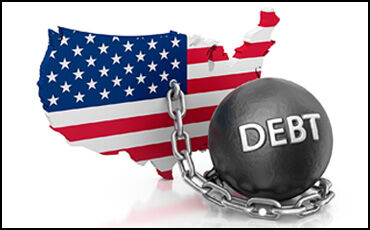
We’ve all seen the national debt clock, that menacing piece of machinery that now reads about $16.5 trillion – and counting. We’re told that left unchecked, the mounting national debt will lead to economic calamity, but is this a legitimate concern or just the latest tool for politicians to “never let a good crisis go to waste”?
Why should we care about the national debt, which is the accumulation of all annual deficits? Are the warnings of a “debt crisis” really something to care about, or are public officials like Wisconsin congressman and former Republican vice presidential nominee Paul Ryan, who has been most vocal in sounding the alarm, frightening us unnecessarily?
In this look at the national debt, which has been fueled by $1 trillion annual federal budget deficits, IB looks at the threat posed by our debt, how a debt crisis would unfold, and what the consequences would be.
This article is not meant to pass judgment on the solutions offered by either major political party, but to explore the consequences for not effectively addressing it.
Where we stand
A recent Government Accountability Office audit report put it bluntly: absent changes, the federal government “continues to face an unsustainable fiscal path.” Some viewed the GAO report as a wake-up call, others greeted it with a yawn.
The Congressional Budget Office also chimed in with its latest fiscal report. The CBO predicts that economic growth will remain slow this year, yet if the current laws that govern federal taxes and spending do not change, the budget deficit will shrink this year to $845 billion, or 5.3% of gross domestic product (GDP), its smallest size since 2008.
After this year, the CBO expects economic growth to speed up, causing the unemployment rate to decline and inflation and interest rates to eventually rise from their current low levels. In the CBO’s baseline projections, annual deficits will continue to shrink over the next few years, falling to 2.4% of GDP by 2015, but they are projected to increase later in the decade due to the pressures of an aging population, rising health care costs, an expansion of federal subsidies for health insurance, and growing interest payments on federal debt.
As a result, over the next decade, federal debt held by the public is projected to remain historically high relative to the size of the economy. By 2023, the national debt will reach $26 trillion if current laws remain in place, the debt will equal 77% of GDP, and it will continue on an upward path.
The ratio of gross debt (all debt a government owns, including debt in government trust funds) to gross domestic product is another way to evaluate indebtedness. A study done by Harvard University economists Kenneth Rogoff and Carmen Reinhart, authors of This Time Is Different: Eight Centuries of Financial Folly, presented empirical evidence that gross debt exceeding 90% of GDP has a significant negative effect on economic growth. In 2011, America’s gross debt was over 100%.
However debt is measured, the CBO says the annual size of the budget deficit “will eventually require the government to raise taxes, reduce benefits and services, or undertake some combination of those two actions, just to cover interest payments. Last year’s interest payments on the debt totaled $360 billion, but those payments could reach $1 trillion by 2017.
When America owed the debt to itself, there was less concern about its sheer size, but now that foreign interests own roughly half of it, many believe the nation is more vulnerable to a debt crisis.
President Obama has called for a balanced approach, which implies new revenues and spending discipline, while Republicans have focused on the spending side, particularly entitlement spending on programs like Medicare. There is universal agreement that health care costs associated with an aging population are the main driver of the debt – hence the passage of the Affordable Care Act, under the promise that it would bend down the cost curve over time, and the introduction of Congressman Ryan’s Path to Prosperity plan to reform Medicare.
Economists make a distinction between cyclical, short-term deficits and structural deficits over the long run. Jim Glassman, a senior economist with JPMorgan Chase, told IB the real issue in the U.S. is not the current deficit, because that’s a result of the lower tax collections and stimulus spending associated with the recession and slow-growth economy that followed.
The real issue, he said, is that federal spending for health care is expected to go from 14% of GDP today to 25% in the next several decades, meaning the size of the government would double “if we don’t do anything.”
“The real fiscal issue that we face in the U.S., and frankly most countries, is the long-term outlook for federal health care spending. It’s on an unsustainable track,” Glassman said. “That’s a structural problem.”
What happens in a debt crisis?
Congressman Ryan contends that excessive debt causes uncertainty about long-term government sustainability, and already serves as an economic drag because businesses and investors make decisions on a forward-looking basis, and they know that today’s long-term debt leads to tomorrow’s tax increases, higher interest rates, or inflation.
In his Path to Prosperity plan, Ryan writes that the first sign of a debt crisis is when bond investors lose confidence in a government’s ability to pay its debts. By that point, “it is usually too late to avoid severe disruption and economic pain,” he asserts.
For now, the U.S. can borrow at historically low interest rates because of Fed policy and because the bonds of most foreign countries look even riskier, but neither of these conditions is going to last. “Interest rates – and the burden of paying interest on the debt – have nowhere to go but up,” Ryan warns.
Interest payments already eat about 10 cents of every federal tax dollar, but as interest rates rise from today’s historically low levels, they will add to the debt. Under the most optimistic rate scenario, Ryan says interest payments are projected to devour more than 15% of all tax revenue, or one in six tax dollars, by 2022.
Since the U.S. now relies more on foreign creditors – they own roughly half of all publicly held American debt – the nation finds itself more vulnerable to a sudden shift in foreign investor sentiment, Ryan cautions, “particularly in a time of crisis.”
“If the Congress continues to put off difficult choices regarding the nation’s long-term problems, foreign investors will re-evaluate the creditworthiness of the United States and demand higher interest rates,” he states.
In Ryan’s view, the economic impact of an American debt crisis would be far worse than what the country experienced in 2008. He notes that no other entity is large enough to bail out the U.S. government; absent a bailout, the only solutions to a debt crisis would be truly painful: massive tax increases, sudden and disruptive cuts to vital programs, runaway inflation, or all three.
Ryan further warns that this could cause stagflation (economic stagnation mixed with higher inflation) and create a huge hole in the economy that would be exacerbated by panic, and the resulting higher interest rates on government debt would translate into higher rates for mortgages, credit cards, and auto loans.
Digging a hole to China?
That’s not a pretty picture, but not everyone agrees that a debt crisis is on our doorstep. Marilyn Holt-Smith, founder and senior portfolio manager for Holt-Smith Advisors, does not put a high probability number on the scenario outlined by Ryan. She notes that foreign investors could choose to move their investments to markets other than the United States, but it would be a costly move for the foreign investors as well as the U.S. To move out of U.S.-based investments, foreign investors would need to sell their dollars and convert into another currency.
“This could, if done in a massive way, cause the dollar to drop in value because it would also force other currencies to move higher and make it expensive to change rapidly,” she stated. “A rapid change could happen for political reasons in an extreme case, but it would be difficult to justify for economic reasons.”
In Holt-Smith’s view, a more economically devastating scenario would be for the dollar to lose its status as the world’s reserve currency, but even that scenario is unlikely.
As she notes, China has accumulated a significant portfolio of U.S. investments and is the largest foreign holder of U.S. Treasury securities. Moreover, China continues to sell more products here than U.S. companies sell to China. As a result, China has a surplus of dollars that needs to find a (usually) safe haven to be invested and doesn’t want all that money converted to their own currency because it would cause their currency to rise in value, making China’s products more expensive on the world market. China netted a $290 billion trade surplus with the U.S. through November 2012, and it had a $295 billion trade surplus for the full year of 2011.
While China has periodically expressed displeasure with the United States’ handling of the debt, Holt-Smith noted that it’s in China’s best interests to have a stable, growing U.S. economy, and any American political infighting over the ongoing deficits are perceived as disruptive to trade. “They have been critical of the Federal Reserve’s easy monetary policies, as they anticipate the policies will lead to higher U.S. inflation or a weakening of the dollar value. Either would lead to a reduction in value of China’s U.S. holdings.”
The dollar is the world’s reserve currency and “we have benefited from that role,” Holt-Smith added. “Although deeply entrenched as the reserve, there is some movement to create an alternative to the dollar, and a U.S. debt crisis and potential credit downgrades can spur the impetus to change.”
For example, Russia and China have agreed to trade oil and natural gas directly without converting to dollars. If further steps are taken to bypass the dollar as the reserve currency, Holt-Smith said it ultimately would become more difficult to finance U.S. debt and interest rates will rise, increasing the costs of the debt to American taxpayers.
These actions would take years to have a major effect, but if the U.S. remains a heavily indebted nation, the future effects could be expensive and the economy could become more vulnerable to outside shocks. “We could be there down the road, but it would take quite a while before we could be replaced as the world’s reserve currency,” Holt-Smith said. “The advantage of being the reserve currency is helping us through this whole situation of having a high level of debt. It’s kind of a macroeconomic situation, as opposed to, ‘Oh, China is going to pull the plug.’ That’s not likely.”
Sara Walker, senior vice president and investment officer for Associated Trust Co., believes the Ryan scenario is a possibility, but not a probability. She also believes that Washington does not respect the latitude the dollar’s status as the world’s reserve currency gives us, a status that could be threatened if economic rivals gain in strength. “Numerically speaking, we can’t lose our reserve status,” she said, “just yet.”
Walker noted that one of the concerns about high debt, which requires high government borrowing, is that private-sector borrowing will be “crowded out,” but that doesn’t seem to be happening. The biggest impact the debt appears to have on the current economy is that it adds to the uncertainty for employers, causing them to hold back on hiring.
Rate environment
Business appetite for debt waned during the recession, especially as the private sector focused on deleveraging. As businesses regain their animal spirits in a low-rate environment, the future cost of borrowing is the main reason they should worry about the possibility of a debt crisis.
Ed Maginot, Wisconsin tax practice leader for Grant Thornton, said the attention paid to highly indebted European nations such as Greece, and the austerity they now face, has elevated debt concerns in the U.S. However, the U.S. is not as vulnerable because current restrictions on vast natural resources – oil and natural gas among them – could be lifted in the event of a debt crisis.
Nevertheless, Maginot said the national debt is on the radar for most businesses because the suppressed interest rate environment can’t last forever, and that would impact future borrowing costs. The concern is that at some point the Fed rate could go up significantly, as it did in the stagflation era of the late 1970s, and businesses with adjustable-rate loans or lines of credit, or fixed-rate loans that become adjustable or “floating” at some point during the term of the loan, are vulnerable to cost spikes. “Businesses with debt are tied to the rate the government charges,” Maginot noted. “If that were to double or even triple, they know their rates will get adjusted.”
With assurances from the Federal Reserve that rates will remain at historic lows through at least mid-2015, business clients view the possibility of spiraling interest rates as more of a long-term threat, said Gary Schaefer, commercial bank group leader for Associated Bank. However, they keep their eye on the rate environment because they know it could impact the cost of borrowing and therefore business planning.
Schaefer said that if banks can negotiate a variable rate, and customers are willing to take that interest rate risk, banks “can protect some of our spread” in a low-rate environment where margins have been squeezed. “We’ve witnessed more fixed or variable loan terms, but the advice we’re giving our business clients is to hedge it just a bit,” Schaefer said. “In some cases, a lot of our customers are taking a look at very low long-term rates and locking them in for seven to 10 years on a portion of their borrowing, and they might float another portion of that borrowing as part of a hedging factor.
“In some cases, we’re seeing companies lock in 60% to 70% of the debt longer term, and then floating the rest of it.”
More fiscal battles ahead
The fiscal cliff deal is expected to raise about $600 billion in new revenue over 10 years, but it also includes new spending. Rather than create more economic uncertainty in a showdown over raising the debt ceiling, congressional Republicans have opted for a strategy of short-term extensions and passed a debt-ceiling bill that withholds congressional pay if the House or Senate fails to pass a budget by April 15.
But whereas President Obama had more leverage in the fiscal cliff deal, Republicans appeared to gain more leverage in the latest budget battle involving sequesters, those unpopular, automatic spending cuts in defense and discretionary spending that were scheduled to take effect March 1 (before this edition is mailed) unless other cuts are negotiated.
The GOP has signaled more willingness to endure defense cuts in return for this “down payment” on the debt, and more battle lines will be drawn on March 27 (when a continuing resolution on the budget expires), in deliberations over the 2014 fiscal year budget, and after the latest three-month extension of the debt ceiling expires.
The automatic cuts were part of the 2011 Budget Control Act, and were incorporated with the belief that the sequester would be so painful that it would force both parties to take a more holistic approach to fiscal discipline. By the time IB readers pick up this magazine, we’ll know if the sequester had its intended effect.
However these budget battles unfold, most of our experts expect the fourth-quarter dip in GDP to be temporary or revised upward as more data are collected. Still, there is an optimism gap between investors, whose glass definitely is half full these days, and business owners, whose outlook is considerably dimmer.
Nathan Brinkman, president of Triumph Wealth Management, said the biggest debt-related concern of Main Street business clients is the possibility of even higher taxes that could stifle growth. “Where people get upset is they are trying to manage their personal finances and their businesses finances,” Brinkman said, “and then they look at the government borrowing to cover more than 40% of its costs.”
Sign up for the free IB Update – your weekly resource for local business news, analysis, voices, and the names you need to know. Click here. If you are not already a subscriber to In Business magazine, be sure to sign up for our monthly print edition here.

