

Environmentalists and businesspeople are clearly not always on the same page when it comes to our nation’s and our state’s future. No one knows that better than the players involved in the recent Gogebic Taconite mining proposal, which was shelved after the state Legislature failed to pass a bill that would have cleared the way for the mine.
But while the interests of industrialists and enviros have often clashed in the past, many folks on both sides of that once-yawning divide are increasingly seeing the value in establishing partnerships that can help forge a more promising future for the planet.
Witness the recent expansion of Monona’s Aldo Leopold Nature Center (ALNC).
Not only did the center partner with numerous local businesses, which lent financial support and expertise, it has also embraced a high-tech, hands-on approach to environmental education that is sure to wring the anti-techie instincts out of even the most dedicated of Luddites.
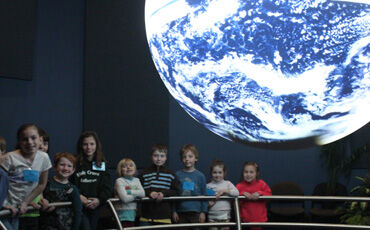
Indeed, high-tech is the driving force behind the ALNC’s new Climate Change Classroom & Interactive Laboratory, which promises to supplement the wonder of nature with a “wow” factor of its own.
“Traditionally, environmental education has been taught in the outdoors, which is what we do; it’s a very effective way to teach people how the natural world works,” said Kathe Crowley-Conn, president and executive director of the Aldo Leopold Nature Center, which will host a grand opening celebration for the Climate Change Classroom from 11 a.m.-3 p.m. April 21. “We’ve come to a stage, though, where there is a lot of science and other kinds of abstract concepts and global connections that are probably best taught using new educational technologies.
“So we are looking at supplementing the traditional programs we do with some high-tech approaches, and illustrating things that we can’t teach in the outdoors. … We’ve found that there are certain technologies that do that beautifully, and they really help students and visitors understand what they’re seeing here locally, and making the connections either in terms of how it works or how it impacts other parts of the world.”
The exhibits that comprise the center’s new expansion offer an impressive mix of educational tools geared toward hungry minds. They include the following:
- Kids’ Climate Cast
, a green-screen, high-definition immersion experience that features simulated weather and climate systems and explains how the user’s changes to weather and climate affect the planet.
According to Crowley-Conn, the center’s focus on marrying cutting-edge technology with traditional environmental education is innovative.
“This is pretty new,” said Crowley-Conn. “We were one of the first to kind of look at, ‘how do you combine what’s going on in the outdoors with some of the new educational technologies?’ So we actually have students who are going outside exploring, they’re taking soil samples, they’re measuring air quality and temperature and then coming inside and kind of looking at that data as it relates to other things that are connected.”
Powering education
MG&E’s contribution to the expansion was among the most significant. The company installed its largest photovoltaic array in its service area on the center’s roof, and sees plenty of synergy with the ALNC’s goals.
“Actually, we believe we are very natural allies,” said MG&E CEO Gary Wolter. “For years, MG&E has been promoting energy efficiency, conservation, and renewable energy to our customers. We have installed solar photovoltaics on all of our area high schools and in public locations like the zoo, the state Capitol, and the Goodman pool, and the solar PV on the roof of the [Aldo Leopold] center is just our latest project to help educate our community on renewable energy.”
According to Crowley-Conn, many local businesses stepped up, in both large and small ways, to help make the center a reality. For example, Sergenian’s repurposed extra or used carpeting for the project, and All-Color Powder Coating in the village of Oregon donated painting services for some of the center’s features.
“In talking to them, the reason [All-Color] told us they were so interested is they put a lot of thought and effort into making their whole production much more energy efficient, and really recapturing lost energy,” said Crowley-Conn. “So something like that, where every time I go out there, I am aware of their donation and what they’re doing back at their own factory and at their shop, I think those are the stories that are nice to share.”
Indeed, Crowley-Conn said that the center will not only educate people about the environment, but could help serve as an example when it comes to sustainable construction and energy efficiency.
“Yes, part of our mission is to show the green building and the things that you can do, and how our community is pulling together on it.”
Great minds
In addition to the extensive list of private partners – which includes Weather Central (which provided meteorological technology), Design Structures, Hewlett Packard, Terra Engineering, Foley & Lardner, Sub-Zero/Wolf, Epic Systems, and more – numerous public entities have contributed to the center’s expansion.
In fact, the largest new installation is Global Warming: Facts & Our Future, an almost $2 million exhibit that was developed by the National Academy of Sciences and represents the leading scientific thought on the science behind climate change. According to Crowley-Conn, ALNC was chosen as the site for the exhibit because of the center’s high-tech, cutting-edge approach to environmental education and its positive relationship with the community.
The center also drew on the expertise of educational institutions such as the UW Department of Atmospheric and Oceanic Sciences, the UW Nelson Institutes Center for Sustainability and Global Environment, Madison College, and the State Department of Public Instruction. In addition, the Madison Community Foundation and the state DNR were key to the launch of the project.
Jon Martin, chair of the UW Department of Atmospheric and Oceanic Sciences, said the interactive nature of the center really allows science to come to life in a way that it simply can’t through staid and static textbooks.
“You can go in and investigate some things and really ask some basic questions and say, ‘Well, wait a minute, you’re saying this, but what if I do this? Can I play with this experiment?’” said Martin. “It’s going to turn on little people’s minds to the idea that we don’t have all the answers but we have the power to create the answers from what we do know. And they’re going to have a chance to do some of that on their own, hands-on. It’s really going to be exciting.”
Indeed, as both a contributor and a spectator, Martin is perhaps at the right orbit to be both captivated and intellectually piqued by the exhibits. For instance, his tour of the Science on a Sphere exhibit left him all but breathless.
“I took the tour around Christmastime, and they had Jupiter, the Jovian atmosphere portrayed on that, and it’s rotating and you can see the storms in the Jovian atmosphere, and I thought to myself, ‘If I’d seen this when I was a young boy, I would have probably been a planetary scientist. It was just so captivating. So again, it’s just going to be a place that sparks young people’s imaginations, about a lot of questions. It won’t just be climate questions, but it will be a lot of very interesting science questions that young people will be able to explore there.”
Of course, that kind of wow factor is the result of the efforts of numerous private and public benefactors, and Crowley-Conn is quick to acknowledge their contributions.
“We had very ambitious goals, and we knew from the onset that in order to do it, we’d really have to work as a community and find partners in the community who really shared our vision and wanted to be a part of it,” said Crowley-Conn. “So there was no level or no gift that was looked aside. We really wanted to embrace the whole concept of everybody helping out, and it all came together.”
Sign up for the free IB Update – your weekly resource for local business news, analysis, voices, and the names you need to know. Click here.

