
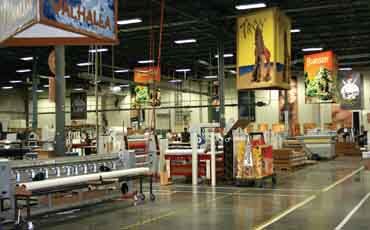

Alice Torti knows that painful decisions are associated with it, but she would recommend the 80:20 principle to almost anyone. Torti, the COO of Great Big Pictures, a Madison printer that makes in-store graphics for large retailers, has not only seen profitability soar — 58 times what it was — after putting 80:20 into practice, but she also intends to use this tool to continually fine tune her printing business.
The 80:20 principal originally pertained to the 19th Century distribution of wealth — 20% of the people had 80 percent of the wealth. Today, since many companies receive the majority of their income from a select group of clients — 20% of customers supply 80% of revenue — organizations should make adjustments to accommodate those few.
Great Big Pictures has made these adjustments with no regrets. “It sounds too good to be true, but it’s amazing the change that it’s had on our company,” Torti said. “I think it’s something that everyone should look at — except my competition.”
While the 80:20 concept has taken hold internationally — the Glenview-based Illinois Tool Works’ emphasis 80:20 as a business tool has helped it become a Fortune 500 company with 60,000 global employees — the actual implementation process is not widely understood.
Torti cautioned that this data-driven process should be undertaken with the guidance of an accountant or other business service with the requisite training. Even though 80:20 involves management techniques, not accounting methods, going it alone can lead to the wrong conclusions.
Principle Has Process
Anita Matcha, a strategic advisor for the Madison accounting firm Smith & Gesteland, described 80:20 as a four-step process, with actual process changes coming at the very end.
The first step, which involves a detailed data analysis to determine where the organization is making money, is to simplify the business. The second step is to separate unlike business units, which can lead to the first transformation in the way business is conducted.
“Let’s say there is a wholesale company and it has a retail business embedded within, or it could be a retail organization but it has a wholesale component. You really have to segment the business, and do a P&L on each of those segments,” Matcha said. “Sometimes, there are legacy businesses, and even if the business has transformed over time, they still are doing their original legacy business. It’s really no longer a valid business, yet they continue to do it, and it’s all sort of embedded in the data.”
The third step is to assign the minimum — or appropriate — level of resources to each business segment. Sometimes, Matcha said organizations do not apply the appropriate resources to some of their most important business. They starve that portion of the business while assigning too many resources to other parts of the business that are not very profitable or are not a growth segment.”
The fourth and final step is to streamline processes, and not just in the manufacturing environment. “It could be something like a billing process or inventory management or shipping,” Matcha noted. “Most clients start with streamline processes, and that is really the last step that we want our clients to go through.”
Great Big Picture
Matcha characterized Great Big Pictures’ 80:20 experience as a transformation from retail to wholesale. Great Big Pictures had always done small print jobs, but never adjusted as its clientele changed. It took a quadrant exercise, plus some extensive number crunching and guidance from its accounting firm, to help Great Big Pictures discover which customers were doing most of the purchasing.
“We realized that we had 75% or more of our clients that weren’t really buying enough to make the cost structure worthwhile,” Torti said. “As a result of that, we cut staff because we didn’t need as many people to manage the large clients that we were serving.”
Overall, the company’s workforce is down from 200 to about 110, which was gradually done over the course of two years. There were a couple of rounds of layoffs, some of them from the 80:20 process, but most from the attrition of not replacing people who had left. Even though attrition made workforce reduction less painful, layoffs were difficult because it involved letting go people who had worked for Great Big Pictures for more than a decade.
The company also formulated a plan to help the people it let go, providing severance when it could, and offering open positions that served larger clients.
Still, Torti admitted, “It was a wrench.”
However, the 80:20 exercise also allowed the company to focus more on its largest clients and give them the best possible level of service “because we weren’t distracted by the other clients that weren’t buying as much,” Torti noted. “It also allowed the people who remained to really focus on what’s most important.”
Another bit of cultural pain: the 75% of low-volume customers included legacy clients. “We’ve grown a lot in the last decade or so, and some of them were legacy clients who had been coming to us for years with small projects that used to be projects we looked for,” Torti explained. “As we got larger and were doing much larger runs, we realized how much it cost to make one of something when you’re geared to make 200 of it.”
Of course, the balance won’t always be 80:20; for Great Big Pictures, it was much more pronounced than that. “If you added it all up, we were at 92:8,” she said, laughing. “It was pretty amazing to find out which clients were really paying our bills.”
Looking at the client base is how the 80:20 process usually begins, but the process is not necessarily a lengthy one. Great Big Pictures started with a summer meeting in 2007, and it had made its first changes by Oct. 1 — all with the benefit of the same office systems it had been using. Breaking the data down into quartiles doesn’t require special training, and new business intelligence software was not needed. The company used the same spreadsheets and databases it had been using.
Great Big Pictures still does small jobs, but it mostly does them for large clients. The difficulties came not only in laying off staff, but in bluntly telling smaller clients that their business would cost more. As counterintuitive as it sounds, the 80:20 transition involves easing certain customers out the door. “The nice thing is that 80:20 teaches you the ‘yes, but’ rule,” Torti explained. “Rather than saying no to anybody, we said, ‘Okay, we can do your job, but it’s going to cost a lot more than you paid in the past, and it will take a lot longer.
“By handling it that way, we put the ball back in their court. They could decide if they wanted to bring in their work, and some of them stayed. Not too many, to be honest about it,” — especially after they found a more economical service.
Since her customers tend to be business clients, most of them understood the business math, but some were offended. However, Great Big Pictures did not simply wash its hands of departing clients; it invested time in helping them find alternative services. “It was hard on our front-desk staff, but we tried to make it as easy as possible for clients,” Torti recalled. “You have to be smart about that sort of thing, and so we said, ‘These are companies in the area that can do this work for you.’”
For a while, the company offered courier services in the event people drove a fair distance to develop their vacation photos. “We kind of went above and beyond, even with the people we identified as not bringing in enough volume to make the cost worth it. We still tried not to burn any bridges, not make them feel like we didn’t think they were important, because that was not the case. They just did not fit with our new model.”
Former employees and customers aren’t the only ones impacted by 80:20. Matcha said the execution of the associated process requires accountability on the part of the management team. “In order to have accountability, you need to have access to financial information,” she stated. “So one of the first steps that an organization has to take is to put its financial statements on a document, a one-page report that we call a scorecard, and open up that information to their management team.
“Sometimes, that’s already being done; in many cases, it’s not being done. So providing forecasts, budgeting, and then holding management responsible for achieving those results is one of the first cultural changes that often happens within an organization.”
Great Big Pictures also used 80:20 to differentiate its products, placing an emphasis on the products that make the most money, and treating those differently than others. They now are tracked more carefully, placed on the most accessible shelves, and kept right next to the places where they will be used.
“That’s another way that we use 80:20 because without that, the typical inventory system might have things tracked in numerical or some other order, and 80:20 guides you to say, “Well, you could really just throw everything else into a room, not look at it very often, and not even bother tracking it because you should track the stuff that really matters in a very disciplined way.”
Examples of products that moved to the top are photo paper and card stock. “They have their own inventory system,” Torti said. “They have their own designated area, and we have a vendor partnership that we’ve developed with that. It makes no sense that people approach inventory as an overall picture, rather than asking, ‘What’s the most important thing? Let’s spend a lot of time on that.’”
As a result of the process, Great Big Pictures also has made changes to its manufacturing plant to emphasize sell line manufacturing over departmental production. The company actually reorganized its entire plant floor, picking up up everything and literally moving it around into the “sell lines” in the spring of 2009. “It’s a lot more efficient to say, “Okay, we print, cut, pack, and collate all in one step,” Torti said.
In a few short years, the company might again be ranking its clients and raising prices on those that aren’t buying enough to make up for the cost that they produce. In fact, Torti expressed an interest in doing the quadrant exercise every year to see how much the top quadrant is buying as opposed to how much the bottom quadrant is buying. “The client that used to be your number one client may be down at number 10,” she noted. “If you’re doing it right, you should be landing a lot more big clients, so you have to continually reassess. It’s a continual improvement process that never really is done.”
However disruptive, the ensuing change can be financially fruitful. Not only did Great Big Pictures experience a meteoric rise in net income, but revenues remained steady because the company increased sales to it largest clients. “People always think, ‘Well, it really wouldn’t work with me because of this, this, and this,’” Torti noted. “The beauty of 80:20 is that it works with everybody — this kind of analysis and this kind of attention on what matters the most. It works in business, it works in your personal life, and it works in pretty much any environment.”
For Almost Everybody
Dennis Breunig, managing partner of Smith & Gesteland, believes 80:20 can be applied in most businesses and industries, including manufacturing, distribution, retail, service companies ranging from architects to accountants, and pubic institutions like colleges or schools within a university.
“There are probably certain industries that are a little bit more in the wheelhouse,” he acknowledged. “We like to work with businesses that have a little bit of a higher gross margin on materials, and sometimes distribution companies can have very lean margins and then there isn’t as much benefit that we can bring to that business.
“But really,” he added, “the 80:20 concept applies everywhere, even in life.”
Said Matcha: “We’re working with just a segment [school] of a college, so we think the application is pretty broad.”
Sign up for the free IB Update — your weekly resource for local business news, analysis, voices and the names you need to know. Click here.

