

When people resolve to improve their level of health and fitness, the first thing that comes to mind is a renewed commitment to proper diet and regular exercise, but how much thought goes into avoiding unhealthy pitfalls at the office?
We spend at least eight hours a day, five days a week in our work environments, so those 40 hours are critical to maintaining, or achieving, the desired level of fitness, especially if you are accustomed to staring at your computer screen all day. There are many little things you can do when making a conscious effort to move around or simply eat properly amid the stress of work, and whether they burn calories or provide nutritional fuel, they can make a big difference over time.
Lori Neilitz, a physical therapist with the UW Health Sports Rehabilitation Clinic and an athletic trainer for Middleton High School, notes that remaining sedentary negatively impacts your health in the long run. “I find that a lot of my patients who have sedentary jobs tend to be stiffer,” Neilitz says. “A lot of sedentary jobs involve sitting in front of a computer, so their posture isn’t as good, and having bad posture can result in some pain and problems over the years if you are constantly doing that. Eventually, it catches up with you.”
So with a little coaching from Neilitz and two of IB’s 2013 Fittest Executive winners — Jeff Haupt, owner of Red Card Media, and Jessica Lynn Anderson, owner of Fleet Feet Sports Madison — we present 15 tips for raising your level of fitness while at the office.
1. Place mindset before matter
In Haupt’s view, the whole idea of backsliding (fitness-wise) at the office is the wrong way to look at staying fit, because the office is your greatest fitness opportunity. As Haupt explains, you only have to worry about yourself (i.e., no family dinners), and you probably are not right next to a full refrigerator or pantry of food. “Most people eat bad food in the office because of social reasons,” Haupt states. “Acknowledge it, and bring a healthy snack or take a walk to a coffee shop, but avoid the bad stuff.”
2. Prepare for fitness
In addition to bringing healthy food to the office, know what healthy choices are within walking distance, and explore menus. For example, Ian’s Pizza is only two blocks away from Haupt’s business, but how many people know it has good salad options? He does. The same applies to planning your morning, noon, and afternoon breaks, both in terms of snacks and/or exercise.
3. Pack it in
To help avoid temptation, eat a nutritious breakfast (still the most important meal of the day) before coming in, and bring healthy snacks to work, even if you lack dietary diversity, to avoid making bad nutritional choices from a vending machine. “If you like something, eat it every day at the same time,” Haupt advises.
Use the snacks for midmorning and mid-afternoon breaks, not for lunch, and concentrate on fruits, multicolored veggies and dips, yogurts, and nuts (almonds, hazelnuts, and peanuts are the top three in terms of nutritional value). That way, you won’t be tempted to get fast food for dinner, and you will obey nutritionists who recommend eating smaller meals throughout the day rather than three large ones. “If you get home and you’re starving, you probably won’t take time to prepare the good meal that you had in mind, and you’re going to choose the quick and fast stuff, which usually tends to be along the junk-food line,” Neilitz noted.
4. Eschew processed foods and limit sweets
During the fitness challenge, Haupt refused to eat anything during the day that was not nutritious. Food only went into his mouth if it had nutritional value and was not processed. In an even truer test of discipline, you might apply the same rule to sweets because sugar cravings are satisfied by eating fruit, which has both nutritional and digestive benefits.
5. Start a lunch rotation
Disappointed with her staff’s restaurant habits, Anderson (Fleet Feet Sports Madison) started a lunch rotation. The store has a lunch schedule, so everyone has to feed the rest of the staff once a month or once a week, in the hope of saving money and time. “Full-timers feed the entire staff once a week, part-timers once per month, and I feed them one to two times per week and buy the coffee,” Anderson says. “There are not always healthy choices, but we bring in home-cooked meals!”
6. Avoid long sitting spells
Get up about every half hour, or work for 45 minutes and move around for 15, to stretch your legs. People tend to burn more calories when standing, and prolonged sitting runs the risk of chronic back pain. If necessary, try to creatively (mentally) solve a problem while pacing like an expectant father, or have walking meetings with co-workers, or occasionally deliver documents personally rather than by email. Choose the stairs over the elevator, park toward the back of the parking lot to get a little bit more exercise on the way in and out, and use a bathroom on another floor just for the extra walking. To strengthen their abs and back, and improve posture, some professionals sit on an exercise ball instead of an office chair while they work.
(Continued)
7. Work in a long workout
If you can only fit in workouts during the day, say between 11 a.m. and 1 p.m., adjust your schedule so that you come to work earlier and leave later. It’s one way to have evenings to yourself and avoid the mid-afternoon energy slump. “I did my best to avoid lunch meetings four days a week so I could work out at lunch,” Haupt says. “You would be surprised how easy it is.”
8. Walk with me
One of Neilitz’s colleagues who doesn’t have a sedentary job still makes it a point to take a walk around the parking lot after every few patient consultations. “I think it’s fresh air, it clears his mind, and it’s a little exercise,” Neilitz stated. “It probably takes him less than two minutes. He’s an outdoor kind of guy, but I think it’s mostly about the pressure [stress relief]. He will do that three or four times throughout the day.”
Fitness experts note that you can burn more calories with brisk walking and quicken your heart rate as well. If you have the luxury of living near work, consider walking (or biking) to the office instead of driving, and remember that you don’t have to walk alone.
During the winter months, Fleet Feet Sports Madison is bringing back (for the second year) a break period that allows employees to go for a run or walk in the middle of the day, once per week. Management encourages the buddy system. “The full-time staff will get a chance to take an hour for themselves when there is still daylight,” Anderson says.
If you can get a few of your co-workers to form a walking group, and identify a 20- or 30-minute route that you can do together, that works in everyone’s favor. Why is there strength in numbers? “Perhaps the pressure of knowing you’d be letting down someone in your group if you didn’t do it, or perhaps on the days you don’t feel like doing it and the other people do, they sort of support you through it,” Neilitz explained.
9. Purchase a pedometer
A small and inexpensive piece of equipment known as a pedometer can be used to monitor how far you’ve walked, the duration of your walk, and even your speed and how many calories you’ve burned in the act of walking. Obviously, you have to be extremely fitness conscious to want to record all this information, but as they say, you can’t improve what you don’t measure, and pedometers have come a long way. “It used to be that if you just turned a little to the right, they would record that as a step,” Neilitz recalled. “Now, they are more accurate and record when you are actually moving.”
10. Wolf down the water
Stay hydrated with water, which not only cleanses the body of toxins but is also considered one of the best “sports drinks” for moving energy to your muscles. “This one is overlooked, and it’s critical,” Haupt says.
Water is ideal for replenishing the body after low-impact exercise, and it also helps with appetite suppression, but there are other considerations. “Some people who are heavier sweaters might need something saltier, more like the Gatorade types of drinks, because they are losing more through their sweat,” Neilitz stated.
How much water should you drink at the office? You should drink an average of one 8-ounce glass per hour, which translates into one 20-ounce bottle of water every 2.5 hours.
11. Clean your office once in awhile
Just as housework and yard work help burn calories, so does keeping your office neat. Filing, organizing, and recycling reams of paper can break up your day and create a better working environment, and it gets you out of your seat.
12. Get physical — at your desk
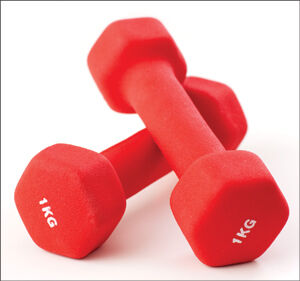
With a resistance band, or little 1- or 2-pound weights, you can do a number of different muscle-toning exercises at your own “desktop gym,” or you could stand up and do body-weight lunges, body-weight squats, stretching, and arm-circling exercises. “There is a real benefit to doing strengthening exercises like that, especially weight-bearing exercises for women who are at risk of osteoporosis,” Neilitz says. “Any kind of weight-bearing exercise is really good for them.” So are yoga exercises, several of which can also be done from a desk and offer a time-tested form of stress relief.
13. App-ly yourself
There are handy technology apps for iPhones and other devices that help track your activity level and your daily caloric intake. MyFitnessPal is a popular one, but there are a number of calorie-counter apps that allow you to enter the things you’ve eaten during the day. “As you put in your calories on an iPhone app, it has a scanner, so if you eat something with a barcode, you can scan it, and then you don’t even have to take the time to type it in,” Neilitz says. “It goes into your calorie count for the day. If you get into the habit of doing that regularly, it becomes easier to take advantage of. There is a learning curve for how to use the programs, but after that it’s pretty easy.”
14. Use music to motivate
If music has charms to soothe the savage breast, it can certainly help with workplace stress or help get you motivated for a productive day. Have a playlist of songs that get you all fired up (or help you relax) and that can be played on your iPad, iPod, or laptop. Listen to music during a break or during a daily walk.
15. Take a seventh-inning stretch
Just like in the game of baseball, consider taking a stretching and calisthenics break about two-thirds of the way through the workday (during the afternoon break). Whether or not you take your break with a co-worker, establish a routine of calisthenics that can be done at some point during the day, especially during the afternoon break, when you might need to break up a day of sitting or do specific exercises to strengthen your back.
Sealed with a KISS
Perhaps the best thing about this advice is there is nothing complicated about it. These are fundamental, keep-it-simple-stupid tips that anyone can follow; if you follow them consistently, positive fitness outcomes will result and your only New Year’s resolution for 2015 will be to keep up the good work.
Click here to sign up for the free IB ezine – your twice-weekly resource for local business news, analysis, voices, and the names you need to know. If you are not already a subscriber to In Business magazine, be sure to sign up for our monthly print edition here.

