
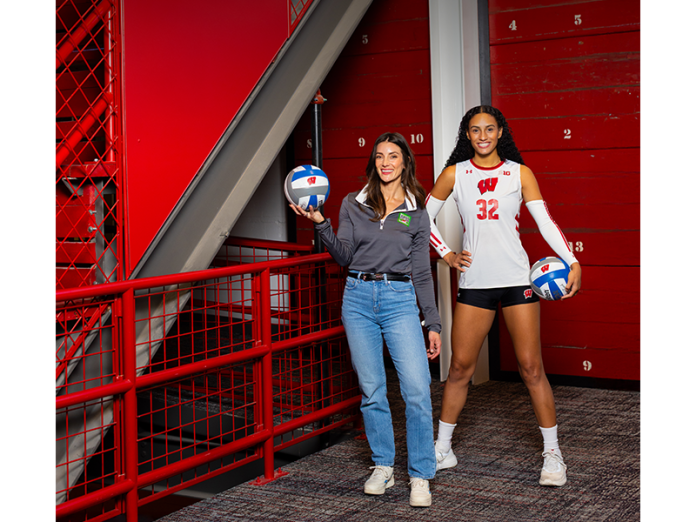

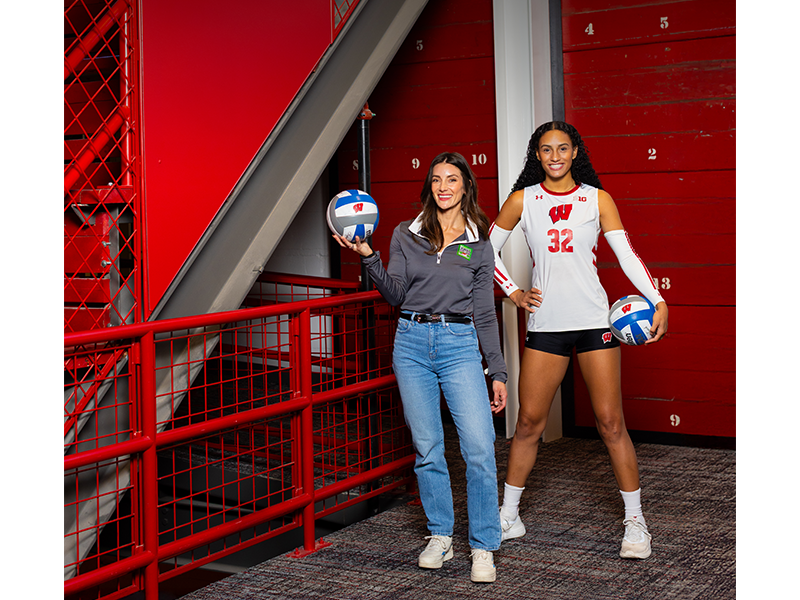
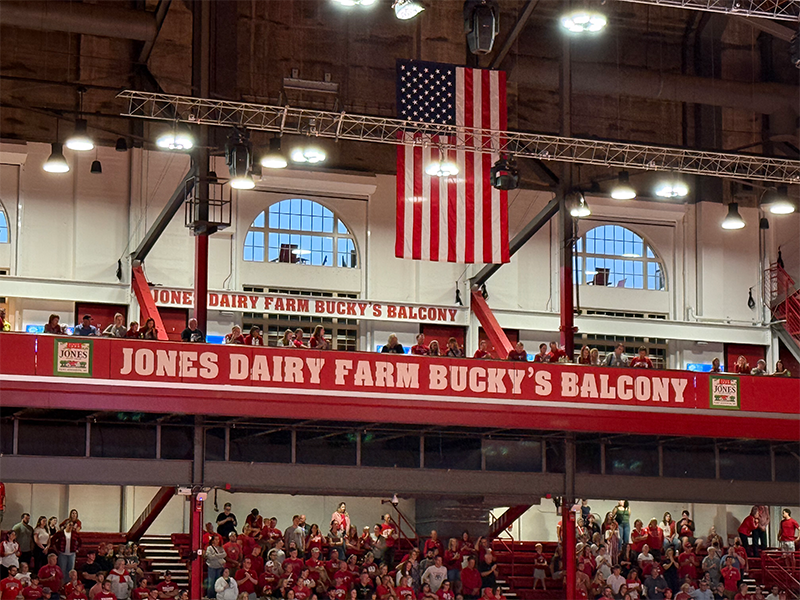
Just as Badgers volleyball outside hitter Grace Egan looms over the net to go for the kill, the Jones Dairy Farm Bucky’s Balcony dominates the upper deck of the northern end of the Wisconsin Field House.
Plenty of eyeballs see the large sign promoting the Fort Atkinson business, as Badgers volleyball games are among the hottest sports tickets in the city.
Jones Dairy Farm, which sells bacon, breakfast sausage and ham, among other meats, also boasts digital signage throughout the venue, hosts fan-engagement activities between games, and is involved in radio and TV spots. (Jones has a smaller presence at Wisconsin football and men’s basketball games, too.)
“We did something so big in the Field House because we didn’t want to have to compete for that space,” said Lisa Caras, marketing director for Jones Dairy Farm. “It’s important to find something that fits your brand really well and just lean into it, rather than… spreading yourself too thin.
“We think that people who are going to the Field House — that demographic — is a good fit for a Jones customer.”
There are a lot more opportunities for local companies to spread their messages these days, as new women’s teams remake Madison’s sports landscape and fans increasingly fill the stands. Plus, with the 2021 introduction of name, image and likeness (NIL) rights in college sports — which allow student-athletes to earn income from business ventures and their personal brand while still in school — the sponsorship game has changed significantly.
The key for businesses, Caras said, is to “make sure that you stand out.” And Egan is helping Jones Dairy Farm do just that.
“I am a communications major. I love, love, love working in marketing and brand work,” said Egan, a redshirt sophomore who has NIL deals with Jones Dairy Farm and Summit Credit Union, among others. “I am just really excited with NIL and where it’s going, and being able to work with companies and (show the) other side of my personality.”
From softball to hockey
In recent years, women’s sports teams have grown at a rapid clip locally.
The Madison Night Mares, a women’s summer collegiate softball team, debuted in 2024, and won the Northwoods League Softball Championship in August in front of a hometown crowd at Warner Park’s Duck Pond (named for the Madison Mallards collegiate baseball team, which has played there since 2001). The Night Mares also led the five-team league in attendance, averaging almost 1,100 fans per game.
LOVB Madison, the League One Volleyball team, begins its second season in January with games at the Field House and Veterans Memorial Coliseum at the Alliant Energy Center.
In May, the city’s first USL W League pre-professional women’s soccer team will take to the pitch at Breese Stevens Field. Big Top Events — which owns Forward Madison FC, as well the Night Mares and the Mallards — announced this year that Forward Madison FC secured the rights to the new franchise.
The women’s team will be branded separately from Forward Madison, and USL W League Madison (its temporary name) has started to collect name submissions and will conduct focus groups to develop the club’s brand and crest.
And then there are the women’s sports juggernauts that have arguably boosted the local profile of women’s sports like nothing else in this city: the University of Wisconsin-Madison volleyball and women’s hockey teams. In 2021, the volleyball Badgers won a national title, and the program has made the NCAA Division I tournament every year since 2013.
Earlier this season, the nationally ranked Badgers — which consistently sell out home matches — led the country in average attendance with more than 8,600 fans per game, and the team is on pace to eclipse $2 million in revenue for the first time, according to UW Athletics officials.
Similarly, the Wisconsin women’s hockey team has won eight national championships, four of them in the past seven years — including 2025. The Badgers, who play at LaBahn Arena, also consistently draw more fans than any other NCAA Division I women’s hockey team in the country.
Why women’s sports?
Call it the “Caitlin Clark effect” — named after the basketball star’s record-breaking career at the University of Iowa and her transition to professional ball in 2024 — which helped propel not only the WNBA but women’s sports in general into a big-time entertainment and revenue-generating business.
According to an August analysis by McKinsey & Company, revenue from U.S. women’s sports grew 4.5 times faster than that of men’s sports between 2022 and 2024, with plenty of growth potential. From a sponsorship perspective, more brands are going all-in on women’s sports, too.
“The (National Women’s Soccer League) has an all-time high of 13 league-level sponsors for 2025, of which eight began partnering with them after 2023. The WNBA started off the 2025 season with a record 45 sponsors, including 14 added in 2024 and 2025 alone,” the report found.
Which is why it makes sense, on multiple levels, for Madison area businesses to invest in and leverage the excitement around local women’s sports teams, too.
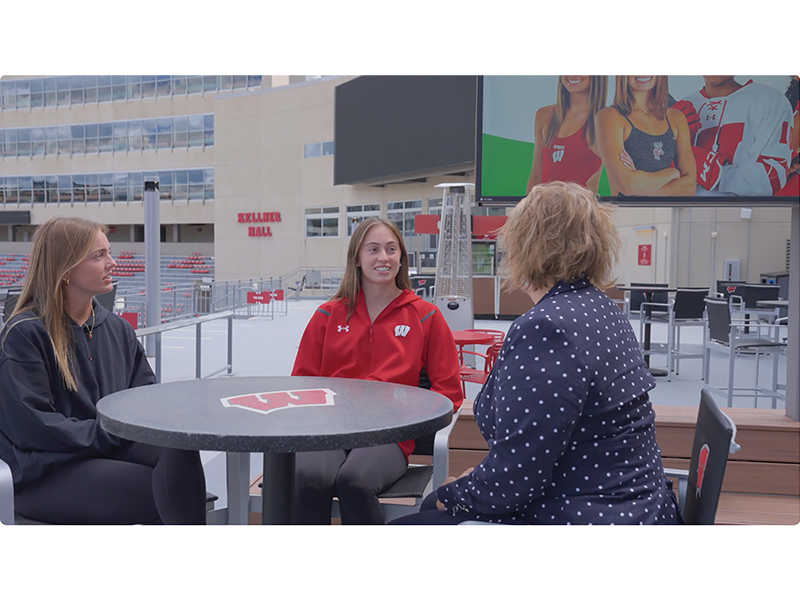
In September, UW Health announced it is now the official title sponsor of all UW-Madison women’s sports.
The new title sponsorship “represents a milestone in support for women’s sports at Wisconsin,” said Mitchell Pinta, Wisconsin’s deputy athletics director/chief revenue officer, noting that it’s the first of its kind in all of college athletics. “There are a lot of brands out there looking to associate themselves with our women student-athletes.”
Chris Roth, chief marketing officer for UW Health, pointed out that “Women are often the health care leaders of their families, in terms of making decisions, and so it’s important for us to have a good connection with them.”
Last year, UW Health opened the Eastpark Medical Center on Madison’s far east side, home to the health system’s multidisciplinary Integrated Specialty Care for Women program. It offers what Roth called often overlooked treatments for pelvic floor disorders, gynecologic conditions and cancers. Some Badgers-related sponsorship campaigns revolve around increasing awareness of such treatments.
For years, UW Health had limited its UW sponsorships and partnerships to major sports like football, men’s hockey, and men’s and women’s basketball — primarily via signage and on-site promotions. But now, especially with the digital marketing opportunities created by NIL rights, the company saw a way to expand its own reach.
Roth, like others contacted for this story, declined to discuss specifics about how much of their marketing budget is dedicated to women’s sports.
“We prefer to say we’re making an important investment in terms of growing our awareness and our connection to the Badgers, but also really connecting to the movement around women’s health,” he said. “And so it’s really less about the budget and more about how we’re supporting those two causes.”
UW Health is using the personal stories of female athletes like track and field thrower Danni Langseth, rower Macy Mosner, and hockey players Laila Edwards and Bella Vasseur who have become ambassadors for such issues as breast cancer, organ donation and mental health.
NIL changed the game
Until July 1, 2021, corporate sponsorship of college athletics revolved mostly around signage, commercials, logo usage and special programming. But once the NCAA adopted its NIL policy, colleges and universities, student-athletes, and companies large and small quickly shifted to developing endorsements and social media campaigns. The deals enable businesses to leverage student-athletes’ existing online presence while helping the athletes earn money, enhance their marketability, and bolster their entrepreneurial skills.
For Summit Credit Union, NIL presented new opportunities to elevate its own game.
“Summit invests in women’s sports not just because women are our target market — but because championing women’s financial success is our mission,” company president and CEO Kim Sponem told In Business Madison via email. “When NIL was enacted, we saw the risk of a new gender pay gap and acted swiftly and strategically to be part of the solution.”
Summit partners with four UW-Madison female student-athletes — including Egan and swimmers Maggie and Abby Wanezek — to be “financial wellness ambassadors.” They work with the credit union’s financial coaches and then share that knowledge. The campaign aims to increase financial literacy among college-aged women and inspire them to reach their financial goals.
“It’s less about highlighting our services and more about teaching people to have confidence with their money and building financial literacy skills,” Jamie Bay, Summit’s vice president of marketing, said in an email. “It shows that we are all connected and can support one another to create a thriving community.”
According to a September report by ESPN, more than 8,300 NIL deals worth nearly $80 million have been approved by the new College Sports Commission.
Wisconsin’s Pinta said while views on NIL run the gamut — “some things positive, some things negative” — he added that “this is truly what NIL was intended to be, and it’s awesome to see not only brands but also student-athletes be able to take advantage of that.
“Five years ago, you couldn’t do that, and it was such a missed opportunity. Sure, there’s a short-term revenue play for (the student-athletes) but learning about what it means to manage your personal brand and be an endorser of corporate brands at such a young age is a really impactful life lesson.”
Deals that popped up early were more formulaic, social media, influencer-based deals involving products or a few hundred dollars, said Brian Mason, UW Athletics’ director of NIL strategy.
“As businesses and brands have gotten more comfortable working with athletes and integrating them into their larger marketing campaigns, you’ve seen the scope of those partnerships grow,” Mason said, with some national partnerships running into six figures.
More common are deals ranging in the four and five figures, where an athlete performs an activity or two on behalf of a brand, up to longer term partnerships, he said.
For businesses, NIL opened new doors for promotion, according to Caras of Jones Dairy Farm, now in its second year of a partnership with UW Athletics.
“With NIL, there are a lot of options that didn’t exist before, new ways to reach different demographics, which I think is very exciting,” she said. This year, the company’s NIL deals include three UW athletes — Egan and basketball player Laci Steele, as well as track and field distance runner Andrew Casey.
Egan, who grew up on a farm in Illinois, said her dad was particularly excited she was working with Jones Dairy Farm. On the day she interviewed with In Business Madison, Egan was set to film a video with the company in front of the Field House — a friendly competition with former Packers/Badgers football player Mark Tauscher on who could make the best breakfast sandwich using Jones products (Egan won). The video will be shared on the UW Badgers, Jones Dairy and Egan’s personal social media this month.
Like Egan, two-time Olympic swimmer Phoebe Bacon had a natural connection with Jones.
“That’s right, my last name is ‘Bacon,’ and I love bacon,” the UW swimmer declared in a 2024 video for the company that was shared on social media. Then she explained to viewers — while frying up some sizzling slices with CEO Philip Jones — why she enjoys cooking.
Caras said as a Wisconsin-based company, “We feel strongly about supporting Wisconsin… we’ve been here for seven generations,” noting she is a part of that seventh generation.
“Athletes are big eaters and, more than ever, they’re caring about where their food comes from — whether it’s locally provided or just healthier. We’re known for our clean labels, and that’s something that people, especially younger generations, care deeply about. We feel it’s a good partnership.”
What’s the ROI for businesses?
Companies typically enter into sponsorships with teams and organizations that reflect their brand or mission. Exact Sciences, for example, is driven by its community-focused goal of eradicating cancer. Discussions with Big Top management resulted in Exact Sciences becoming a partner for Forward Madison FC and now USL W League Madison.
As such, the company’s sponsorships allow for, among other things, low-cost tickets for fans, free tickets for educators on teacher appreciation nights, and scholarships for youth soccer camps.
“Sports bring communities together. Sports allow for communities to bond around something that is not divisive,” said Katie Boyce, senior director of corporate impact and strategic communications at Exact Sciences. “We want to make sure that things like sports, or the arts, are accessible to everybody.”
Boyce added that in Exact’s case, “We haven’t made a distinction of whether it’s a men’s sport or women’s sport, whether there’ll be more eyeballs or less eyeballs.” Exact is in its third year of an NIL program with 12 Badgers (including seven women).
“We know the kids love to see these athletes — those players on Forward or our Exact Sciences (NIL) athletes — out in the community,” she said. “Just to be able to tell those stories, that’s what makes it all worth it for us.”
An ancillary benefit is increased employee satisfaction — and not just because of free game tickets.
“They’re proud to see the company’s name in social media or hear its name on podcasts when it’s mentioned as a community partner,” Boyce said. “I also believe it helps with recruitment and retention.”
Ideally, sponsorships of women’s sports over time will lead to increased visibility and sales. But, unlike other marketing campaigns, they don’t necessarily come with a quick return on investment.
The Dane County Regional Airport sponsors the Mallards and the Night Mares, via outfield and scoreboard signage at the Duck Pond. The airport also has signage at Breese Stevens Field, home of Forward Madison FC and the forthcoming USL W League Madison.
“We rely on the venues to report metrics as far as attendees over a given period of time and get an ROI that way, but I think there’s also just a lot of goodwill to be had by being where our literal neighbors are,” said Michael Riechers, director of marketing and communications for the airport, noting that it is located less than two miles from the Duck Pond.
“It’s really nice if our neighbors see us there, and then they hear us on the radio, and they might see a billboard off the Beltline. And then when they’re thinking about where to go when we’re under 18 inches of snow, they’ll consider flying out of Madison instead of driving to an airport further away,” Riechers said.
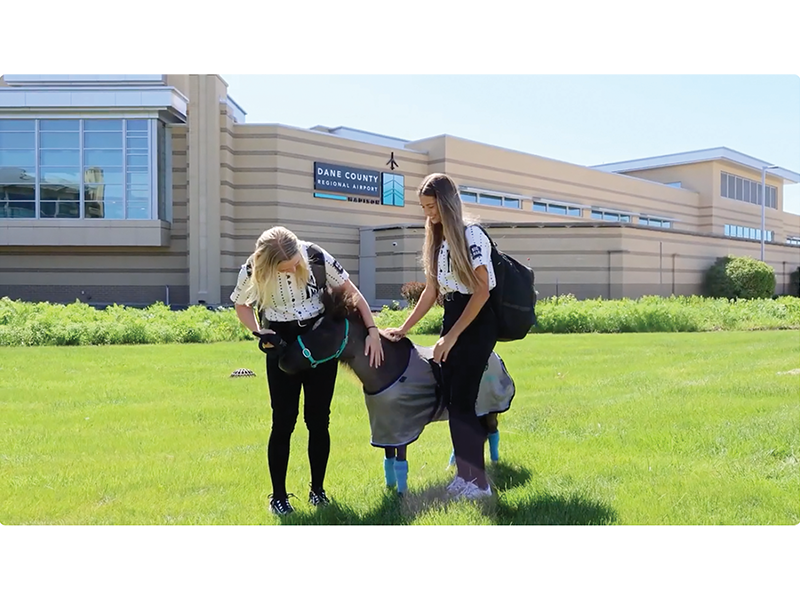
This past spring, the airport also filmed a “fly local” video featuring Karlie McKenzie and Madison native Andrea Jaskowiak of the Night Mares (along with Midnight, the team’s miniature horse mascot). It targeted new airport users and was featured on social media and the Duck Pond’s video board.
The percentage of the airport’s marketing budget dedicated to sports sponsorships has increased as it continues to see passenger growth, and Riechers said 2025 is shaping up to be the airport’s busiest year ever — even as other Wisconsin airports, he added, are still struggling to recover from COVID. Riechers attributed part of that success to the video and its partnerships with Big Top’s women’s (and men’s) teams.
“We’re not going to back down (on the investment) when everything is pointing to airport growth,” he said. “We’re going to keep doing it.”
And Riechers had a few words of advice for other businesses considering such an investment.
“If you, as a brand or organization, can get in on some of (a team’s) early seasons and become part of the whole experience, then you can benefit as its popularity and attendance and name recognition all take off,” he said. “You can ride that wave with them.”
Rewriting the playbook
Determining what a sponsorship might accomplish, brainstorming with a sports organization that aligns with those goals, and then “being open to being creative” are all critical steps in finding the right fit, according to Exact Sciences’ Boyce.
“The leadership at Big Top has been incredible, so when they bring us an opportunity, we are going to look hard at it — whether it’s women’s or men’s sports — because we think they’re strong community partners and good community leaders,” she said.
For UW Health, a good fit also equates to authenticity. Along with its partnership with UW Athletics, the company is entering its second year as the official medical provider of LOVB Madison for the 2026 season. In addition to UW Health receiving front-of-jersey logo placement and being involved in game-day experiences, the company plans to engage players in real-world digital storytelling celebrating medical care — just as the company has done with UW student-athletes via NIL.
“We recognize that authenticity is really important in content creation, and oftentimes some of the athletes we’ve profiled who don’t get as much attention (as others) were super excited about the opportunity to share a story,” Roth said, referencing the video clips about UW Health services.
“There is an opportunity to raise awareness of the services we provide but also to drive case volume with patients getting the care they wouldn’t have in the past,” he said. “So, there’s a community impact in terms of people’s lives, but there’s also a business opportunity for us in terms of growing those services.”

