
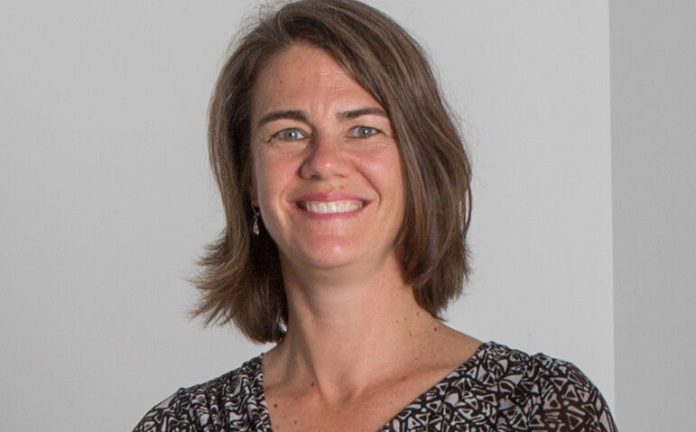

Perhaps it’s appropriate that Kathleen Lake’s last name refers to a body of water that dominates the local landscape because she’s been instrumental in preserving them.
As an environmental specialist for the Madison Metropolitan Sewerage District, it’s her job to keep pollutants out of the water that are difficult or expensive to remove, and it’s not easy. It has involved challenging people and entities — farmers (manure application), and municipalities and residents (street salt usage) — to change long-held practices.
Her environmental influence here and beyond Madison is the reason she is one of six local women to be honored in the 2016 “Women of Industry” awards program.
Pollution solution
Too much phosphorus leads to increased algae in lakes and streams, and too much chloride (part of salt) is toxic to freshwater organisms. Since Madison’s economy and quality of life are dependent on the quality of its water, two programs that Lake is currently engaged in, Yahara WINs and WISaltWise, seek to reduce phosphorus and chloride, respectively.
The Nine Springs Wastewater Treatment plant where Lake works receives too much of both of these pollutants, but the fact progress is being made in reducing them is the accomplishment Lake is most proud of because more people — residents and business owners alike — realize they have a role in keeping the water clear.
“Water is essential to our region and it is essential to all of us in our daily lives, but none of us really think about it,” Lake notes. “It’s something that we take for granted, and the biggest accomplishment of this project is seeing how many people are coming around to the idea that we can each do something to improve our water. We all can do just a little bit more, and every collective piece is helping to improve our water.”
Salty language
To encourage a new approach to salt use, Lake engaged local experts who were interested in the topic — from salt applicators to health and water professionals. They represented organizations such as the Wisconsin Departments of Transportation and Natural Resources, the Dane County Office of Lakes and Watersheds, the Madison Area Municipal Storm Water Partnership, and the Capital Area Regional Planning Commission. Lake facilitated listening and learning sessions, which evolved into development of WISaltWise.
Perhaps nowhere is a consumer more able to impact water quality than “on the salt side.” A lot of times, people put salt on roads, driveways, parking lots, and sidewalks, and then think it goes away. Water comes and we don’t see the salt anymore, but it hasn’t really gone away. It dissolves and it persists in that water, and part of her challenge is getting people and entities to realize the chloride component of different salts is toxic in a freshwater environment. A very low amount, like of one teaspoon in five gallons of water, is deadly for freshwater organisms.
Like most wastewater treatment plants, Nine Springs does not remove salt. All the salt that arrives ends up in local freshwater streams. Each day, that amounts to 140,000 pounds, or 3,500 bags of water softening salt or the equivalent of 15 loaded dump trucks.
MMSD found that adding technology to remove chloride would cost $300 million to $2.3 billion. MMSD’s chloride source reduction program is expected to bring the discharges into compliance with the Clean Water Act without investing in treatment expansions on either the water supply or wastewater treatment side. If treatment were necessary, rates could increase anywhere from 50% to 500% for customers in more than 30 communities that send their wastewater to MMSD.
Instead, Lake is leading the district’s chloride source reduction program, which will allow MMSD to meet water quality standards by working with homeowners to improve their water softeners and changing people’s perceptions and use of salt. At the moment, research proceeds on the “right amount of salt” and spreading the salt in patterns can help reduce the amount applied, but chloride reduction is not just the responsibility of municipalities.
“We’re so lucky,” Lake notes. “If you look at an aerial photograph of the region here we’re just covered with fresh water. We also have groundwater and wetlands and rivers and streams and lakes, and we’re putting hundreds of tons of salt in that fresh water.”
(Continued)
Yahara’s big WIN
Also during the past four years, Yahara WINs tested adaptive management through a pilot project. MMSD led the project and coordinated a group of local municipalities to pool funds and invest in practices to improve water quality — practices that occurred in municipalities and on farms. They ranged from cover crops to leaf management, and from stream buffers to rain gardens.
In 2017, due to the project’s promising early success, it will expand to all 536 square miles of the Yahara Watershed, which incorporates parts of Dane, Rock, and Columbia counties, and 23 municipalities joining in an intergovernmental agreement to reduce an estimated 100,000 pounds per year in phosphorus runoff.
“Kathleen works proactively to improve water quality in the region,” notes Jane Carlson, senior associate with Strand Associates. “She has an inclusive and collaborative style when working with diverse stakeholders, and she promotes education and incentives such as chloride and phosphorus reduction grants over more traditional approaches like ordinances and enforcement.
“Her work to reduce chlorides extends beyond the immediate boundaries of the sewerage system to look at practices that may impact regional water quality.”
Both WISaltWise and Yahara WINS are being closely watched from a national perspective and many are looking to replicate these approaches. Wisconsin is the first state to allow a compliance approach for so-called point-first dischargers that “isn’t at the end of a pipe,” Lake notes.
“Our regulatory framework allows us to look at the entire watershed and make all the reductions in that watershed so that water quality, at the end of the day, meets the standard. It is a completely new way of thinking. It is a new way of acting, but it is really the only thing that is going to take us to the next level of water quality.”
Lake adds that the Clean Water Act did amazing things by controlling what came out of point-first dischargers, but there are only so many pollutants that can be removed at that point. If you don’t look at all the other sources that are coming in, you can spend large amounts of money for small benefit and not even see it in the water.
“We are getting questions throughout the country about how to make this happen,” Lake states. “The number of people that have pulled together to bring in ideas and bring projects, and test and try pushing urban and rural practices so they are ahead, is amazing.”
Highly sought after
Along the way, Lake was invited to participate in the Wisconsin Women in Government Leadership Seminar in 2014. By speaking and writing, Lake engages groups throughout the region, state, and nation. Earlier in 2016, she was a featured speaker at Minnesota’s Road Salt Symposium and engaged the Wisconsin DOT Maintenance Managers at the Wisconsin’s Highway Maintenance Conference in September, encouraging attendees to “right-size” their salt diet.
“Kathy’s work is critical to the water quality of the Dane County area and beyond,” notes Jennifer Peters, human resources manager for the MMSD. “The issues Kathy is working to address, such as chloride in our water, affect the waterways downstream of Madison also, so her work has a greater impact.”
Lake is routinely requested to write about and speak on adaptive management and the Yahara WINs project, including several return engagements. She was the principal investigator for a 2015 study titled “Optimization of Water Softeners for Reduced Chloride Impact,” which is being used throughout the water quality and wastewater industries.
While the Yahara WINs project won the Lumley Leadership Award from the Clean Lakes Alliance in 2016, the Women of Industry award brings rare individual acclaim for Lake. “I’m really honored,” she says. “This is something that doesn’t happen in my industry and that doesn’t happen in my world.”
Click here to sign up for the free IB ezine – your twice-weekly resource for local business news, analysis, voices, and the names you need to know. If you are not already a subscriber to In Business magazine, be sure to sign up for our monthly print edition here.

