
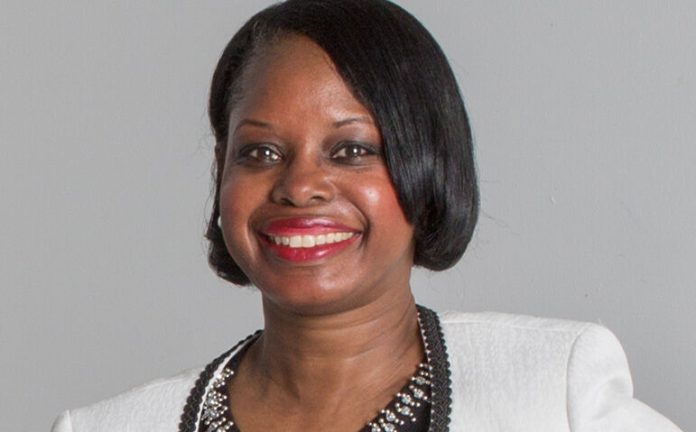
For 27 years, Corinda Rainey-Moore has been a fierce advocate for people with mental illness, and the one thing she’s most pleased about is that people are finally beginning to value the mentally ill as contributing members of society. Not completely, however, and with one in five Americans having a mental health condition, that’s more than enough to keep her going.
For her advocacy and her tireless effort to de-stigmatize mental illness, Rainey-Moore is one of six local women to be honored in IB’s 2016 Women of Industry awards program. While mental health advocacy has been a professional passion of Rainey-Moore, she serves a variety of populations as the community outreach and engagement coordinator for the Wisconsin Council on Children and Families, a position she’s held for the past year.
As she talks about her advocacy for the mentally ill, especially the need for more funding for services and more progress on reducing the stigma associated with mental illness, her passion comes pouring through. There is much left to do in the provision of services for the mentally ill, but as the stigma of mental illness gradually fades, she says, “the whole of the person” is finally coming into clearer focus. “Just as heart disease is not all of what a person is, mental illness is not all of what a person is, either,” she states.
Passion at work
Rainey-Moore has not only raised awareness about mental health issues, she has brought her programming expertise to organizations such as Leadership Wisconsin, the Foundation for Black Women’s Wellness, and the National Alliance on Mental Illness, where she served as board chair.
In her advocacy, Rainey-Moore has mentored students and staff on mental illness, and she ran the first community support program to hire consumers as peer specialists, recognizing the expertise of consumers who suffered with mental illness, themselves, and who can help others cope with a mental health issue. She also was part of the group that worked to bring to Madison the film Home, which was about an African-American male who suffered from schizophrenia. In addition, she has worked to bring mental health education to the Madison Metropolitan School District and community organizations such as Middleton Outreach Ministry, and the African-American Health Network of Dane County.
A related issue she’s raised awareness about is suicide and suicide prevention, particularly in the African-American community. Rainey-Moore developed a program called the Red Lip Campaign to raise awareness about suicide, and she also trains people to recognize mental health signs and symptoms through a program called ASK — assess, support, and knowledge.
Through it all, the accomplishment she’s most proud of is advancing the voices of people with mental health issues, especially at the policy table, and also making sure that people see them for who they really are because “they are really just people with the same hopes and dreams as everyone else.”
Asked if getting society to acknowledge that people with mental illness can live perfectly normal lives is “job one” for advocates because everything else that can be done for the mentally ill flows from that societal recognition, Rainey-Moore notes there is some truth to that, but the job isn’t completely done. She continues to advocate for increased services because there is more need than there is access to mental health services, as evidenced by the long waiting lists for services.
“What I know about mental health issues is that when people are ready for the help, the services need to be available because people can’t wait a month down the road or two or three months down the road,” she states. “They need services right away, particularly people who are suicidal and people who are depressed. Oftentimes people who have a diagnosis of schizophrenia or bipolar disorder, if they have to stay on the waiting list, by the time they get services it will be too late because then they will need to be hospitalized. By that time it generally requires more potent treatment than if they had gotten services earlier. For me, it is about accessibility and getting people in as quickly as possible.”
Making sure that money is put into continuing services that address their needs is crucial because the number of people with mental health issues is actually increasing rather than decreasing, she adds. “A lot of the trauma that we see in terms of violence, in terms of homelessness, those are all areas where we can make an impact and improve some of the outcomes for people who are suffering from mental health issues.”
Suppressing stigma
In her view, having authorities view those with mental illness as everyday people who can remain in the community and do not have to be institutionalized is another advancement. “That’s what they used to do years ago,” Rainey-Moore notes. “They institutionalized people with mental health issues and now many people with mental health issues live productive lives just the same as you and me.”
While she is pleased with the progress being made in removing the stigma, there still is more work to do in that area. Families with mentally ill loved ones must be more open about it, and the media must stop shying away from it. “I think one of the ways, which is another reason why I’m happy to be honored for this because we don’t often talk about mental health issues, but one of the best ways that we can decrease the stigma is by having more people talk about it and having more people express what’s happening within their families in terms of people suffering from mental health issues,” Rainey-Moore states.
One example of a typical societal attitude occurred while Rainey-Moore worked at Journey Mental Health Center in Madison. One day she was walking toward the facility and a woman who was at a nearby gas station walked across the street and followed her, not realizing that Rainey-Moore worked for Journey. When Rainey-Moore saw the same woman a couple of days later, the woman approached her and asked whether she worked there or “are you are one of them?”
“I said ‘what is one of them?’ She proceeded to ask if I was going there for services and to see whether I had a mental-health need. And to me, it really shouldn’t matter if I was going there for services or not because if I walk into Meriter, nobody would ask me if I worked there or if I’m going there for services.
“So I think we have still a ways to go in terms of decreasing the stigma, which is oftentimes why mentally ill people don’t like to admit there’s a problem, but I do acknowledge that progress has been made. More and more people are speaking out about their illnesses and what’s happening with their families. The newspapers are now reporting mental health suicides whereas before they did not mention that we died by suicide. I think because a lot of families are able to at least talk about the affects of a tragedy in the family to the media that also gives us some ways to decrease the stigma by having that acknowledgment that mentally ill people are dying because of suicide … and they don’t have to.”
(Continued)
Clarissa Pearson, team lead with Journey Mental Health Center, says Rainey-Moore actively connects people with necessary resources and services and she also is able to help others understand how everyone has been affected by mental illness, regardless of whether it’s depression or a family member with schizophrenia.
“Due to Corinda being very active in the community, she is able to connect with others from all different backgrounds and social economic status,” Pearson says. “When she interacts with others in the community, she meets people where they are at. She does not ignore the challenges that people face within the community who deal with mental illness, especially when faced with the negativity of stigma, biases, and stereotypes. These challenges can be most difficult when it involves our own supports such as family and friends.”
If there is one overarching thing that Rainey-Moore would still like to accomplish for the mentally ill — something that stands out as a “must-do” — it would be further reducing the stigma attached to mental illness. In her view, that means more people have to acknowledge it, more people must be willing to talk about it, and more people must treat it like any other illness.
“Mentally ill people are individuals just like you and me,” Rainey-Moore states. “They have hopes, dreams, and goals like anybody else. Many of them are able to live productively, they are in their own homes, they have jobs, they are volunteering, and they have neighbors and family members and loved ones just like everybody else. People need to treat them the same way that they would treat somebody who has heart disease or diabetes and as somebody who basically is a contributing member of society and should be valued for the whole of who they are and not just be recognized for their illness.
“To me, that would be a huge accomplishment,” she continues. “We have a long way to go with this, but I think that we’re all working toward decreasing the stigma every day and more and more people are talking about it. We have famous people who are talking about their mental illnesses, which also helps.”
Another big task on her to-do list would be improving access to jobs because having a mental illness doesn’t mean people are unable to work. “Employers need to be more understanding of the symptoms that we see on a daily basis and still be open to respecting and valuing people with mental illness as human beings,” she states.
Voicing her gratitude
For Rainey-Moore, it’s gratifying to be recognized as a Woman of Industry for her passion and her calling. “This honor means everything because I’ve worked in mental health for 27 years and the work that I do in mental health is actually my passion,” she notes. “To be recognized for something that is not just your passion but is your calling is really a great honor. I just appreciate being nominated and receiving this award because it really validates the work that I’ve been putting into working with people who generally don’t have a voice.”
Click here to sign up for the free IB ezine – your twice-weekly resource for local business news, analysis, voices, and the names you need to know. If you are not already a subscriber to In Business magazine, be sure to sign up for our monthly print edition here.

