
Wire mesh product manufacturing and artificial intelligence may seem like an unlikely pair, but a Wisconsin manufacturer of woven and welded wire mesh products stands to benefit immensely from the AI-enabled data center boom.
That company is Banker Wire, a Mukwonago-based manufacturer whose woven and welded wire mesh has both industrial and architectural applications.
The 130-year-old company is an example of the vast manufacturing supply chains that have helped to make Wisconsin an attractive location for large, hyperscale data centers being proposed and built by technology giants and data center operators alike.
While opposition to large data centers is building, AI isn’t slowing down either. And as more data centers are constructed, the economic benefits up and down the supply chain are likely to keep them viable as an economic development option for willing communities.
The Milwaukee 7, an economic development partnership for the seven counties of southeastern Wisconsin, estimates the economic benefits from the Mount Pleasant and Port Washington data center projects alone represent $228 billion in total investment and 1,800 direct and 4,200 indirect jobs.
Kurt Bauer, president and CEO of Wisconsin Manufacturers & Commerce, wrote in a January 2026 column published by the Wisconsin Bankers Association that he believes artificial intelligence has the potential to revolutionize manufacturing in much the same way the assembly line did more than 100 years ago.

Frank talk
Banker Wire offers custom and stock products for functional and decorative applications, selling through distributors and original equipment manufacturers (OEMs).
Its customers include companies in the architectural and transportation sectors, producers of pet and animal cages and now data center rack makers.
Banker Wire CEO Tim Frank said data center work represents about 15% of the company’s annual revenue.
“We have grown every year since I have been here, except 2009, and we are hoping to hit $85 million this year,” Frank said.
Frank knows how fortunate the company is to have the increase in data center demand. “I don’t know the exact impact on GDP, but I do know it is quite significant and has been growing every year since 2023,” he said.
Established by Charles Banker in 1896 as C.I. Banker Wire & Iron Works, the company grew in Milwaukee as a metal fabricator making use of inexpensive steel.
The welded and woven wire mesh can be used as part of an industrial plant, form the front grill for a semi-truck and contribute to the modern elegance of luxury apartments.
The uses seem endless — from stairwells to trellises — and they serve both form and function.
“We’re extremely diversified,” Frank said. “The architectural stuff is the fun thing that everyone goes to first. … As you can see on many neat projects over the years, including many stadiums and high-end architectural projects all over the world, primarily in North America, it’s just a diverse product that is used everywhere.”
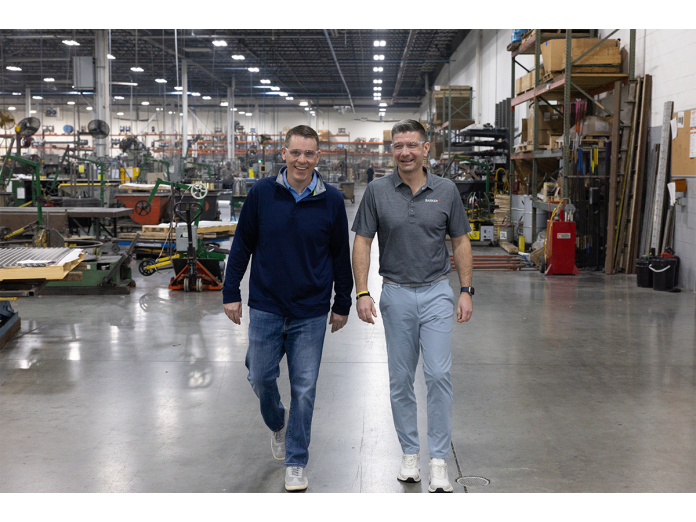
On the plant floor of Banker Wire’s 250,0000 square-foot facility, automated machines help make its product diversity possible. Some machines are staff-tailored versions of purchased products while others are completely built in-house by company machinists, but they produce a variety of wire mesh products based on customer needs.
First, steel rod purchased from Charter Steel in Saukville is drawn down into wire. And far from negatively affecting anyone’s style, crimpers put dents into the wire at precision locations so that when wires are weaved together by looms, it will have already created the perfect opening.
While Banker Wire has a workforce of 215 people, Frank said he estimates labor costs for most well-run manufacturers are about 10-15% of an income statement. Material costs, meanwhile,can range from 40-70% of an income statement, which helps explain why precision machining and automation is so important.
Frank also said the current topic of fair trade is important because material costs, more than labor, determine the outcome of a manufacturer’s success.
“Manufacturing, with our products, everything sort of needs to be just right,” said Harrison Horan, vice president. “If it’s off, cumulative problems occur and it ends up being a really bad day on the manufacturing floor.”

Looming demand
Banker Wire is located at 123 W. Boxhorn Drive in Mukwonago, and at the company’s insistence, the street is named for the Boxhorn brothers, George and John, who gave the company so much of its innovative energy after their father purchased it in 1965. They are no longer involved in the company’s day-to-day operations, but George still stops by about once a week “just for fun because he loves to spend time with the engineers,” Frank said.
That energy is reflected in the company’s determination to design and build many of its own machines. This capability not only saves on capital expenditures, but when it comes to continuous improvement, management believes the best input often comes from the people who are doing the jobs.
A recent tour of the facility, which opened in 2019, showed the advanced equipment used to make its wire mesh products. One of the newer machines is named HAL (Heavy Automatic Loom).
Justin Wesolowski, a senior mechanical engineer, was the main designer behind HAL. He once worked as a weaver and has designed and programmed looms.
“We build anything within our capabilities and our size limitations, so all small parts of the machines will be built in-house, and then anything big like the machine frames are outsourced to a local vendor,” Wesolowski said.
“Anything on the woven side, we’ll build here,” he said. “Any machine in this department — crimpers, looms, shears — all of that we build here.”
The process is one of continual refinement. With HAL, Wesolowski said, “We’re early in the development phase, which means we built it, went through the design phase, went through the building and assembly phase and programmed it. Now we’re testing it and troubleshooting it as we go to really iron out all the bugs in the programs and develop it into a consistently producing line.”
Elsewhere, automated welders are used on some orders but still require a skilled operator to run and maintain them while they weld wire. Peter Forester, vice president of welded product, oversees this area.
“What I’ve been doing since I came and joined Banker is basically getting the machines to run more efficiently, train the people in how resistance welding works and to give them the skill set to optimize each product,” Forester said.
Being creative with its machinery enables Banker Wire to respond to shifting customer demand, Horan said.
“This is an industrial-based product of which we’ve been doing fantastic keeping up with whatever the demand is, and there’s new demand each and every time,” Horan said. “We usually follow up with a piece of equipment that gives us new capability to dive deeper into whatever that demand is.”
Horan said the aesthetic side of the business probably existed as early as 1905 and over the history of the company, it has repeatedly faded away and come back.
“In the early 2000s, it came back pretty hard,” Horan said. “Most of the (architectural) designers were looking for an industrial-looking product to use for an aesthetic application, and we just had all the right ingredients.
“It just so happened that because we sweat the small stuff early on, it was ingrained in us and then we had an opportunity for this new thing — either to weave faster, or weave to an aesthetic — and we were right there ready to answer the call,” Horan said.
The big change with the architectural community showing interest in the product is that it gave Banker Wire “a whole new industry to play with,” Horan said.
Since 2019, Bank Wire employees have worked in its current facility, the first to be built in Mukwonago’s Bear Industrial Park. It is the fourth location for Banker Wire, which began in Milwaukee and has steadily expanded and moved southwest to Muskego and now Mukwonago.
Even though it has added square footage to the site, Banker Wire is already maxed out there and has purchased a 16,000-square-foot facility in nearby East Troy for storage.
“I jokingly call it ‘Monica’s closet’ from ‘Friends’ because we’re moving some of our equipment that doesn’t necessarily fit the perfect flow, just so I can just get us back to allowing for the perfect process flow inside this (Mukwonago) facility,” Frank said.

Banking on private equity
Outside interests have noticed Banker Wire, but they needed some prodding. In 2023, Banker Wire approached Lincolnshire Management, a New York-based private equity firm focused on investing in and acquiring middle-market companies, to inquire about a partnership.
The talks led to Lincolnshire acquiring Banker Wire in 2023, and the New York firm has lent business expertise and as-needed capital, and evaluated acquisitions for Banker Wire.
At the time of the acquisition, George Henry, managing director of Lincolnshire Management, cited the potential for expansion in the high-margin filtration, border fencing and mining markets.
But it was the quality of Banker Wire’s management team, which then included current board director Dave Stout, that was the main selling point.
“The first thing we saw was the management team, and that’s our investment style — that we really like to partner with strong management teams,” Henry said.
“We spent part of our due diligence on the business, but we spent a lot of time with them,” Henry said. “We thought they were someone we could trust and work closely with.”
Banker Wire’s diversified approach was another attractive feature.
“In terms of the business, what we really loved about it is that they’re in a lot of different industries,” Henry said. “The industries seem to all go up and down a little bit, just like any industry does, but since they’re a player in so many of them, it kind of balances out.”
What Lincolnshire did not envision was the explosive growth of large, hyperscale data centers.
“We knew that (data centers) were a business line that they did have, and the product that they produced was used in data centers,” Henry said. “But if you remember back then, it wasn’t the kind of growth that we were seeing today, but it was part of the thesis that they served so many end markets that some of those markets were bound to perform better than others.”
Data centers of attention
The supply chain needs of hyperscale data centers are now readily apparent. These massive facilities, which can have millions of square feet of space, can house thousands of servers and miles of connection equipment.
Whatever the size of a data center, Banker Wire’s wire mesh products are used to protect the equipment, enhance air flow and help organize all the cables that connect to the servers. They also provide the caging for storage and wire mesh for cable trays.
Asked how much wire mesh product is needed for a hyperscale data center, Frank said simply, “It’s exponential.”
Banker Wire typically works with the local contractor or subcontractor who takes its wire mesh and puts a frame around it.
“That’s worked out really well for us because we don’t necessarily have an end-product as opposed to some of our competitors, but we make sure that we’re their wire mesh partner,” Frank said. “We don’t provide mesh with a frame around it unless it’s more of a high-end product.”
Another part of the data center supply chain is Banker Wire’s biggest supplier, Charter Steel. Frank said 99% of the steel used by Banker Wire is purchased from Charter. Buying the low-carbon steel rod allows Banker Wire more flexibility and better control of its inventory.
With large data centers already offering Wisconsin manufacturers opportunities to serve a transformative need, Frank is concerned about the controversy over their impact on electric rates and energy and water use.
Frank, who once served on the plan commission for the town of Delafield, has seen NIMBY (not in my backyard) controversies, and he believes the bad public relations of large data centers is due to misinformation.
Frank said Banker Wire has joined the Wisconsin Data Center Coalition, which includes companies that supply data centers, to become better informed about them.
One task of the coalition is to address what it views as misinformation, as it did recently by citing a study challenging assertions that data centers are causing broad energy price increases.
“Our group is trying to make sure we at least have the facts out there and learn and understand what is truly happening,” Frank said, “and make sure that these data centers are going to do what’s best for Wisconsin.”
Banker Wire snapshot:
▶ Founded: 1896
▶ Founder: Charles Banker
▶ Headquarters: 123 W. Boxhorn Drive, Mukwonago
▶ CEO: Tim Frank
▶ Projected 2026 revenue: $85 million
▶ Global employees: 215
▶ Business classification: C-Corp.
▶ Industry: Manufacturing

