
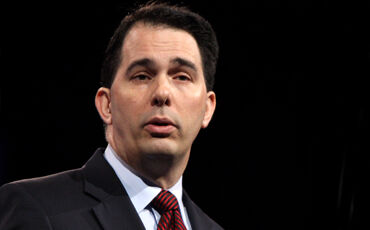
Running for president can be a humbling experience. Just ask former GOP frontrunner Scott Walker.
The Wisconsin governor’s surprisingly early exit from the 2016 presidential sweepstakes came just two months after his official entry, but for those who think his presidential bid was limiting his effectiveness as governor, the decision couldn’t come a moment too soon.
Judging by the most recent Marquette University Law School poll, 63% of Wisconsinites (including 28% of Republicans) did not like Walker’s decision to run for president.
Walker’s overall job approval rating has plummeted to 39%, with disapproval at 57%. Controversial measures like the repeal of prevailing wage for local government units, which goes into effect in January 2017, have arguably hurt his standing as much as budget cuts to the University of Wisconsin System. Asked whether the phrase “cares about people like you” describes Walker, only 37% say it does, while 59% say it does not.
Clearly, if Walker wants a third term, or if he wants to improve the environment for Lt. Gov. Rebecca Kleefisch or other possible 2018 Republican contenders, he has some repair work to do. Now that he’s dropped out of the race, what should his economic development priorities be?
Unfinished business
The state’s economic data isn’t bad; it’s also not what Walker promised when he set a goal of 250,000 new jobs in his first four years. According to the Quarterly Census of Employment and Wages released Sept. 17 by the U.S. Bureau of Labor Statistics, a respectable 39,600 private-sector jobs were created in Wisconsin in the 12-month period ending in March 2015. With an unemployment rate of 4.5% as of August 2015, the state is now approaching full employment, and private-sector wages increased by 4.5% in the first quarter of 2015, compared to the same period in 2014.
However, much like a modestly growing national economy gives people the sense that we’re not clicking on all cylinders, the same can be said for Wisconsin.
Kurt Bauer, president and CEO of Wisconsin Manufacturers and Commerce, says the organization has two immediate legislative priorities for lawmakers and the governor to consider and both are regulatory reforms. One is to more closely align the federal and state versions of family and medical leave. Bauer claims this measure has broad support from a diverse coalition. “We will have to be aligned with the federal law,” Bauer adds, “but with some nods to the fact that Wisconsin does have some unique aspects in the state law that we would want to maintain.”
The second is to mandate legislative approval of new state administrative rules with a $10 million economic impact. “We think that’s a smart reform, and we hope the legislature agrees with us,” Bauer states.
Longer term, he says Wisconsin must continue to reduce taxes. WMC would like to see Wisconsin get out of what Bauer calls “the infamous top 10” of the highest-taxed states in the union and focus on the “holy trinity” of tax, regulation, and litigation reform. “We could still use a healthy dose of all three,” he states. “Wisconsin’s transformation has been remarkable, but it’s still incomplete. There is more work to be done to make this an economic haven.”
(Continued)
WEDC: Reform or rejection?
One thorny issue is what should happen to the state’s primary economic development agency. After several years of reports about failed loans and questionable business decisions, Democratic state lawmakers have called for an end to the Wisconsin Economic Development Corp., which was established by Walker in 2011. They have proposed a new hybrid model — a Wisconsin Department of Economic Opportunity that would administer economic development programs, and a public-private board called the Badger Innovation Corp. that would recruit businesses, help develop industry clusters, and lead trade missions.
Meanwhile, Republican lawmakers want to maintain the agency, now led by former banking executive Mark Hogan, but they might be willing to modify its governance. State Rep. Samantha Kerkman, R-Salem, has proposed legislation that would create a criminal penalty for defrauding WEDC. Under Wisconsin’s current criminal code, bank fraud is a Class E felony punishable by up to $50,000 or 15 years in prison, but the WEDC falls between the cracks because it isn’t a bank. The agency has the power to impose a financial penalty on grant recipients who provide false or misleading information, but not criminal penalties.
Bauer says the Kerkman bill makes sense, but he wants people to slam on the brakes regarding the WEDC and keep its role in mind. He doesn’t think the agency gets enough credit for its successes, and notes the focus often is on its failings. “Economic development is their role, and they often have to support businesses that are unable to gain financing from traditional sources because they are startups having trouble,” Bauer explains. “There are going to be times when they lose money on those deals, but we have to recognize that this is why they exist. We want them to perform that mission.”
Michael Eisenga, owner of American Lending Solutions and the former mayor of Columbus, prefers the idea of merging WEDC and the Wisconsin Housing and Economic Development Authority (WHEDA). He says it was wise to hold off on the merger while WEDC sorts out its startup problems, but he adds that “it still makes sense to have one state economic development agency, not two.”
State of manufacturing
Buckley Brinkman, executive director and CEO for the Wisconsin Manufacturing Extension Partnership (WMEP), says despite some up-and-down swings, manufacturing is extremely strong in Wisconsin. Those swings, however, make it more difficult for manufacturers to manage their businesses between the peaks and the valleys, he notes.
The state can further boost manufacturing by addressing its current struggles with funding infrastructure. Wisconsin’s three major industry sectors — agriculture, manufacturing, and tourism — all rely on good roads, rails, and ports, but past raids on the state transportation fund have taken their toll. “Many of our transportation routes are past their engineered useful lives and need to be replaced and upgraded,” Brinkman notes. “We continue to rely on increased borrowing to fund these projects, rather than finding a permanent, fiscally responsible way to finance these projects into the future.
“Instead, we constrain our growth and productivity because we can’t reliably and efficiently get our goods to market.”
Brinkman cited the Zoo Interchange in Milwaukee, the busiest freeway interchange in the state, as an example. More than 50% of Wisconsin’s exports travel through the interchange every day, yet the state is stretching out the project over a number of years because it can’t afford to complete it in less time. “This causes needless delays and increased expenses for Wisconsin manufacturers,” he states. “Those additional costs make us less competitive.”
Eisenga agreed, noting that funding for the state’s proposed transportation projects are short about $300 million a year, putting dozens of projects on hold. The difficulty, he adds, is that all the options are bad. Some support raising the gasoline tax; others want to borrow the money every year to make up the difference. “Both are horrible ideas,” Eisenga states, “but so is doing nothing, which is also not an option.”
He suggested taking a page from two historically iconic politicians — President Ronald Reagan and House Speaker Tip O’Neill — who in 1983 collaborated on a fix for Social Security. “Remember what Ronald Reagan did as president to keep Social Security from going broke? He held a high-level “blue ribbon” negotiation with Democrats and Republicans to cut a deal, including a firm agreement not to politicize the solution, which both parties still honor to this day.”
Click here to sign up for the free IB ezine – your twice-weekly resource for local business news, analysis, voices, and the names you need to know. If you are not already a subscriber to In Business magazine, be sure to sign up for our monthly print edition here.

