

Nobody likes paying for insurance, but when you need it, you’re glad you did. For small business owners, business insurance often isn’t cheap, but the alternative — going out of business if disaster strikes — means it’s money well spent.
Business insurance protects business owners from the unexpected costs of running a business. Accidents, natural disasters, and lawsuits could run you out of business, so it’s important to protect yourself with the right insurance.
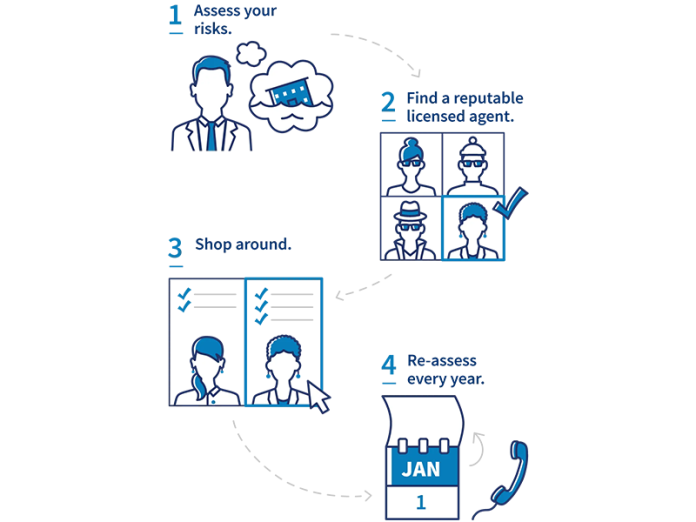
When looking to buy business insurance, there are four basic steps to follow to ensure you’re purchasing the right insurance in the right amounts:
• Assess your risks. Think about what kind of accidents, natural disasters, or lawsuits could damage your business. Is your business located in a commercial area that is at risk from seasonal events? Commercial property insurance will help protect against loss.
• Find a reputable licensed agent. Commercial insurance agents can help you find policies that match your business needs. They receive commissions from insurance companies when they sell policies, so it’s important to find a licensed agent that’s interested in your needs as much as his or her own.
• Shop around. Prices and benefits can vary significantly. You should compare rates, terms, and benefits for insurance offers from several different agents.
• Reassess every year. As your business grows, so do your liabilities. If you have purchased or replaced equipment or expanded operations, contact your insurance agent. You should discuss any changes in your business and how they affect your coverage.
While these are important things to know if you’re a new business owner, seasoned owners are likely more interested in what’s trending in the business insurance marketplace and how those changes might impact their operation. What follows is an overview of some of those trends, including the rising cost of property-casualty coverage and how insurers are using AI.
Insurance costs surge
According to Ross Heginbottom, client executive for M3 Insurance, the property placement market faced significant challenges in 2023, marked by rising rates, a strong emphasis on achieving adequate replacement cost valuations, higher deductibles, stricter terms, increased underwriting scrutiny, and the withdrawal of some markets due to persistent losses in specific business sectors.
“Many insurance companies worked to reconcile their balance sheets due to issues with reinsurance capacity, pricing, as well as an increase in large severe event losses,” says Heginbottom. “Rate impact was seen widely across industries as property rates increased for the sixth year in a row.
“Rates are expected to increase in 2024,” Heginbottom continues, “but there are signs that those rate increases will not be at the same levels presented throughout the end of 2022 and 2023. We anticipate that there will be some variability in the level of property rate increases dependent on carrier relationship, loss experience, inadequately protected risks, coastal or catastrophe-prone areas, and business segments such as frame or joisted masonry habitational, foundries, food manufacturers, and chemical manufacturers.”
Severe convective storms, particularly in the Midwest, are receiving heightened attention, notes Heginbottom. In 2023, the U.S. experienced 28 distinct weather and climate disasters, each costing at least $1 billion. This is the highest number of billion-dollar events recorded in a single year, including 17 severe weather and hail events across various regions.
Policyholders should anticipate more common wind and hail deductibles, even in states like Wisconsin. Insurance companies will also be closely assessing the concentration of their property values in specific areas.
“The hard property market has presented situations where increased deductibles, limitations on coverage terms, and property limits may no longer follow the requirements outlined in leases, loans, or contracts,” explains Heginbottom.
“There have been situations where the requirements outlined in these agreements are no longer commercially available or perhaps cost prohibitive to an insured. Careful review of the property insurance requirements within these documents and approval processes for changes to the coverage terms should be conducted ahead of time to ensure continued compliance.”
Underwriting scrutiny and the need for complete submissions will remain prevalent throughout 2024, Heginbottom adds.
“With the emergence of AI and technology, underwriters are declining less desirable business using algorithms instead of open discussion. Insureds should be prepared to provide additional information surrounding the updates to the building(s), look to close any open loss control recommendations, and provide any documentation pertaining to the maintenance and care of their building to achieve the best results in this market.”
For some companies, traditional insurance programs are not always effective, yet they are often the only option considered. A captive insurance model can provide an alternative form of risk management that offers tangible benefits.
While captives may not be suitable for every business, they are often highly effective in high-risk industries with substantial annual workers’ compensation premiums.
In a captive arrangement, you essentially become your own insurer. This means that when claims are minimal, the profits stay with you, not the insurance company. Additionally, captives have mechanisms in place to control costs even when claims are high.
As businesses grapple with the challenges of obtaining adequate coverage at a palatable price point, captives can provide a lifeline.
For property and casualty insurance, there are few different types of captive solutions that might make sense, says Brendan Bush, director of property & casualty captives practice for M3. They include:
Group captives
“Amidst the hardening insurance market, group captives have become a beacon of hope for mid-sized companies,” says Bush. “By pooling resources and sharing risks with other best-in-class companies, members can collectively tackle the rising costs of traditional lines of coverage. These captives offer stability, cost predictability, opportunity for return on premium, and the ability to negotiate with insurers from a position of strength, all of which are critical in a hard market.”
Single parent captives
“Large corporations, faced with escalating premiums and reduced capacity in property and liability lines, have turned to single parent captives as a means of taking control over their risk exposures,” notes Bush. “Single parent captives allow for tailored coverage solutions and efficient capital allocation, providing much-needed flexibility in the face of the hardening insurance market.”
831(b) microcaptives
“In the context of the hardening insurance market, 831(b) microcaptives have demonstrated their resilience,” explains Bush. “While regulatory scrutiny remains, legitimate microcaptives have proven to be a viable option for businesses looking to manage escalating insurance costs.
“These structures offer greater risk control — particularly relating to low frequency, high severity exposures, helping businesses navigate the challenging insurance landscape.”
For business owners requiring auto insurance, the marketplace is experiencing similar price increases.
According to Tiffany Hausmann, personal lines consultant and principal with Hausmann Group, on average, auto rates in Wisconsin were up over 30% in 2023, the largest annual increase in almost 50 years.
She notes the primary factors driving this disruptive market include:
• Cost of replacement parts — Generally, the cost of auto parts is stable with an average annual increase of 3% between 2017–2020. That increased to 8.5% in 2021 and 16.5% in 2022.
• Supply chain issues — Auto manufacturers have struggled to maintain new inventory resulting in the cost of new cars going up 18% over the past couple of years. Low inventory shifted the demand to used cars where the impact on costs is even worse.
How AI is transforming the insurance industry
Artificial intelligence (AI) is transforming business operations across all industries, including insurance. By automating processes and analyzing vast amounts of data, insurers can enhance customer experience and streamline their operations. From generative AI, like ChatGPT, to predictive analytics, there are AI solutions available to benefit every insurance agency.
“The impact of AI can be felt companywide,” explains Billy Collins, a senior manager with Wipfli. “McKinsey & Company predicts that the use of AI by insurers could lead to a 40% decrease in operating expenses by 2030. Additionally, AI-powered insurance experiences have been found to increase customer satisfaction by up to 20%, according to Capgemini. A study by Salesforce found that more than 60% of customers say they’re open to AI being used to improve their experiences.”
According to Collins, the following are just some of the ways insurers can utilize AI to improve their processes and enhance the customer experience:
Personalization and recommendations
By analyzing customer data, AI enables insurers to offer personalized recommendations and tailor their products and services to meet individual customer needs. For example, a life insurance company can use AI to suggest policies based on a customer’s age, health, and lifestyle. Additionally, AI can segment audiences by numerous factors and dynamically create marketing campaigns or offers that are more likely to elicit a positive response from customers. This process can be fully automated, allowing agents to hyper-personalize customer outreach without increasing their workload.
Claims processing and fraud detection
AI can significantly enhance the efficiency and accuracy of claims processing for insurers. By analyzing data from various sources, such as photos and videos, AI can identify fraudulent claims and flag them for review. AI-powered claims processing not only improves efficiencies and reduces costs but also accelerates the claims process for customers. Computer vision algorithms enable quicker verification, allowing insured customers to receive their claim payments faster.
Risk management and underwriting
AI can assist insurers in more precisely evaluating risk and enhancing underwriting processes. For instance, an auto insurer can leverage AI to analyze data from telematics devices, enabling more accurate pricing based on a customer’s driving habits. These systems generate detailed data records, including G-force values, date, time, speed, location, trip mileage, and fuel consumption. This data allows insurers to better estimate accident damages and reduce fraud by examining driving behaviors such as hard braking, speed, and timing during an incident.
Chatbots, virtual assistants, and 24/7 support
AI-driven chatbots and virtual assistants can provide around-the-clock support to customers, addressing their questions and resolving issues. This not only enhances the customer experience but also alleviates the workload of customer service teams. Virtual assistants are notably independent of a visual user interface, enabling insurers to connect with customers beyond their websites, portals, or mobile apps by integrating with voice tools like Amazon’s Alexa devices. Additionally, virtual assistants make 24/7 support feasible, allowing customers to seek assistance at any time, which is a significant advancement for many insurers.
“More than a year and a half after ChatGPT was released to the public, the insurance space is well aware of the predominant use cases for AI and machine learning,” notes Collins. “And, while SaaS companies have been racing to develop tools and technology for those primary use cases, little is being discussed about how insurers should think about emerging technology so that future implementations don’t fall flat.
“Many legacy companies in the financial services sector are finding innovative use cases for generative AI to be few and far between,” continues Collins. “Leaders appear to be in their wait-and-see era, pondering the practical impacts AI will have on the space after it’s had a chance to mature among insurtech startups or adjacent industries. For the past several years, AI has been primarily deployed in every sector as an efficiency booster. The term ‘doing more with less’ persists, especially in margin-strapped environments like insurance.
“Still, more than three in four insurance CIOs (76%) ranked excelling in customer experience as their top priority going into 2024, followed by generating revenue (68%) and boosting margins (65%), according to a Gartner study,” Collins explains.
“For companies that want to adopt AI in insurance effectively, the aim is to break away from wait-and-see tactics and siloed investments in back-office technology and focus on greater speed, personalization, and quality in their digital customer experiences.”

