
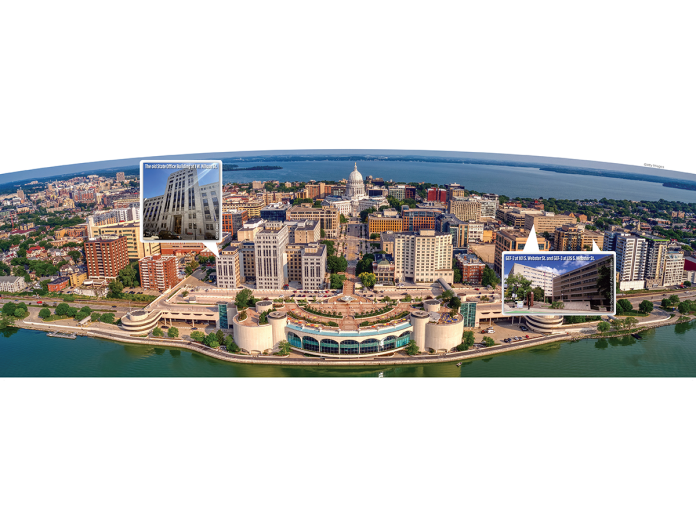

The pending sale of former state office buildings near the Capitol Square has local executives and officials salivating at the redevelopment possibilities for an area already undergoing transformative change.
The buildings, known as GEF-2 and GEF-3 (General Executive Facility), are located south of the state Capitol at 101 S. Webster St. and 125 S. Webster St., and were put up for sale March 18 as part of the state’s Vision 2030 facilities plan.
The Vision 2030 plan, according to a statement by Department of Administration Secretary Kathy Blumenfeld, is to “right-size” its real estate portfolio. Among other goals, it seeks to modernize and consolidate state owned facilities, reduce the state’s real estate footprint by 10% through hybrid work favored by state employees, and save taxpayers an estimated $100 million in deferred maintenance to aging buildings.
The plan was revised after the COVID-19 pandemic, when many state employees became accustomed to, and expressed a preference for, working from home.
The Webster street block, also known as Block 107, is zoned for mixed-use developments, and prospects for adding housing, hospitality, retail and restaurant spaces in their place represent a golden economic development opportunity.
Jason Ilstrup, president of Downtown Madison Inc., said GEF-2 and GEF-3 sit on one of the most dynamic sites in downtown Madison.
“It’s a 2-1/2 acre site right in the heart of the action, located a block from the Capitol, a few blocks from Lake Monona on a burgeoning and very vibrant King Street, and potentially connected to the new Madison LakeWay project, and all of the development happening on Wilson Street,” Ilstrup said.
The Madison LakeWay project is a public-private partnership to transform 1.7 miles of the Lake Monona shoreline (17 acres overall), from Machinery Row to Olin Park, into more of a welcoming public destination and better connect downtown and south Madison to the lakefront. It aims to improve public access and water quality and recognize the cultural history of Madison that is associated with the lake.
Reimagining Block 107 “really is a once-in-a-generation opportunity to look at something new and to have a vibrant, dynamic use on the street that interacts with the surrounding areas and adds significant economic strength to the downtown,” Ilstrup said.
He said the two GEF buildings could be replaced with multiple buildings to address local housing needs with a mix of affordable, workforce and market rate multifamily units or owner-occupied condominiums.
“I do think you’ll see some commercial development, potentially, and I think you might see some hospitality,” Ilstrup said. “Those are probably the most common needed usages downtown, and when it comes to the first floor, we want to see a very dynamic storefront so that you have the vibrancy that helps create those connections between the Capitol, the Lake Monona area, and the Wilson Street area.
“There’s a significant amount of residents in that area and growing all of the time with 109 (East Wilson) opening and other projects,” he said, referring to the new luxury apartment building. “Some of that retail can help serve that residential base but also some of the retail can help serve the larger community that comes in, including visitors from the rest of the area in Dane County and then, of course, tourists.”
Hospitality is not out of the question, even with recent hotel space added downtown such as the 151-room Moxy Madison Downtown on East Washington Avenue and the recently approved 205-room Drury Plaza Hotel on the former Madison College site on Carroll Street. Construction on the latter could begin later this year.
Chris Caulum, vice president of commercial brokerage with Oakbrook Corp., said new hotel rooms downtown are being supported.
For Block 107, he said the strongest cases are housing and hospitality. “We haven’t seen any new hotels on the west side of Madison, but downtown over the last few years, there’s definitely been more,” Caulum said.

Another nearby redevelopment opportunity is the pending sale of the state’s 1 W. Wilson St. property.
The historic structure, also known as the old State Office Building, dates to 1931 when its first section was completed. It was most recently home to the Wisconsin Department of Human Services, which has moved to GEF-1, located at 201 E. Washington Ave., which still is used by the state and also serves as the headquarters of the Department of Workforce Development.
With 422,087 square feet of space and 11 stories above ground, the 1 W. Wilson building is zoned to allow residential, hospitality or corporate use. The request for proposals for the sale of the building closed on March 16 and the Department of Administration is currently reviewing the submitted bids. The agency plans to evaluate them at this month’s State Building Commission meeting.
Madison Ald. Mike Verveer, who represents the 4th aldermanic district where the GEF and West Wilson buildings are located, said he’s had preliminary meetings with developers interested in 1 W. Wilson. Verveer said that site is likely the future home of a mix of housing, hospitality and an Amtrack station serving a line that connects Madison and Milwaukee.
“This is a golden opportunity to further the investment in downtown Madison to keep us going on this spectacular trajectory that that downtown has been enjoying,” Verveer said.

Brutal Reality
The GEF buildings, built in 1978, were designed decades ago in the brutalist architectural style. Brutalism, which emerged after World War II, was marked by raw, unadorned materials — mostly block concrete — and often used in government and university buildings.
Today, they are considered eyesores by many, and both Ilstrup and Caulum said the GEF buildings are likely to be torn down and replaced, rather than remodeled, as part of the redevelopment proposals that follow the announcement of the winning bid.
“Unless somebody really falls in love with brutalist architecture, yes (it will be torn down),” Caulum said.
Caulum said there might be some new office space in the mix, but that’s not the “highest and best use today.”
“The zoning allows a lot of different uses,” Caulum said. “It probably encourages mixed-use but regardless of that, developers are going to go with whatever they think is going to be the highest and best use for today, and that’s not going to be office.”
The state usually accepts the highest bid for its properties, and the two GEF buildings were appraised last fall by Racine-based L&A Appraisal Inc. at a combined $45.5 million.
Of all the redevelopment opportunities, addressing the area’s housing shortage is the most important, Ilstrup said. Last August, 340 upscale apartments were added with the opening of the 109 E. Wilson building (the One 09), but more housing can be added in the downtown area.
“Look, we know we need more housing, even as the market has softened a little bit downtown,” Ilstrup said. “It’s basically gone from unhealthy to healthy. It’s now about 6½ or 7% vacancy, partially because last summer in a three-month period we added about 8% new supply into the downtown, and that just takes some time to get absorbed.
“But the demographics are there,” he said. “We know it. The projections all have us continuing to grow significantly, at least until 2050, and so we need housing.”

What’s next for Brayton Lot redevelopment?
Yet another opportunity to address the area’s housing needs rests on downtown Block 113, the city’s Brayton Lot, a two-acre square block along East Washington Avenue.
Three blocks from the Capitol Square, the Brayton Lot had been used for surface parking and as a staging area for the bus rapid transit project.
Now that BRT is up and running, city staff is reviewing proposals for a high-density, mixed-use redevelopment on the site, which is bound by East Washington Avenue to the north, East Main Street to the south, North Butler Street to the west and North Hancock Street to the east.
The city has received development proposals from Madison’s Brink Development and Tareen Development Partners of Roseville, Minnesota.
Both companies have submitted plans for hundreds of residential units, including affordable housing, and public spaces, but they differ on the housing mix for what is considered a prime piece of real estate.
A recommendation on the city staff’s preferred development partner was expected to be delivered to city officials in early 2026, but as of early April, city planners were still weighing the options.
Matt Mikolajewski, director of the city’s Economic Development Division, said in an email that both the Brink and Tareen proposals are still on the table. He said the city has partnered with Baker Tilly, its financial consultant, to help review the proposals.
“We hope to complete this review soon, at which time we will be able to present our findings and recommendations to the Finance Committee,” Mikolajewski said.
Brink plan
Brink Development’s “Brayton Square” plan, named in honor of Louisa Brayton, Madison’s first teacher, calls for two residential buildings with a total of 281 owner-occupied condominiums.
In its proposal (pictured), Brink said 20% of these units will be priced for households earning up to 80% of the area median income. Madison’s median household income is approximately $78,050, according to U.S. Census data.
Retail and commercial spaces would line the East Washington corridor and flank a pedestrian plaza.
Tareen proposal
Tareen Development Partners would construct three buildings, one 10-story and two 12-story structures, with a total of 574 units of affordable housing and 30 market-rate condos in building 3 at the corner of Main and Hancock streets.
A seventh-floor restaurant in building 3 would offer views of Lake Monona, and the site design positions all three buildings along street frontage and introduces a central plaza space with different access points.
Preference for owner-occupied
While residents waited for city staff to make a recommendation — launching a review process that includes public testimony — In Business Madison spoke to Ald. Davy Mayer, who represents District 6 that includes the Brayton Lot.
Mayer said the city is looking for more housing of any kind, “but especially, there is a huge demand for owner-occupied housing since most of what we’ve seen built in recent years are apartments.”
Mayer said the mix of housing — affordable, market rate and high-end — matters a great deal, as does some green space.
“There is always going to be a demand for affordable housing,” he said. “It’s very difficult to build that new, so whenever we can find ways to offer incentives to build that, that’s a plus. But otherwise, market rate is always better than nothing.”
Some street-level retail is always a welcome addition, but Mayer said it’s predicated on demand.
“We have quite a bit of vacant retail still in the downtown area, so I don’t know that the demand is that high for that,” he said.

