
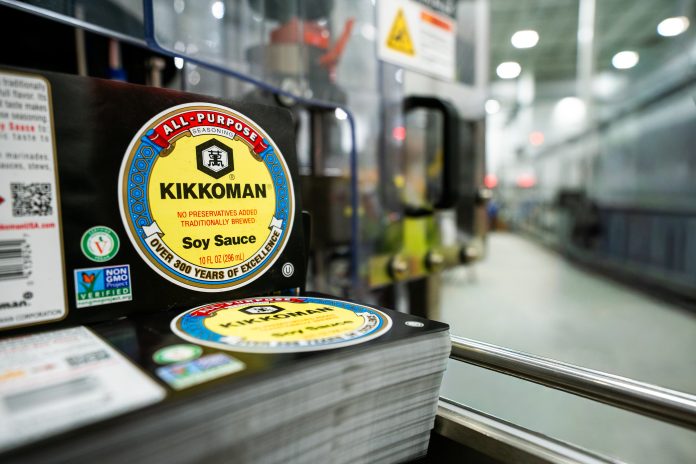
The new Kikkoman Foods manufacturing plant in Jefferson rises above a freshly minted industrial park as if to invite neighbors — and to serve as a visible reminder of continued Japanese investment in Wisconsin.
It’s the second Kikkoman manufacturing plant in Wisconsin and only the third in the United States, where the 350-year-old company has invested $800 million over time to make soy sauce, teriyaki sauce and other products for American markets and beyond.
Why Wisconsin? The answer starts with soybeans (lots of them), ample water, available sites, a solid workforce and a working relationship with state and local governments since the early 1970s, when Kikkoman’s Walworth plant was built.
Toss in cultural ties that involve some of Wisconsin’s most iconic names and a measure of uncertain times in the Pacific Rim, and it’s easy to understand why Kikkoman is one of more than 80 Japanese owned or operated companies in Wisconsin. They collectively employ about 10,000 people in the state.
Such firms include Fujifilm’s biotechnology arm in Madison, Komatsu, IRIS USA and Toshiba, as well as smaller operations such as Asahi’s Octopi brewery in Waunakee.
Kikkoman looked at 64 sites before settling on Jefferson, company patriarch Yuzaburo Mogi told about 350 people who attended the Sept. 18 dedication. Jefferson emerged for many business reasons, including performance-based state tax incentives, but Mogi recalled that people in Walworth “embraced us from the first moment we arrived” more than 50 years ago. Today, Walworth is Kikkoman’s highest-producing plant in the world.
Japanese companies have collectively been the No. 1 foreign direct investor in the United States since 2020, totaling $827 billion at the end of 2025. In Wisconsin, Japan runs neck-and-neck with Canada, with $4.2 billion invested by Japan since 2003. The Jefferson plant will add $560 million to the state total over 10 years. Japan is typically among the top five U.S. trade partners, as well.
Also on hand in Jefferson was Japan’s ambassador to the United States, Shigeo Yamada, who later made the short trip to Edgerton to visit the boyhood home of author Sterling North. His book “Rascal,” which captured North’s early years with a pet racoon, enjoys a strong following in Japan today in print and anime.
Also in Edgerton, Yamada marked a book donation by the Japan-America Society of Wisconsin to the city’s library, where about 70 people showed up to welcome him. In both Edgerton appearances, Yamada stressed the value of people-to-people exchanges.
It’s not just pet raccoons that draw Japanese culturally closer to Wisconsin. Architect Frank Lloyd Wright, naturalist Aldo Leopold and author Laura Ingalls Wilder are familiar names there, too, which is why a “Rascal Trail” effort is underway to bring more Japanese visitors to Wisconsin.
Like many nations in today’s nervous world, Japan is dealing with issues closer to home that reinforce the need for strong U.S. ties.
American tariffs have led to a baseline 15% rate on most Japanese imports under the 2025 U.S-Japan Framework Agreement. Those tariffs are a factor in direct American investments, with more onshoring by Japanese car companies serving as an example.
Japan is not immune from inflation, either, which is why the Bank of Japan has raised interest rates to a 31-year high after decades of an “easy money” policy.
Japan’s leaders are keeping a close eye on Taiwan and China’s longstanding urge for reunification with that island nation. The latest Chinese moves don’t signal imminent force, but there are roughly 54,000 U.S. service personnel stationed in Japan to aid in regional defense. North Korea isn’t far from Japan, either.
Russian President Vladimir Putin recently stirred resentment in Japan by visiting the Kuril Islands, which the former Soviet Union claimed for its own at the end of World War II. Japan asserts sovereignty over the Kuril’s four southern-most islands.
Those geopolitical issues don’t directly involve Wisconsin, of course, but it’s easy to see why friends need to help friends on both sides of the Pacific. It’s a recipe that calls for a little more soy sauce.
Tom Still is past president of the Wisconsin Technology Council. He is an adviser to Competitive Wisconsin Inc., a nonprofit public policy group.

