

As one of the more than 6,300 students in the School of Computer, Data & Information Sciences at the University of Wisconsin-Madison, Shona Acquaye is looking forward to seeing more of her professors, who are gathered under one roof for the first time.
And, as she begins her final semester, pursuing a degree in information science and a certificate in digital studies, Acquaye is also excited that more students may receive exposure to the academic areas she’s most passionate about.
“I hate the thought that tech is only for certain people, or people who know how to code,” she said, adding that the newly constructed Morgridge Hall “will definitely open opportunities for people that are interested.”
As the official new home of CDIS, Morgridge Hall was designed to increase the school’s capacity — especially since it unites the largest majors on campus, computer sciences and data sciences — and amplify cross-campus collaboration.
The 343,000-square-foot space at the corner of University Avenue and North Orchard Street is the product of $267 million in private funding, including gifts from principal donors John and Tashia Morgridge; inspiration from CDIS’ founding director, Tom Erickson; and the cooperative efforts of a team of local and national architects, builders and interior designers.
With eight stories — including one underground — a student classroom capacity of over 1,000 and more than 20 research groups represented, Morgridge Hall will serve as a hub for Wisconsin’s robust tech ecosystem right in the so-called “tech corridor” of the UW-Madison campus.
The facility is well suited to the growing needs of CDIS, especially as UW-Madison weighs the possibility of spinning out the school into a new college focused on artificial intelligence.
Morgridge Hall’s building design, with several multifunctional areas and a keen eye on environmental sustainability, establishes pathways for curiosity and connection. Its dedicated spaces for students, staff, research and industry and community partners pass by, overlook and intercept one another.
As CDIS Director Remzi Arpaci-Dusseau puts it, “The facility is world-class, offering the latest in classroom technology for students, and incredible collaborative space for research and team work.”
Departments unite
The inspiration for Morgridge Hall dates before the COVID-19 pandemic with the formation of CDIS, which joined together the Computer Sciences and Statistics departments and the Information School, or iSchool.
Arpaci-Dusseau said with those departments “scattered across campus,” his predecessor, Erickson, sought a home base for the combined school.
“We began work on the idea of a building to bring us all together, and serve as a center of computing, data and information for the campus, city and state,” Arpaci-Dusseau said. “One of the things we realized early on was the opportunity to bring more than just the three CDIS departments into the building, to further cross-unit and cross-campus collaboration.”
He cited several examples, including the Biostatistics and Medical Informatics department within the School of Medicine and Public Health, about half of whose faculty works in the building; the Data Science Institute, which undertakes data-driven research and science campuswide; and the Center for High Throughput Computing, which collaborates with researchers from almost every other college at UW-Madison.
“The building has quickly become a hub of activity in computing and data-driven research,” Arpaci-Dusseau said.
Trinity Krohn, a CDIS student pursuing a double major in computer sciences and data science — as well as a certificate in entrepreneurship — heartily agreed as she made her way through the new building on the first day of fall classes.
“I think the fact that they’re bringing all the majors and others in is really cool,” she said. “It never used to be that connected. … Now, it can be more collaborative.”
A tall order
Bringing so many areas of campus into one house and creating an environment of interconnectedness, rather than isolation, presented a challenge in a massive facility with a largely vertical structure.
Findorff led the building construction, while Kahler Slater and Seattle’s LMN Architects were tasked with designing approachable spaces that fostered interaction.
“We’re thrilled to continue being part of monumental projects like CDIS, which will have an enormous positive impact on the local community and its workforce,” Jim Yehle, Findorff’s president and CEO, said in a statement. “It’s exciting for us … knowing that the students inside this building may become future innovators — ready to deliver the world’s next big idea.”
“The idea was really not siloing these departments,” said Mark Tumiski, design principal for LMN. “They wanted to have a common heart where they could essentially create this whole new idea of CDIS.”
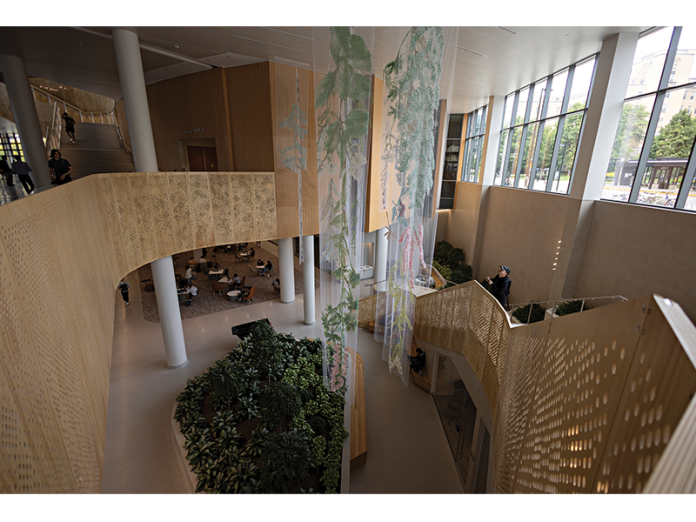
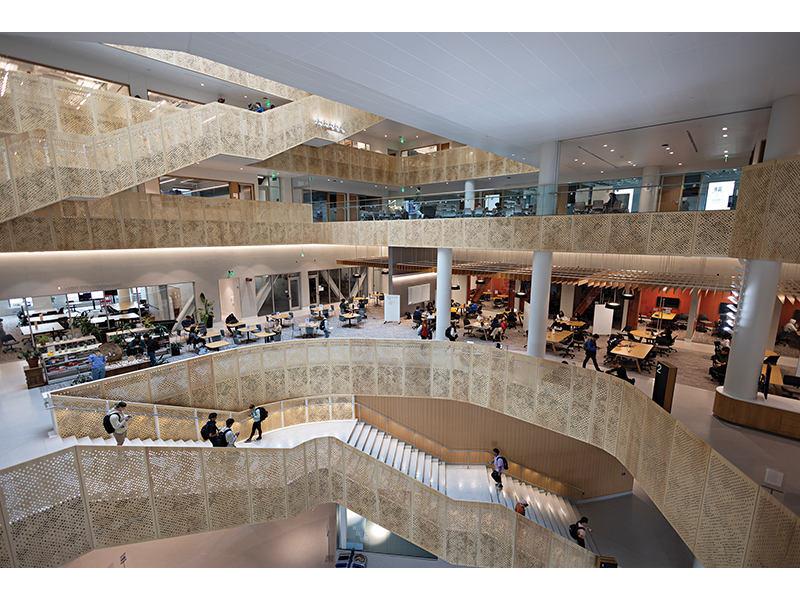
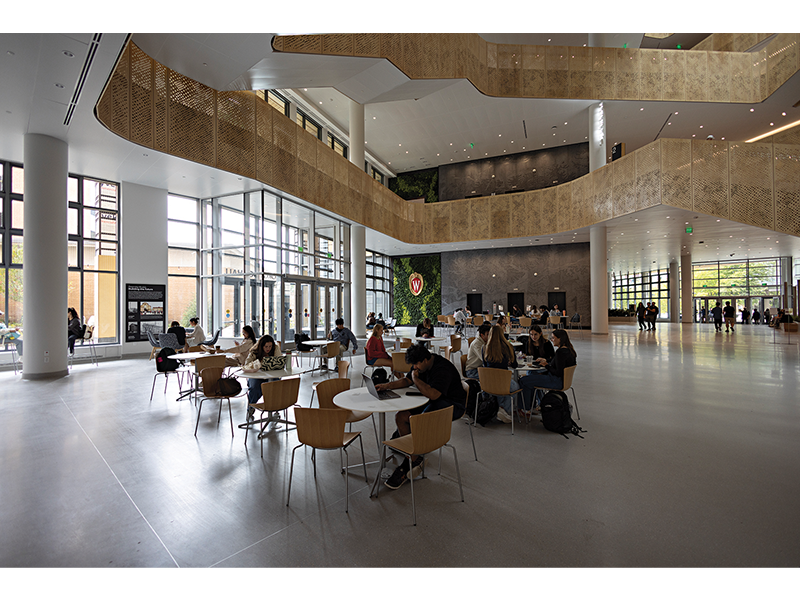
Morgridge Hall’s “heart” is a center atrium, beginning with an open first floor that includes a cafe and aims to draw in the community. A sweeping staircase winds upward toward a large skylight, and offers a broad view of every floor.
Even the wooden guardrail of the staircase is perforated for better visibility and light, and a clear portion of it on the third floor lets passersby look into an open lab space.
“How people actually navigate through the building as part of their experience of campus was really important,” said Chris Ludwig, a senior designer at Kahler Slater, adding that Wisconsin landforms and ecologies provided a familiar and organic feel “from the building form, to its terracing, all the way down to the materials and textures that were created.”
A series of “ecosystems” focused on learning, students and research weave through the facility and provide continuity across its several levels.
The learning ecosystem is made up of the main student classrooms, which are conducive to large classes that include CDIS majors and other students still exploring.
“You’re engaging people earlier in what interests them,” said Ludwig.
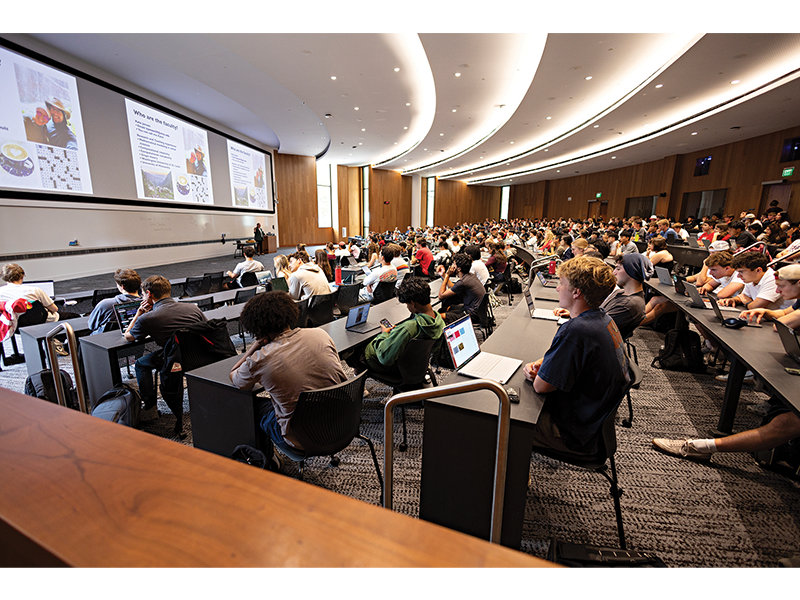
The first floor’s “Hello, World!” auditorium — a nod to computer programming, where the phrase is the common first program written in a new language — has a 320 student capacity and is well-suited to introductory courses.
In total, there are 13 classrooms distributed among the lower floor, first and second levels.
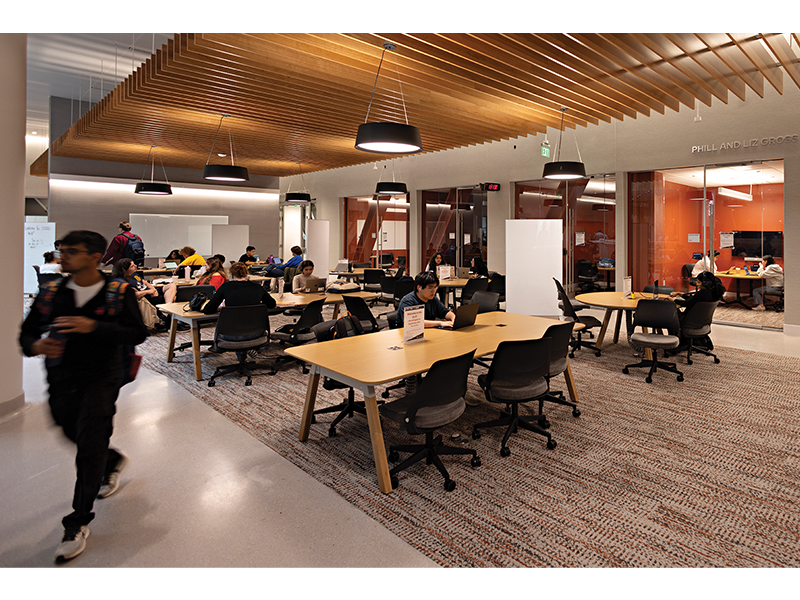
The student ecosystem on the building’s second floor consists of tutoring spaces, advising suites, student groups, undergraduate and graduate commons, a library and more.
“We really wanted to create this dense cluster of activity for students to build their career at CDIS,” Tumiski of LMN said.
The research ecosystem on Morgridge Hall’s upper floors, meanwhile, aims to balance the need for privacy with what Tumiski called a “porousness” — or openness and visibility — to student life.
“How do we link all of that together? The idea of a breadcrumb trail,” he said. “There’s all these key hubs throughout the building, and we linked them together with this stair that winds through the central part of the building.”
Many of the labs, offices and collaborative spaces in the building are flexible to rearrangement based on the changing needs of the university and community.
The Morgridges had also urged a focus on environmental sustainability throughout the facility’s planning stages.
“Mr. Morgridge … basically asked the question, ‘how can this be the most sustainable building on campus?’” said Kahler Slater’s Ludwig. “So that, for us, set a very clear benchmark.”
The building was designed for LEED Platinum Plus certification, with nearly 360 solar panels, two green roof terraces, water efficiency exceeding federal standards, a minimized carbon footprint and even triple-glazed windows with bird frit to protect migrating flocks.
“(John Morgridge) wanted the spaces to feel warm and welcoming — places people wanted to live and be all the time, not just institutional,” said Tumiski. “(There’s) an unusual touch and feel to the building that you don’t always see at this scale.”
Forging the future
CDIS founding director Erickson’s original vision for Morgridge Hall centered on its future role as “lighthouse for technology in Wisconsin,” and as the facility opens its doors for its first semester of classes, that notion is becoming a reality.
“The colocation of the three schools is going to create some significant synergies and opportunities for (CDIS) to capitalize not only how they educate, but the connections that they have between the schools and … for future business opportunities for the students that they’re educating,” said Ludwig.
Jennifer Buck, project manager at Kahler Slater, added that one of the reasons the project has been so successful is because of the many industry partners Erickson brought to the table.
“(He got) their input on what would be most beneficial for educating these future computer, data and information science leaders and researchers,” she said. “They’re investing in this for Madison and the broader state of Wisconsin, and embedded in the building right now. … They can have physical space and involvement with the research on a day-to-day basis.”
With the emergence of AI, it’s more critical than ever for CDIS to remain on the industry’s bleeding edge and keep up with increased workforce demand. The school’s new home will provide necessary infrastructure that’s flexible to UW-Madison’s future needs.
“Soon after the ‘AI moment’ started happening in the world … it became quite clear that AI was having a transformative effect on many things we all do,” said Arpaci-Dusseau. “We’ve been thinking hard about how this will impact campus, in the broadest possible terms.
“How will research change, as science and discovery become more intertwined with the latest AI-based techniques? How will education change, as students learn how to use modern AI tools not only as learning tools but also as tools to harness to get work done?”
When Morgridge Hall was conceptualized, Arpaci-Dusseau said, there was already an understanding that CDIS or some form of it might become a separate college, and he’s confident the building would be “well suited as a home for a new entity.”
“Within CDIS, we always seek to teach the fundamentals of our fields, and we will keep doing so for our majors and others who take our classes,” he said. “But we also see how as AI influences everything, we — as technical leaders in the field — need to be at the forefront of how such technology is taught across campus.
“Morgridge Hall serves as a perfect centerpoint for this activity. … We look forward to working with all of our peers in driving the transformations that are to come, and ensuring that they help improve people’s lives across the city, state and beyond.”
Krohn, like many of her fellow students, shares Arpaci-Dusseau’s awareness of how crucial a beacon for AI that Morgridge Hall might be.
“The AI learning curve is so high,” she said. “There needs to be a space for everyone to get the opportunity.”

