

The University of Wisconsin-Madison is weighing plans to create a new college that will not only keep up with AI developments but help lead them — an endeavor that could prove revolutionary across academia and industry alike.
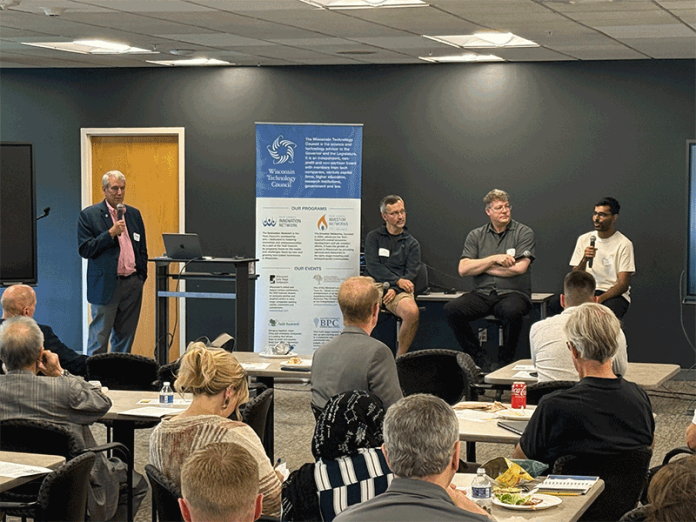
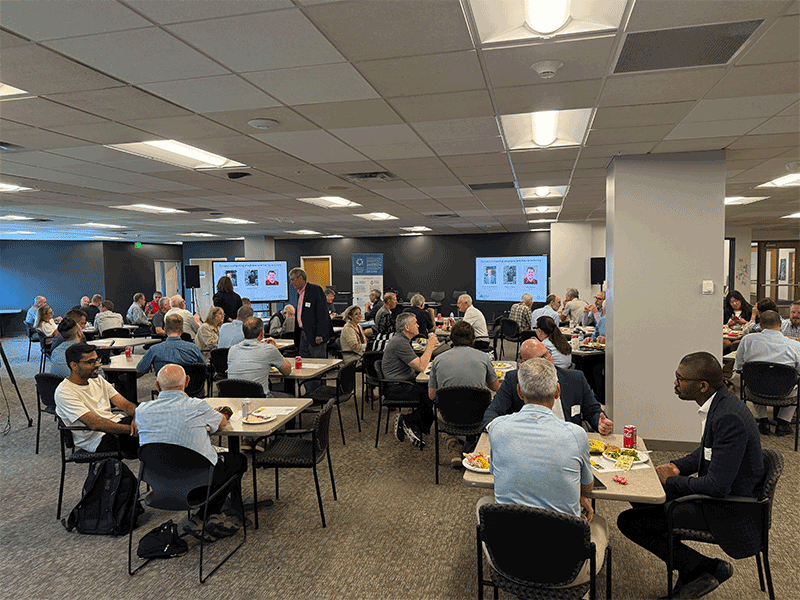
Remzi Arpaci-Dusseau, the director of the school of Computer, Data & Information Sciences and the special advisor to the provost on computing, raised that possibility at Tuesday’s Wisconsin Technology Council Innovation Network luncheon in Madison, where he and other panelists discussed the implications of AI for the university, businesses and the future workforce.
With its long and pioneering history in computer science and translatable discoveries, UW-Madison stands on the precipice of a new age. If a new college is born out of the CDIS — currently under “strong consideration” — it would be the first this century.
“Colleges aren’t created very often on campuses,” said Arpaci-Dusseau. “The last one was 1979 … That’s a really unique opportunity that we have.
“I think that makes us all a little nervous, but it’s also really exciting. … (UW-Madison) can be a leader in this space. … We have a really broad and excellent university … pretty unusually positioned to make some dent in (a variety of) fields.”
He added that the new college would center on AI innovation with more focused leadership, accelerated growth to keep stride with industry demand and opportunities for new fundraising and initiatives.
“Having a college that’s focused on being the prow of the ship is really important,” Arpaci-Dusseau said. “We want the impact of this thing not to be insular. It’s not to just generate more majors that are steeped in the topic matter but rather to have a much broader impact.
“The word I use to summarize this is, ‘integrative.’ To be successful, a new college, if we do decide to do that, must be integrative. It must bring AI and all the other related disciplines that we study into education and research throughout campus.”
Computer, Data & Information Sciences today
Founded in 2019, the CDIS connects computer sciences, statistics and the information school, paving the way for new educational and research opportunities.
“(The CDIS) helps transform campus to be even more future-ready,” said Arpaci-Dusseau, who recently succeeded founding director Tom Erickson in the head role. “Why did we bring these three departments together?
“We saw increasing intellectual overlap across these fields — computer sciences and statistics because of machine learning … and then the information school and computer science were overlapping more and more around the human-computer interaction interface.”
In November 2023, a task force of outside experts was recruited to assess the state of CDIS and make recommendations for its future. The key recommendations were to elevate CDIS to create a standalone college and solidify the vision for where the school is headed.
“This is a very interesting time for technology,” Arpaci-Dusseau said. “There’s already been a lot of technological change in my lifetime, which is not that long. … And even though there’s been a lot of change, there seems to be even more change going on right now.”
AI is already transforming the world, he noted, spanning sectors from software, science and health to agriculture, transportation, the arts and more. This sweeping overhaul will ultimately change the face of research and education as well, and universities are well-positioned to lead the charge.
“Universities need to be a little careful in this moment,” Arpaci-Dusseau said. “Big tech plays a big role in the world of AI, and there is a little bit of a danger around universities seeing a lot of innovation happening in the big tech space and maybe being left behind.
“It’s a moment when we really have to pay attention and think, how do we change?”
Much of the work within the CDIS focused on new educational programs, which Arpaci-Dusseau noted have become prolific.
“We created the data sciences major just five or six years ago. It went from zero, having no students, to now it’s the second-biggest major on campus. … The biggest major, of course, is computer science. So we have the two biggest majors on campus. … We’ve been growing like crazy.”
CDIS enrollment has skyrocketed from 3,200 to 6,200 students.
The creation of CDIS also prompted the development of a new facility that joins departments from different parts of campus under one roof. A $267 million fundraising process has yielded Morgridge Hall, the largest privately funded project in UW-Madison history.
“The question that we faced a few years ago, then, was, what’s next?” Arpaci-Dusseau said.
AI on campus
Arpaci-Dusseau highlighted several key opportunities for universities on the emerging AI frontier.
First, he said, they could help shape AI for the public good, counterbalancing what he called “industrial” AI coming out of massive technology companies.
AI could spur core developments in computer science, expand a number of research areas and justify higher research expenditures, he said, adding that the technology has also already opened more doors for entrepreneurship, with companies “sprouting up” to address new problems.
Finally, Arpaci-Dusseau said, advancements in AI in the long-term could help generate a better understanding of one of the great mysteries of the natural world — how (at least part of) the human brain works.
“We can play a role in how these powerful technologies roll out into the world,” he said. “And it’s not like AI is solved — there’s still so much work to do.”
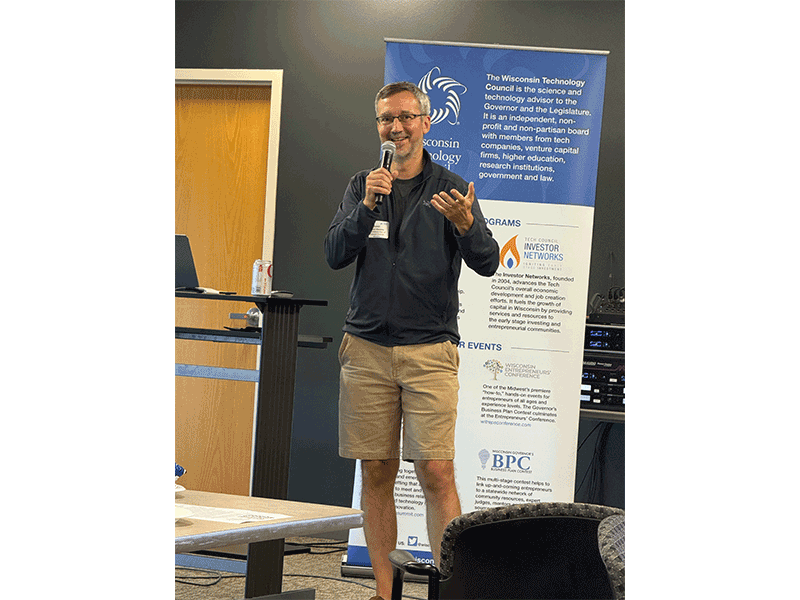
After an initial presentation, Arpaci-Dusseau was joined by Shaleen Deep, a senior research scientist in Microsoft’s Gray Systems Lab, and Milo Martin, an engineering director at Google and site lead of its Madison office, for a discussion on the relationship between computing in academia and its ties to industry.
Deep spoke to the practical applications of AI already happening in collaboration with academia.
“The (Gray Systems) Lab is basically taking on the hardest challenges,” Deep said, “doing a whole bunch of research in collaboration with CDIS and the students there, and then our job is to take the best of these research ideas and transition them into products for Microsoft and its customers.
“Since joining Microsoft, I’ve been working at the intersection of data plus AI … seeing where we can use AI in an efficient manner and then help customers for Microsoft to be more productive.”
“This really emphasizes the interdependence and interlocking nature of academia and industry,” said Tom Still, president of the Wisconsin Technology Council.
AI’s effect on the workforce
Still then referred to a headline from Monday’s Wall Street Journal, which read, “AI is wrecking an already fragile job market for college graduates.”
He noted that many people are critical of AI as an emerging technology and concerned about its broader effects. Arpaci-Dusseau countered that this is nothing new and not confined to AI.
“If you look at the history of computer science … it’s a lot about automating things that people used to do by hand. That’s true, there’s no way around that,” he said. “Before computers existed, there were books … things were recorded with paper and pencil.
“And before that there were stone tablets,” he joked, “and then the paper people put those stone tablet businesses out of work.
“So I think it’s fair to say that there’s a disruption that we should be keeping our eyes on. What’s going to be disrupted, and how much is that disruption going to be? I don’t think we know. … But by no means is somebody like, you know what, we don’t need people anymore. Let’s just throw the tools at it… to solve all problems.”
Conversely, he said, the goal is to make AI tools “amplifiers” of people rather than replacements.
Martin pointed out the complicated nature of the business environment, regardless of the AI surge.
“Since the pandemic, there’s been a lot of strangeness in the economy. … Certainly the rise of AI is a big thing, and we’re seeing it transform a lot of things … but I think as far as the individual job market, there’s a lot going on right now. … There’s a lot to think about there in terms of cause-and-effect.”
Deep echoed this sentiment.
“The job market does feel a little bit fragile, but there’s a lot of things going on,” he said. “Companies are thinking very hard about how much hiring they want to do. … At the same time, I also think these (AI) tools are transformational. … In a few years, we will have these tools become so mainstream that everybody will be using them in some capacity.”
Arpaci-Dusseau said this is one of the main reasons UW-Madison is considering the creation of an AI-focused college.
“We can really lean into that,” he said, “and put enough resources into it to transform what is a very… traditional computer science degree program into something that’s a little bit more modern.”

