
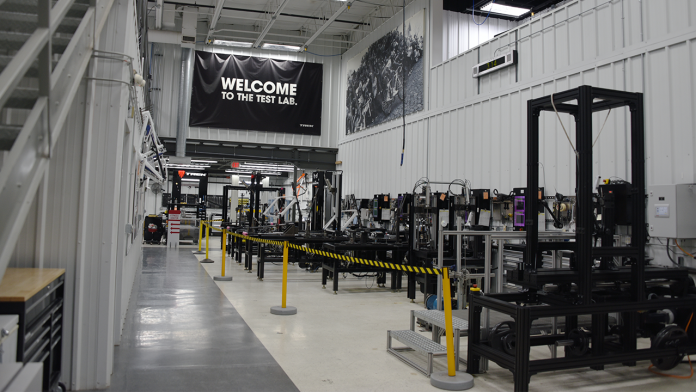

Matt Scheiber, test lab manager at Trek for the “affectionately” dubbed Break Room, watches as sacks filled with sand fling and jerk at acute angles, sag and bang and generally get a bit brutalized.
“It’s a standard test, but it’s crazy to watch that flop around on a test machine,” Scheiber said of these sandbags.
Mounted to a rack test machine, these child-sized sandbags are put on child carriers to represent children.
“That’s actually what’s happening when you’re riding down the road,” Scheiber said. “We’re really concerned about, you know, the safety of some products.”
Scheiber said customizing equipment or building new machines to destroy bicycle parts — to make them safer and stronger — provides something different everyday and every year.
“We have to adapt to all of the new designs that come out, so it may not fit on our test machine, but we have to design a new fixture to interface with them,” he said. “That can be a lot of fun.”
These tests of durability for safety and structural integrity for frames, rims and more are pivotal for Trek. It puts many of these parts and pieces through a series of stress tests.
“And then we’ll take them and put them into these ultimate test machines, and we just blow them up,” Scheiber said.
It’s all part of creating the safest, strongest, lightest and best product Trek can.
Equipment for these stress and durability tests were built in-house, much like the software the data is uploaded to.
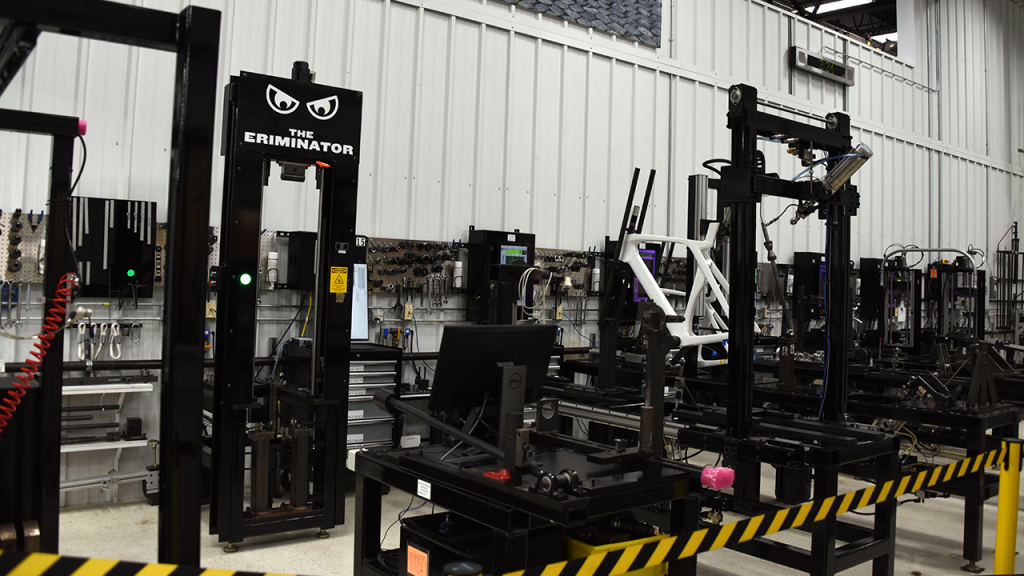
Machines like the “Eriminator” may have been built with a little bit of marketing in mind — it is showcased in a video on a Trek blog, with its two intense eyes gazing down at anyone in the Break Room. It was built to stress test Trek’s new rims that were too strong for its previous rim breaker. The machine applies pressure to rims to see what it takes to mangle them.
Testing bikes in this manner has greatly evolved over the years.
When Scheiber began, it was him and one manager over 30 years ago.
In some of those earlier days, Trek would do some proof of concept testing, benchmarks, fatigue testing and more rudimentary testing.
Since then, Trek has upped the resources, and engineers at Trek have reshaped what testing can and should be.
His team is still relatively small with five people in Waterloo. But in 2005 Trek opened an engineering facility in Taiwan, allowing it to test the same things.
A small team runs that facility, and there are 13 other test labs globally. Some manufacturers that supply frames, wheels, forks and more to Trek have them, too.
Trek builds the same machines it uses in Waterloo, ships them to manufacturers, sets up the machines for them and shows them how to use it.
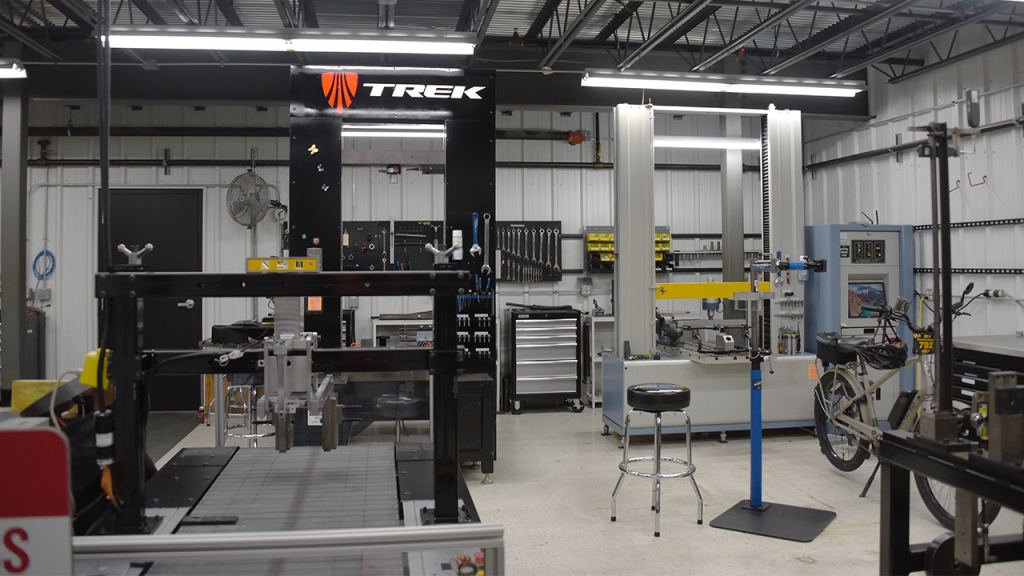
“We monitor the equipment over the years, we calibrate it, we make sure their technicians are always trained,” Scheiber said. “That saves us a ton of product development time and a lot of money in shipping and gets us to production a lot faster.”
For Scheiber, his team and the customer, this data is crucial.
“We have instrumentation on each machine that will measure loads and displacements throughout the testing, and that data automatically gets uploaded into the cloud, and in real time, we could go and look at that information, and the engineers can see it anytime they want to while the testing happens.
“We get the exact data that we want out of it.”

