
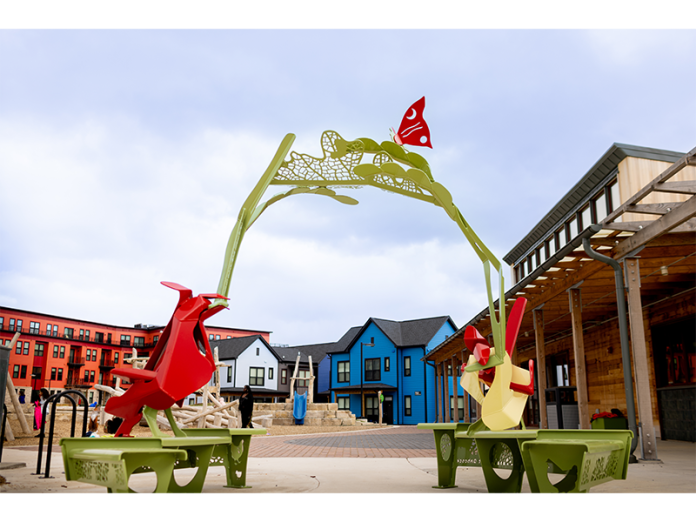

A colorful, butterfly-like mural on a new building encapsulates the Bayview development’s cultural diversity and community connection. It’s a place where people come together, according to resident Amelia Corea and her husband Jose, who said they helped name the mural “La Mariposa de la Vida” (“The Butterfly of Life”).
Redeveloping the site at the corner of West Washington Avenue and Regent Street has been a long time coming, said Alexis London, executive director of the Bayview Foundation. The nearly 60-year-old nonprofit organization provides housing and social services for its residents, creating a safe, stable and connected community.
The original housing structures, built in the 1970s, offered affordable units but lacked much-needed infrastructure and amenities, so in 2018, the nonprofit’s leadership put together a team that envisioned a newer, brighter Bayview. Years of planning and design work and three-and-a-half years of construction went into the project. Central to each step were the voices of residents — voices London said are often underrepresented in redevelopments like these.
“We all had (a say) about what we wanted, what we would like to see,” said resident Assita Diarra. “What would be realistic, and what could be kind of a dream.”
That community engagement, coupled with the nonprofit’s unique programming and services, have created a neighborhood that bolsters Madison’s affordable housing, celebrates cultural diversity and gives Bayview residents a sense of belonging.
From the ground up
Bayview’s 57 modern townhouses, 73 apartments and new community center replaced 102 dwellings and an aged community facility.
The Coreas had lived there for decades — Amelia since 2001 and Jose since 1988 — and the couple said it was hard to raise their four daughters in an apartment without a washer and dryer or dishwasher.
Diarra had just one bathroom in her three-bedroom home that she shared with her three children, her stepchild and the children of relatives who frequently visited.
She and other residents were skeptical when they heard about Bayview’s redevelopment, Diarra said.
“We never believed it would happen,” she said. “When they say it’s going to happen, and we don’t see it, we say, ‘Yeah, talk, talk, talk. … We’ll see how far they go, and what they’re going to do.’”
London said organizers took concrete steps forward with a capital needs assessment and an architect consultation that determined the best plan would be a complete rebuild.
“That put us in the category of doing a pretty massive redevelopment project,” said London, “applying for tax credits through the state and through WHEDA (the Wisconsin Housing and Economic Development Authority), having a development partner, and then putting together a big team with the architect, the engineer, the landscapers, the investors to make the project happen.
“Around that same time was when Bayview as an organization — the board of directors and the staff at the time — knew that they wanted to do (this project) differently. … They wanted to do a redevelopment that really centered the voices and the needs and the priorities of the people who live here.”
That process included community engagement efforts that London said reached about 70% of Bayview’s 100 or so residents at the time.
“We had 25 meetings, we did door-to-door surveys. We really took our time with trying to understand what people’s wants and needs were,” she said, adding that survey questions probed beyond simple aesthetic preferences.
“It really became the focus of safety, stability, what is healing, what elevates your spirit — a little more of these values that people hold — and then, how do those types of values … play out in the physical space? How does that play out in the architecture? How does that play out in the landscaping?”
The results of the Bayview Foundation’s resident surveys were largely unsurprising, London said. Feedback like, “having access to nature gives me a feeling of peace,” and “I really want to know my neighbors,” guided planning choices like the addition of green spaces, gardens and porches.
Cedarburg’s Kubala Washatko served as the project architect and was chosen, London said, because of its “focus on human experiences in architecture and community development.”
“Prior to really putting pencil to paper in terms of the redevelopment, we had done all this work in putting together a master plan guided by the values of the residents,” she said. “So the roots of the redevelopment, I’m really proud to say … do come from the people who lived here and who live here currently. Most of them stayed.”
Tag Evers, the Madison alder for District 13, which includes the Bayview development, championed the model.
“The project was not conceived, designed and implemented from the top-down,” he said, “but rather from the ground-up, with consistent and determined input from those most impacted.”
Transformation in phases
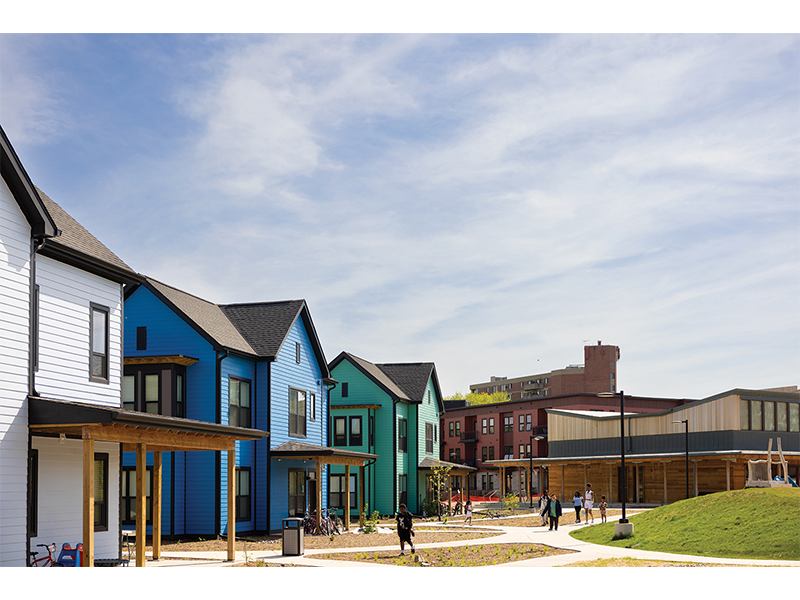
With resident input in tow, collaborative partners and a vision, construction began. London said the guidance of Horizon Development Group was critical.
“When we first began work several years ago, it was clear to us that this was going to be a unique project,” said Scott Kwiecinski, vice president of Horizon. “We could see the physical limitations and obsolescence across the residential units and community center, but what we also saw is how deeply rooted Bayview is in culture and community.
“Horizon’s experience with affordable housing development, tax credits, and other financing helped facilitate the overall development, but it was the collaboration and creative thought up front that helped solve many challenges and provided a solution for coming decades.”
That collaboration involved design and consulting partners Smithgroup, Madison Gas and Electric, Green Built Home, Spire Engineering, Precipitate, Eco Achievers, Design Engineers and Slipstream, and financing partners WHEDA, Enterprise, Sugar Creek Capital, the city of Madison Community Development Authority, Dane County, the Department of Housing and Urban Development, and the Dane County Housing Authority.
A phased construction process maneuvered through the COVID-19 pandemic and related price increases and schedule delays — and notably did not displace any residents.
“If people chose to move, then that was their choice, obviously, and some people did choose because they didn’t want to deal with construction for three years, or they just were ready to move,” said London, but she emphasized, “nobody was forced out.”
“We didn’t want to move anywhere else,” Amelia Corea said. “We lived here when Bayview was the old apartments. … It’s a place where we’re together.”
Bayview’s first — and largest — new housing facility was built on vacant land, and upon its completion, families moved into those units so that the old building could be demolished. Then the process was repeated.
“The most unique aspect of the development was replacing all of the buildings on a six-acre property while not displacing any residents,” said Kwiecinski, “while managing a three-phase construction project over more than three years that was supported by nine different funding sources, including a HUD contract as well as federal and state tax credit equity.
“This all required careful planning and communication, detailed financial modeling and accounting, flexibility in adapting to changing market conditions and a dedicated and skilled team.”
The redevelopment also prioritized sustainability. Bayview’s new community center is certified “as one of the most energy efficient structures of its kind in the nation,” Evers said.
In total, the new development has 130 units, up from its original 102, including one-, two- and three-bedroom dwellings. According to London, 107 of these are Section 8 units, subsidized at 30% of the resident’s income; 13 are tax credit units at 50-60% of Dane County’s median income; and 10 are offered at market rate.
“It’s very affordable,” London said. “The goal is that people can save money for the other things that they need in life, and subsidized housing is what we really need in order for economic diversity to exist in Madison. Low-income housing that’s subsidized for people is really the best solution.”
Residents have voiced high satisfaction with the changes, citing both enhanced convenience and a continued emphasis on community connection.
“We’re happy with the new buildings,” said Amelia Corea. “It’s more clean, more secure.”
“The new apartment is a nice apartment for my children,” added Jose.
“One of (my) dreams was to have two full bathrooms in the house with a lot of kids, and we wanted a bigger kitchen, a bigger fridge,” said Diarra.
“Weall had dreams … and some of them came true.”
A foundation to thrive
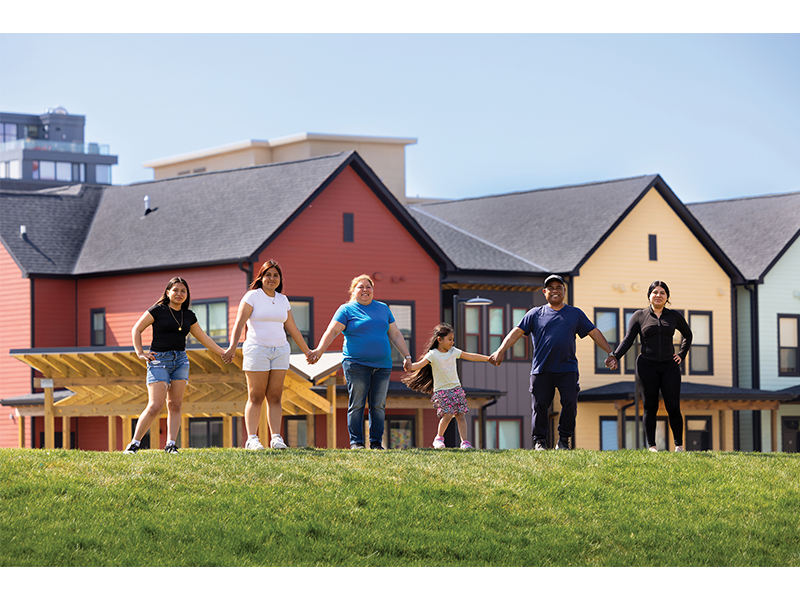
Bayview continues to offer and expand services beyond housing, a tradition going back decades. The new community center, London said, is vital to the Bayview Foundation’s “holistic approach.”
She said coupling housing services with social services “really is what makes for a much more safe, stable, thriving community.
“We have out-of-school-time programming for youth, free of charge; we have a food pantry onsite; we have social workers who can help people navigate resource referrals and mental health services and things like that; we have a meal program for seniors. All of those services are housed here at the neighborhood center. They’re free of charge, they’re open to anybody.”
London said those services help Bayview to prioritize its relationships with tenants, which creates positive cycles.
“When you have a strong relationship with a family, the likelihood of having healthier outcomes for the kids, for the housing situation, for neighbors, it just improves dramatically because people know that you care,” she said. “They then want to be a good tenant — it kind of goes hand-in-hand.”
For some residents, Bayview’s programs have been a big part of their reason for staying.
“I could enroll (my children and those I was watching) in Bayview’s programs during summer,” said Diarra. “That was awesome. They all can say, ‘Oh! We grew up at Bayview. We were (going on) field trips, playing with other kids.’”
“We have programs at Bayview for children, for the teens, for the older people,” said Jose Corea. “My children go to school, then play games here.”
He added that in the past, he would help out with outdoor tasks at Bayview, like mowing the lawn.
“We try to help keep Bayview looking good,” said Amelia Corea. “We’ve participated in programs. … After school or in the summer, Bayview has jobs for the teens, so my girls come here and work for the summer.”
And the Bayview Foundation has assisted the family in challenging times.
“In some circumstances, we might not have the money to pay the rent, so they help you,” Amelia said. “The form (in which) I say thank you to them is participating in their programs and helping in any ways I can.”
She and Jose said Bayview’s food pantry and donations of diapers, clothes and personal items have also helped when needs arose.
“We take care of Bayview,” said Amelia Corea, “and Bayview helps us.”
A sense of belonging
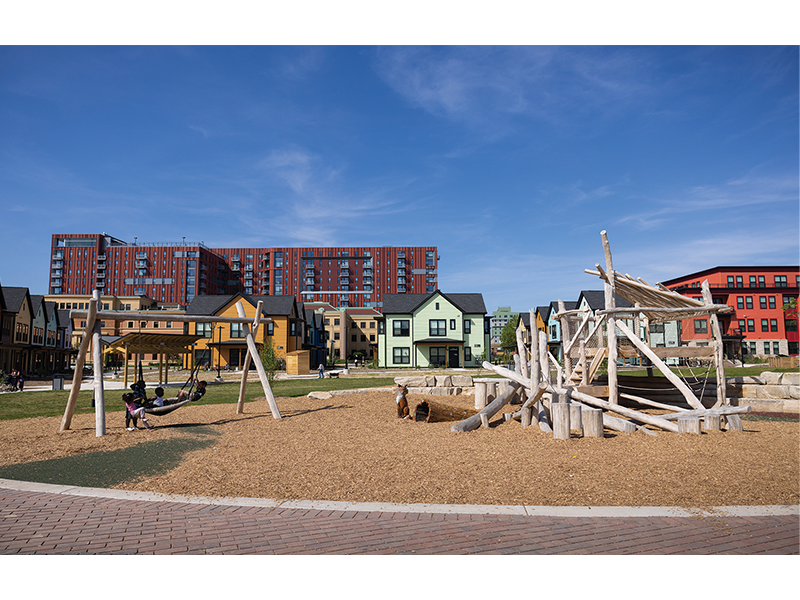
Bayview’s design and programming aim to create a sense of place and connection for residents. Art is one vehicle for this, and London emphasized its prominent place in Bayview’s history.
“Lots of different arts organizations were actually founded at Bayview and/or have their roots at Bayview,” she said, pointing to the Madison Youth Choir, Call for Peace Dance and Drumming Group and Create Wisconsin.
“The way that the art really shows up is as a way for people across cultural differences to communicate and to create connections. No matter what your background, there’s always an opportunity to connect on food, art, music, poetry.”
Accordingly, the redevelopment includes space for public art projects. The first project to follow construction at Bayview was “Hope Finds a Home,” a striking, three-story mural depicting a bird’s nest and suggesting themes like home and resilience. Another mural, “Memory and Future,” completed in May at the corner of West Washington Avenue and La Mariposa Lane, incorporates similar bursts of color as well as nods to nature and cultural diversity.
Amelia Corea said that, like “La Mariposa de la Vida,” the recently completed mural “represents everybody in the community.” She and Jose immigrated from Mexico and Nicaragua, respectively, and value neighborly connection.
Bayview has also added amenities like a fitness room, community gardens and other outdoor spaces.
“Back in the old days, we only had a small playground,” said Diarra. “Now, by the playground, we have a huge space by the basketball court. I exercise around that place a lot. It’s just peaceful. … There are community rooms that we can use when we are having birthdays or parties.”
She said coming to the U.S. from the Ivory Coast, West Africa, meant leaving much of her extended family. She said she feels fortunate for the decades-long friendship with her neighbor.
“We used to joke that we could tear down that wall between us and then we’d have one household,” Diarra said. “Coming from different cultural backgrounds, at Bayview, we learn to have common goals one way or the other. Even if we don’t speak English very well, we find ways to communicate and relate to each other’s experience, babysit for each other, keep an eye on each others’ kids.
“I found a different kind of family here. I found (them) from Mexico, I found (them) from Nicaragua and from Nigeria. It was beautiful.”
She said before construction, Bayview would host celebrations in which residents who were immigrants could dress up to represent their culture. While the tradition lapsed during the redevelopment process, she believes it may return now that life is settling down.
“I’m blessed I’m still here,” she said. “I could move to a house, and I’d be by myself. I wouldn’t feel included like I am included here. For me the purpose is to have a sense of belonging, and here I belong.”
For much of the community, Bayview has become a model for affordable housing developments that center underrepresented voices.
“Several other organizations, developers and municipalities have expressed an interest in Bayview’s project and have come for tours,” said London. “Many are specifically interested in the resident engagement process.”
“We are extremely proud of the end result, and even more excited to see how the transformation positively affects so many at Bayview and the greater community,” said Kwiecinski, Horizon’s vice president.
Evers added the development “serves as a highly visible signpost to the rest of the city, showing a path forward that others hopefully will pursue.”
More to come
While construction is complete at Bayview, redevelopment of the adjoining “Triangle” property is underway. Madison’s Community Development Authority is planning a more than $300 million overhaul of several properties it owns on around 10.5 acres between West Washington Avenue and South Park Street. The redevelopment is set to take about 10 years to complete.
Phase one, with a price tag of $71 million, will see the CDA and development partner New Year Investments build a five-story apartment facility on vacant land in the middle of the block. Residents of Brittingham Apartments will move there before the old structure is razed and two more five-story apartment buildings are erected.
On other parts of the Triangle, improvements include a geothermal heating system and a private courtyard shared by the three apartment buildings — which will offer around 344 total units — and a portion of a public bike and pedestrian path through the property.
Phase one construction is expected to continue into late 2026 or early 2027.