



The appearance of a photograph posted on social media can vary greatly depending on which filters are applied, says Tim Szczykutowicz, founder of Madison startup RadUnity Corp.The same can be said for medical images — a conundrum for radiologists and other clinicians seeking clarity in scanned data.
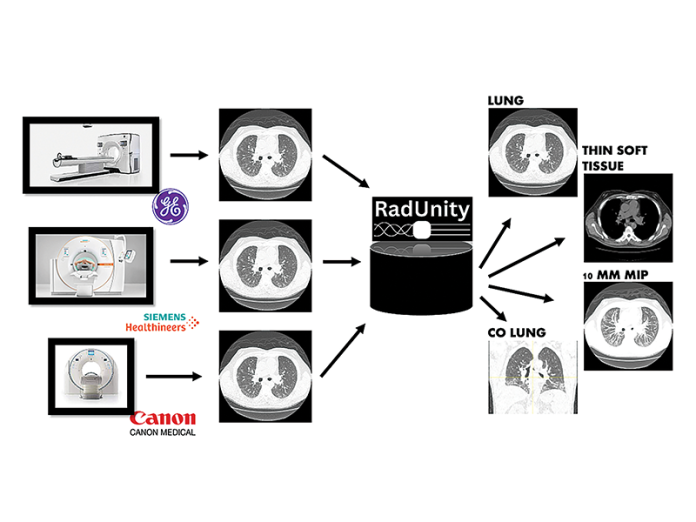
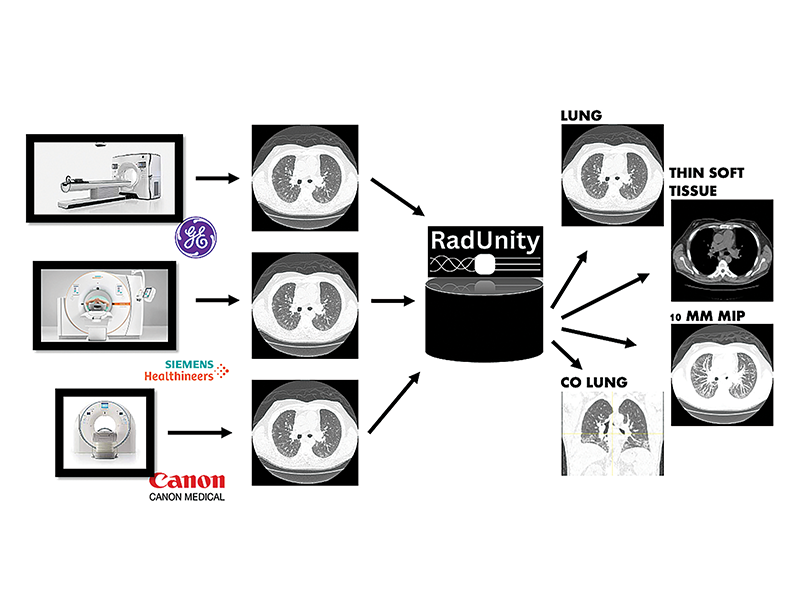
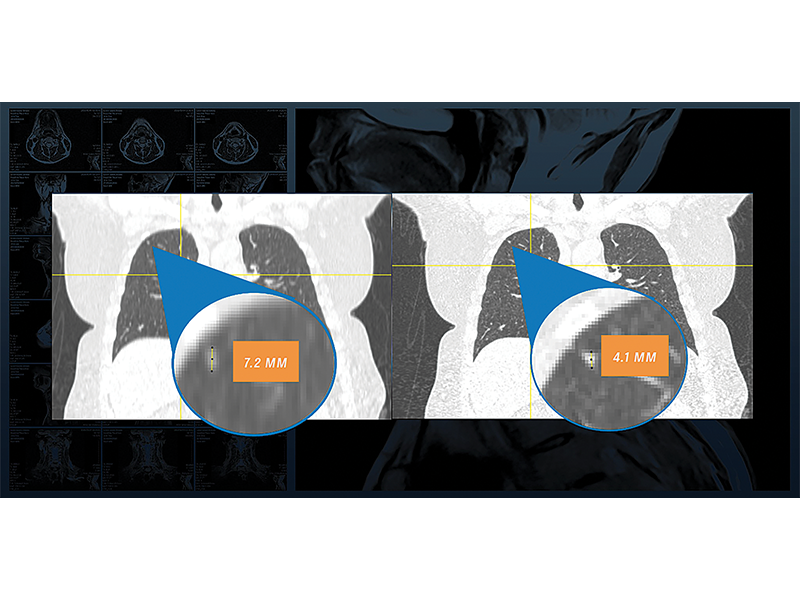
Different scanners supply different presentations, says Szczykutowicz, a professor in the University of Wisconsin–Madison’s Radiology Department, and non-uniformity can affect a provider’s ability to home in on the details that matter in a given case. RadUnity’s medical imaging product, recently approved for commercial distribution by the U.S. Food and Drug Administration (FDA), looks to “harmonize [these images] so that physicians have the same … presentation of that data coming in,” giving them “more reliable quantitative information.”
Szczykutowicz, who has a doctorate in medical physics, founded RadUnity in 2022 at the recommendation of the Wisconsin Alumni Research Foundation (WARF), spinning off a patent he had developed earlier.
“RadUnity is developing a CT image harmonization software, which will improve formatting and presentation of CT scans,” said Jeanine Burmania, WARF’s senior director of intellectual property and licensing. “This promises to provide improved image sets for radiologists as well as enhanced inputs for AI applications, resulting in better image interpretation and post-processing and patient care.”
So how does this process break down? Szczykutowicz starts by asking physicians about exactly what they want to see, and their preferred format. He said they may need to observe images at different “thicknesses,” viewing information only on certain planes or surfaces within a patient’s body, and RadUnity’s software can manipulate the image accordingly. It sifts through the data provided to prioritize the desired information and allows clinicians to direct labeling throughout the image. A profile records each provider’s preferences, and “every time the physician, or in this case the radiologist, opens a study like that, they’re going to see those images looking the same way.”
This process brings clarity to medical images coming from various scanners by letting providers view the most accurate and applicable data, and it’s in patients’ best interests as well.
According to Szczykutowicz, patients who receive imaging services at smaller centers but need advanced care from a larger regional health care provider sometimes must undergo reimaging due to a lack of trust or cohesion in the images.
“I’d love to see our product have an impact there. … I really want to help patients in their health care journey and mitigate some kinds of needless reimaging,” he said.
RadUnity has made swift strides, raising half a million dollars in a pre-seed round, building a product, and approaching commercialization in its first 16 months alone. Its next step is seeking investors for a $3 million seed round to support four new, full-time Madison employees.
Szczykutowicz believes this work is critical to resolving an issue with far-reaching implications.
“The problem today is non-uniformity, and unfortunately that problem exists for everyone, whether you’re an academic radiology practice like UW, or whether you’re a private … group of radiologists sitting on a beach in Hawaii.”
Bringing the product to market “is really huge, because I want to get our product in the hands of physicians so it can make their lives easier, help their patients, [and] make better diagnoses faster.”
RadUnity Corp

