

The local housing crisis features a classic example of economic supply and demand — the lack of supply to meet growing demand is the primary factor driving up costs. And if Dane County doesn’t get busy building, supply will never catch up to the reality that people, particularly members of Generation Z, are discovering Madison in greater numbers than ever before and a historic opportunity will be lost.
That opportunity is to solidify Madison’s status as a technology and innovation hub, which is attracting people to local jobs and quality of life. If the housing shortage is inadequately addressed, it could undermine what’s been done to improve Madison’s position in the technology world, says Zach Brandon, president of the Greater Madison Chamber of Commerce.
“We are at a crossroads,” Brandon states. “For the last 10–15 years, there has been a concerted, organized effort to position this region as a global innovation hub. We know the risks [with underbuilding] that are ahead of us.”
Build baby build
The trick is figuring how much to build. According to a new regional housing strategy, Dane County must produce roughly 7,000 housing units per year to meet existing needs and keep up with growth — 2,000 units more than what is currently produced annually. In calling for the county and public and private sector partners to devote more resources to housing development, the five-year action plan (2024–2028), put together with the help of 17 municipalities, says the county must produce 139,000 new housing units from 2020–2040 to keep up with demand. Included in that figure are more than 13,000 new rental units affordable to households making under 30% of the county’s median income.
The 189-page report noted growing costs. From 2010 to 2022, the median home price in Dane County increased from $226,000 to $369,000, and rents also increased by 28% on average over the same period, from $1,085 per month in 2010 to $1,385 per month in 2022. One in four households in Dane County are housing-cost burdened, meaning they spend more than they can afford on housing costs, and 40% of those households are considered “severely cost burdened,” meaning they spend more than half their income on housing.
The 139,000 figure sounds daunting, but Brandon believes that it’s on the conservative side, and conservative estimates of population growth are among the reasons the area underproduced by thousands of housing units during the past 15–20 years. Brandon maintains the county cannot afford to make the same mistake over the next 20 years. “The first question we’re grappling with is that we know at least 200,000 people are going to move here in the next 25 years,” he states. “It’s more likely closer to 300,000 and maybe even over 300,000.”
Less permisso
The local housing strategy comes at a time when new building permits are falling even amid higher rates of multifamily development. New permits in the Madison metro peaked at 10.6 housing units per 1,000 people in 2021, and fell to 7.9 units in 2022 and 7.6 in 2023. Most of that new permitting was accounted for by multifamily housing, which saw a 78% increase between 2021–23 from the three years before the onset of the COVID-19 pandemic.
Economic obstacles like elevated interest rates and labor shortages continue to threaten necessary housing development, but Chris Ehlers, president of Veridian Homes, notes that his company, the most active home builder in Dane County, pulled 90% of the single family permits in Madison, 484 in all. That’s a fraction of the projected 3,250 new homes per year over the next 20 years that will be needed to meet the demand for single-family housing alone.
The city of Madison’s dire fiscal situation — the city is pursuing $22 million in a referendum to avoid permanent cuts to city services — could well be a contributing factor. “There’s demand for housing, but there really is significant staffing issues when it comes to Madison,” Ehlers notes. “The team they have in place does a good job. No slight against them, but there’s no capacity to pull more permits and build more houses. It’s a processing issue for Madison, but other municipalities have recognized their growth projections and are starting to staff accordingly in key departments that will lead to an increase in housing units being produced.”
In addition, Ehlers believes Dane County municipalities should consider the creation of special tax districts within their boundaries that help subsidize public infrastructure costs that single family-developers typically have to pay for. He notes this approach to stimulating single-family development is very popular in westerns states such as Arizona, California, and Idaho, and has even been used in some Wisconsin communities.
In Dane County, recent low inventory of single-family homes on the market has frustrated would-be homebuyers on several fronts, especially affordability. In recent months, however, there has been some upward movement on housing inventory, but it’s modest, according to David Stark, president of Stark Company Realtors in Madison. In late July, there were 832 properties on the market in Dane County — 639 single-family homes and 193 condos, which is about 80% of the available inventory pre-pandemic. The pre-pandemic inventory wasn’t historically high either, and Stark believes a balanced market would see double the pre-pandemic numbers.
A balanced market, which Stark defines as four months of inventory instead of the commonly cited six months, would remove some of the upward pressure on cost. “We’ve got to get supply up if we’re going to see prices moderate,” he states. “There’s no doubt about it.”
Certain home affordability factors are out of local control, including Federal Reserve reductions of its federal funds rate, which influences rates on mortgage loans and other consumer loans. Some economists, citing the recent rise in unemployment as a sign of a slowing economy, believe the Fed will begin cutting interest rates in September, and the Fed has signaled that a rate cut is “on the table” if economic data supports it.
The July jobs report was disappointing — the economy produced only 114,000 new jobs with an uptick in the unemployment rate to 4.3% — but if there is no significant deterioration in unemployment and the Fed continues to receive favorable inflation reports, this increases the likelihood of a rate cut in the near future.
The Fed, however, remains cautious. Monthly Personal Consumption Expenditures (PCE) inflation has been running near a 2% annual rate, the Fed’s target for annual inflation, but if the Fed starts to loosen monetary policy too soon, it could allow inflation to flare up again and damage its credibility. Stark believes that once the Fed starts lowering interest rates, mortgage rates will fall only to about the historic norm of between 5.5% to 6.5%. “It’s all about what you’re used to, and we’ll get used to 5, 6, 7 percentage points again,” he states.
Burb density
Additional multifamily development in Madison is a given, but to build enough housing to meet future demand, Dane County suburbs will have to pursue more housing density as well. Gebhardt Development, which is best known for high-end, mixed-use projects on Madison’s East Washington Avenue, has built the 284-unit Colorado Commons, a market-rate multifamily development that recently opened in Sun Prairie.
According to Otto Gebhardt, CEO of Gebhardt Development, there’s certainly multifamily housing demand in outlying communities because of where growing numbers of people are employed. “We’ve been approached by multiple townships and areas surrounding Madison from Windsor, Sun Prairie, and Fitchburg that are very interested in upping their density, even their mixed-use development, to get the housing they need,” Gebhardt says.
Gebhardt has placed a hold on a workforce housing project in Windsor until the economics make more sense, which speaks to the difficulty in building affordable housing. At the moment, interest rates are higher, banks are more cautious, labor isn’t easy to find, and there still are disruptions in the building materials supply chain. “We need more housing, but we have a dilemma right now where it’s very hard to get numbers to work unless rents go up 30%,” Gebhardt notes. “Something’s got to change.”
Sue Springman, senior project manager with the Madison-based Mullins Group, is among those who would like the state to be more flexible in how it allows tax incremental financing to be used for housing. Historically, tax incremental financing has proven to be a primer for housing development, but its uses are somewhat limited to projects that would not occur “but for” TIF.
Springman also believes that even though some suburban communities understandably want to retain some rural character and green space, there is ample opportunity for adaptive reuse that produces more housing. “When I drive around, I see lots of places that could be redeveloped along major corridors that are one-story buildings and surface parking lots,” she notes. “There’s a lot of capacity to add more, and where that density should be added is along bus lines, bus rapid transit (BRT) lines.”
In the meantime, the high cost of housing is contributing to the homeless population. The county’s action plan identifies those suffering the most, including lower-income households unable to balance the costs of rent, medical care, food, and other necessities. Nicole Christen, program director for The Road Home Dane County, administers housing programs for one segment of the homeless population — families with children. On average, Christen says there are between 70 to 80 local households actively experiencing homelessness.
Local homeless shelters do what they can, but the area still needs more affordable housing options, especially with a rental vacancy rate of only 3%, Christen says. “That means we don’t have enough housing units — that the need is for more housing and specifically more affordable housing to be built.”
Low rent rendezvous
According to Brandon, the cities where rent is going down are cities that are growing and building enough housing units to accommodate growth. He cited Austin, Texas, which saw a 7% decrease in rent last year and built a 16% increase in its housing stock in the same time frame. In contrast, Greater Madison built about 4% of its housing stock last year.
Brandon has traveled to Austin and posed the following question to local officials: If you could go back 30 years, what would you do differently? Their top recommendation was get ahead of and align the housing and transportation infrastructure with projected growth. “It’s realistic to build enough housing if we come to the realization that the first step in our housing challenge is to build,” Brandon states. “We see this across the board in municipalities throughout our region where the urgency of this moment doesn’t seem to be catching on with our elected officials.”
Faustian faith moves mountains … and builds a home sweet home
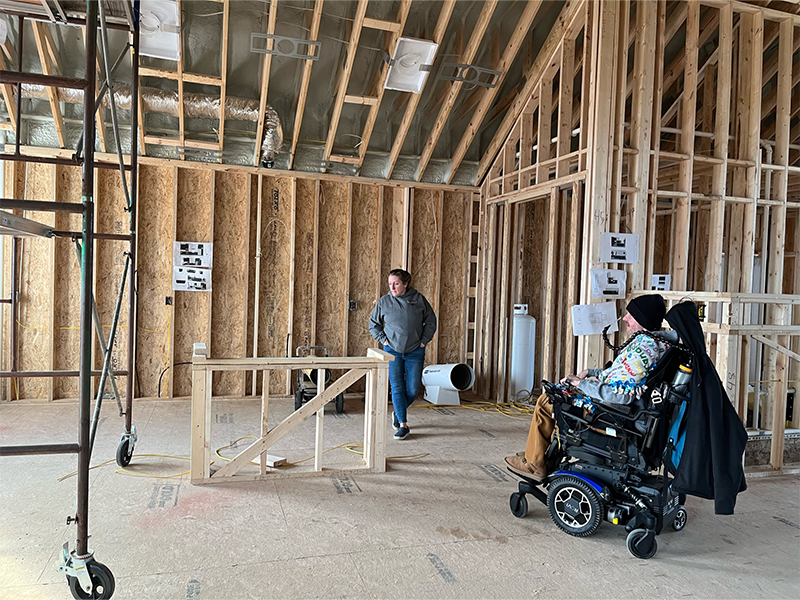
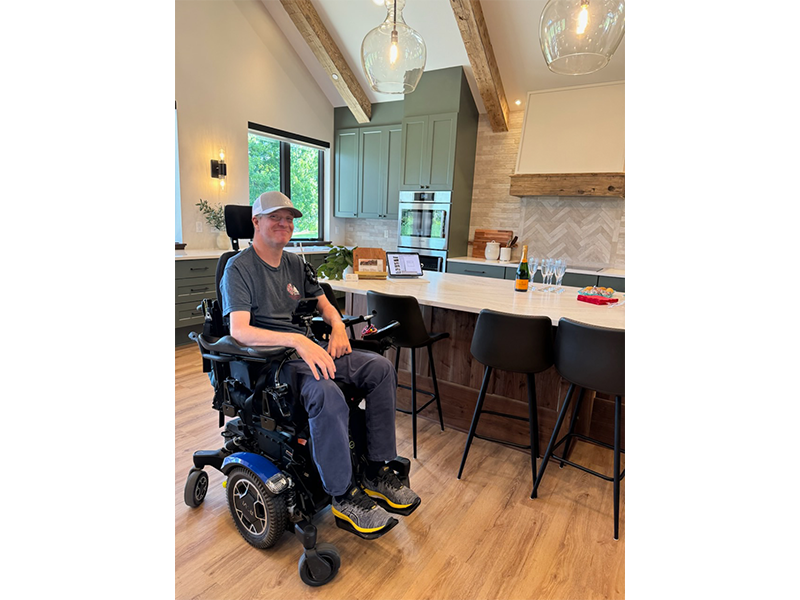
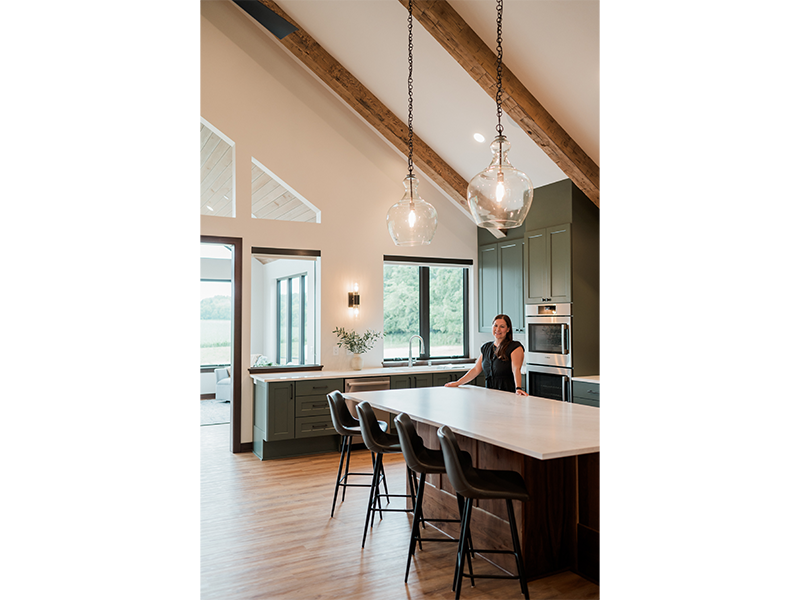
Jesse and Sharon Faust easily cite the most amazing thing about their new, special-needs home. It’s not the off-the-charts beauty and functionality of the house — although it’s one impressive domicile — it’s the caring and concern that went into making this 6,000-square-foot house a home.
That caring came from family, friends, Madison firefighters, and the vendors who offered discounts to make it happen for a family rocked by a rollover vehicular accident that left Jesse, a Madison firefighter with Firefighters Local 311, a quadriplegic who gets around with the help of a power wheelchair. The home represents the type of building innovation that will be necessary for Greater Madison to meet its daunting housing needs over the next 25–30 years, but for now it’s just what the doctor ordered for the Faust family.
“It’s life changing,” states an appreciative Jesse Faust, who suffered a broken neck in the accident. “I can get anywhere in the house I need to. I don’t feel cramped, and I don’t have to be extremely precise like I had to in the old house with my wheelchair.”
That’s a reference to the small family farmhouse, still occupied by Jesse’s mother, that sits on the same property and is now connected to the new house by a concrete path. It was poured by caring friends like builder and contractor Tom Herrling of Summit Custom Homes, who along with design architect and interior designer Kelly Hensler of knh studio, firefighting colleagues, and others, gave the Fausts a new lease on home life.
Hensler notes that Jesse Faust was still hospitalized when those caring friends and colleagues met to start planning the new home, and showcasing it at the Spring Parade of Homes, where it was one of the most talked about new dwellings, demonstrated that “accessibility can be beautiful.” With its wide aisles and hallways to accommodate a wider wheelchair-turning radius, the home was carefully built into a rolling farm field. “If you didn’t know it was special-needs house, you might not be able to see much of a difference,” Herrling says.
The home has several unique design features, including custom reclaimed wood beams, posts and trusses with quartz/travertine counters, a sauna/gym adjacent to a spa-like bathroom, a sunroom, and a stone fireplace. Other amenities provide as much independence as possible, including zero entry (no steps) at the front door, patio, and garage; an elevator/lift for basement accessibility with a window so there is natural light during the entire ride down; automatic door operators; smart home/voice command lighting, shades, and AV features; automatic faucets and appliances located and selected for ease of use; a ceiling track in the primary bedroom for transfers and daily care; and even a wheelchair charging zone.
Bill Sullivan, a fire marshal with the Madison Fire Department, insisted on donating and installing a fire suppression sprinkler system, saving the family about $50,000, because in the event of a fire, Jesse would have more difficulty escaping. The system, concealed in reclaimed beams with custom cover plates, is another example of the thoughtful generosity of friends.
According to Sharon Faust, the home’s amenities not only help Jesse adapt to life in a wheelchair, they enhance his ability to enjoy simple yet important things like saying goodnight to his children, ages 7 and 8. “He’s able to get into their room and say goodnight, whereas previously (in the old house) they were upstairs and he couldn’t do that,” she explains. “He shed a lot of tears about that, and so having this space and not being limited about where you can go, or being left out, is very impactful.”
For Sharon, having an other-abled husband, two small children, and a career as senior vice president of specialty pharmacy with the Madison office of Lumicera Health Services, can be overwhelming. Suffice to say, the former Badger women’s hockey player, a member of the 2006 national championship team, never experienced a crosscheck on the ice quite as jarring as the accident that changed her family’s life. “Each thing that creates efficiency is massively impactful,” she notes. “For me, having the lift in the ceiling has been life-changing because I can be that much more efficient when I’m moving him around.”

