
The Greater Madison area’s reputation as a place where people want to live and work is no secret locally, but it’s always rewarding to receive national recognition, too. Last year, the Washington, D.C.-based Ludwig Institute for Shared Economic Prosperity ranked the Madison metro area No. 1 in the country in functional employment rates.
The Madison market is “driven by robust job growth, higher wages, and the ability to secure desired hours,” according to the institute.
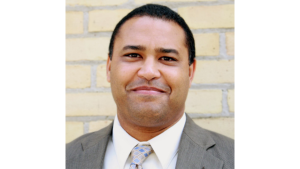
“Madison gets a fair amount of accolades that recognize our quality of life — the outdoors, arts and culture, our K through 12 and post-secondary schools, our diverse neighborhoods,” said Seth Lentz, executive director of the Madison-based Workforce Development Board of South Central Wisconsin. “But I think it’s also important to recognize that our economy is thriving, and it’s pretty diverse, too. We’ve got a great mix of healthcare, biotech, manufacturing, and construction; education and government are still big sectors in our community; and we’ve also got technology, business, and finance. That mix of industries really helps in the stability of our economy and attracts individuals with a variety of passions, pursuits, and educational backgrounds.”
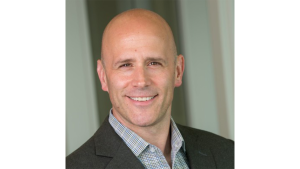
“One of my favorite parts of the job is taking candidates around the Madison area and watching them fall in love with it,” added Casey Liakos, who was recently promoted from vice president of executive and professional search at The QTI Group to president of the Madison-based staffing and recruiting agency.
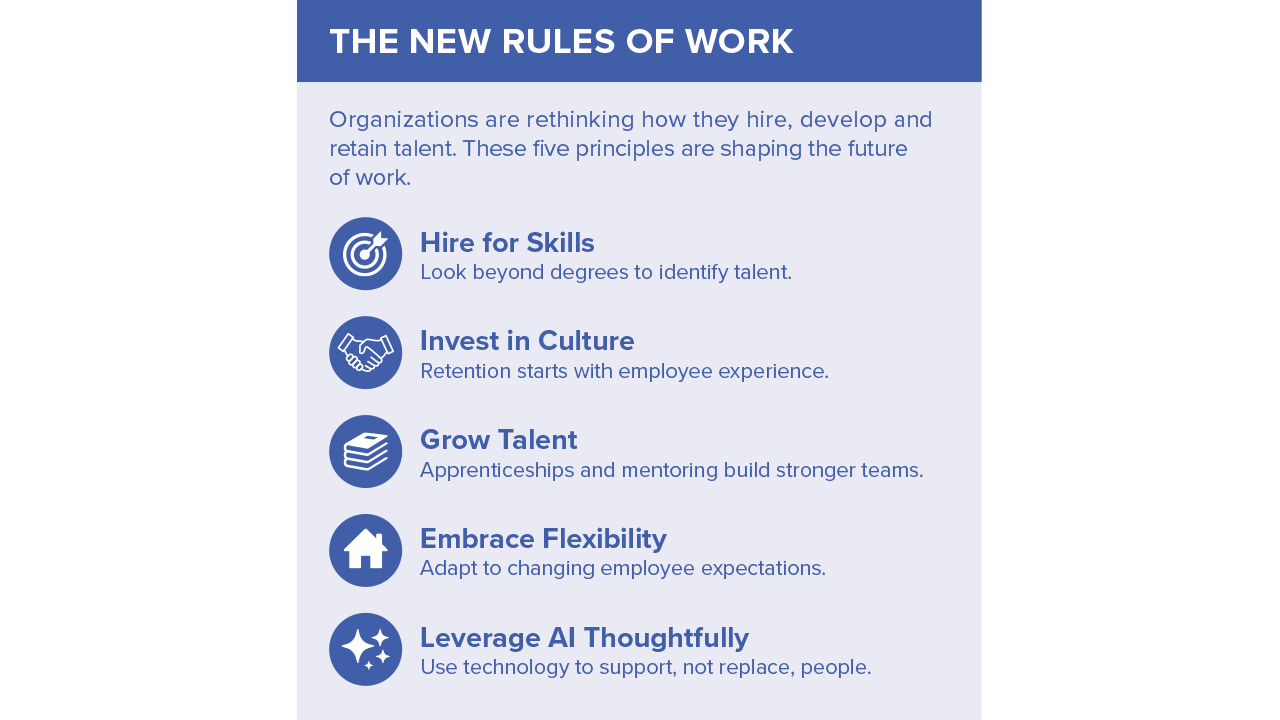
Yet despite the accolades and feel-good vibes, Madison employers are not immune to the challenges facing their peers in other metropolitan areas around the country. Those challenges include bolstering workforce retention and engagement strategies, confronting shifts in the talent pipeline, a widening skills gap, and taming AI.
Many of those challenges are interconnected, and it’s often up to human resources professionals to develop strategies and solutions to help their organizations navigate a constantly shifting landscape.
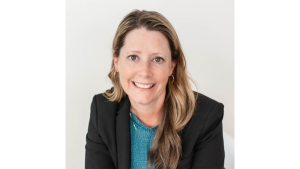
“I think we’re doing a lot, as far as education goes,” said JoAnna Vanderpoel, president-elect of the Greater Madison Area Society for Human Resource Management (GMASHRM), as well as chief people officer at the Wisconsin Housing and Economic Development Authority (WHEDA) in Madison. “GMASHRM has over 600 members, and we’re the largest chapter in the state, so we are definitely the go-to resource and subject matter expert for all things HR.”
Retention and engagement
“All things HR” can include everything from overseeing recruiting, hiring, onboarding, payroll, and benefits administration to training, compliance, and workplace conflict resolution. Workforce retention and engagement fall broadly into many of those responsibilities and are an overarching and ongoing mission of not just HR professionals but all leadership.
One of the keys to success in that area is to “forge an authentic connection between the company and the community, beyond geography,” Liakos said. “Show prospective employees during the recruitment process what the organization’s role is in the Madison community and how it fits into the bigger puzzle. For me, community service and engagement with nonprofit organizations is very important for companies, and I think that authentic bond is more powerful than people realize.”
Indeed, local community service initiatives have become more vital to company culture in recent years — not only as effective ways to attract and retain talent, but also as indicators that Madison offers “a very vibrant nonprofit ecosystem,” according to Liakos.
“There are a lot of people doing a lot of really good, important work in Madison,” he said. “I see more and more where companies are trying to attach themselves to that work through some program, whether it’s donating a portion of their profits to particular nonprofits or — like we do at QTI — offering two days of paid time off that is specifically designated for volunteering in a way that’s meaningful to the employee.”

“It’s not just about compensation,” added Ashley Kowalchuk, immediate past president of the Greater Madison Area Society for Human Resource Management and senior HR manager at Iconica, a Madison-based commercial design and construction firm. “It’s about the culture, flexibility, work-life balance, and what you are able to provide for that employee’s experience.”
Iconica conducts an annual engagement survey of its 65 employees that includes questions about flexibility and benefits — including, for example, whether they prefer a higher healthcare deductible or a lower-premium plan.
Meanwhile, WHEDA (which has more than 200 employees) offers flexibility via a hybrid work schedule that allows employees to work remotely up to three days per week; managers can work remotely up to two days per week, according to Vanderpoel.
Similar to Iconica’s strategy, The QTI Group conducts an annual employee engagement survey to gauge satisfaction with everything from the organization’s management to its culture.
Regardless of whether such surveys are formal or informal, they can go a long way toward boosting both engagement and retention, according to Liakos. “We’re all susceptible to falling into the trap of making assumptions,” he said. “So it’s better to just ask and find out what employees want — and then try to find a way to create a workplace that they value.”
That said, the days of an employee spending an entire career with one organization are probably long gone, Lentz admitted.
“There’s been some increased mobility in the workforce. I think it’s just a reality, right?,” he said. “But I also think that the idea of employers understanding what workers are looking for is getting more attention. As a business, I better be able to articulate what the advancement opportunities are and make them attractive to you. I have to tell employees that ‘I’m willing to invest in you, to help you, because I value you.’”
Talent pipeline and skills gap
As fewer potential job candidates pursue traditional higher education options, in part because of rising tuition costs and shifting values and priorities, savvy employers are taking notice. They realize that intangible factors such as job readiness, digital literacy, strong communication and problem-solving skills, prior experiences, and a knack for adapting can trump a degree — especially in non-credential-based fields.
“We’ve got to get creative,” Kowalchuk said, acknowledging that while architecture is a credential-based industry, Iconica (when it makes sense) also looks beyond whether a job candidate has or does not have a college degree. “There’s a people shortage, so you have to think outside the box in some regards when hiring people. We’re a little unique in our ability to cross-train and mentor, so that people can maybe start as a preconstruction estimator, gain that experience, then get out in the field and eventually move into a superintendent role. If you’ve got good people, how can you utilize their skill set and interests in different ways?”
Vanderpoel agreed, explaining that WHEDA now hires based, at least in part, more on transferable skills than the organization did in the past.
“We’ve been trying to recruit from the hospitality and restaurant industries, because we can find people who can provide great customer service or do well on the phone,” she said, adding that an HR colleague at a retirement community in the Madison area is now recruiting former teachers who might be burned out in the classroom but still possess the skills necessary to work with an aging population — including patience and the desire to help others.
Skills-based hiring sounds like an easy solution to employee shortages, but it requires a clear strategy, according to Liakos.
“If you’re going to do skills-based hiring, you need to really define what the skills are that you’re looking for, and then you have to implement the necessary assessment tools and interview processes to identify the talent that matches them,” he said. “Beyond that, you should be able to train any additional skills once you hire the person. This takes a lot of work and time.”
Ultimately, according to Lentz, it comes down to a broadening of the job application process.
“Are we being as inclusive as possible to candidates? Are we screening candidates in or are we screening them out?” he asked. “Are we funneling people with talent or potential into our process, or are we artificially inputting some barriers? This is an opportunity to really look at candidates who’ve done apprenticeships but don’t have a degree, or those who have military service and have durable skills and abilities.”
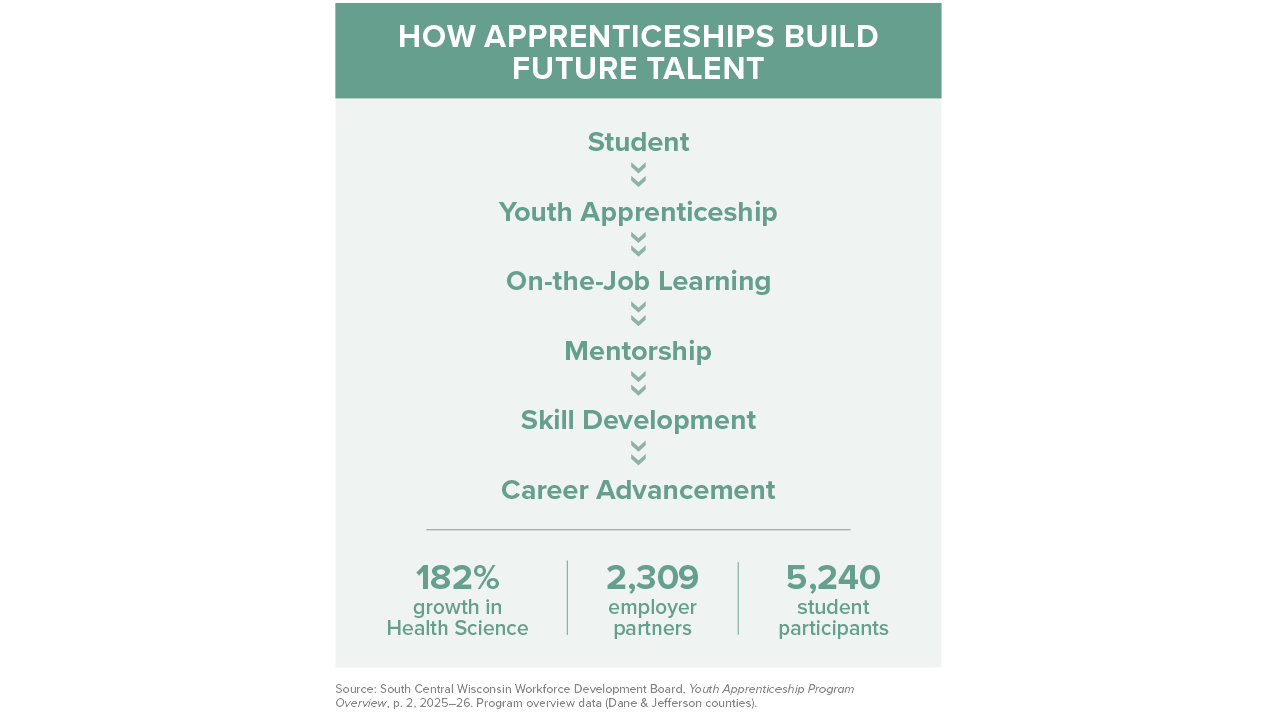
Youth apprenticeships, in particular, play an increasing role in keeping south-central Wisconsin’s talent pipeline flowing. The Workforce Development Board’s Youth Apprenticeship Program, active for 35 years, is a school-to-work initiative that prepares students for careers in a variety of fields — especially the building trades and manufacturing, as well as IT, marketing, and education and training. In 2025, the organization placed more than 1,100 young people with about 800 employers throughout Dane and Jefferson counties, according to Lentz. Health science is the program’s fastest-growing and largest sector, with an 182% jump in four years. Meanwhile, employer participation nearly doubled over that time.
“We’re seeing apprenticeships gain momentum in our region right now,” Lentz said. “It’s attractive for both parties — student and business — because it really is an agreement: ‘If you work and participate in specific classes, we’re going to provide you this level of support and this sort of a wage progression.’ It’s often multi-year and provides some stability and predictability for both parties. It’s a way for companies to get access to a new workforce pipeline and develop future employees.”
Apprenticeships are an investment strategy, he added. “There isn’t an immediate return, although you’ll be amazed at what these youth apprentices can accomplish as far as productivity,” Lentz said. “But they still need the mentorship, they need the guidance, they need to develop and see those skills in action — because that’s going to make them better down the road.”
The Workforce Development Board also offers, among several initiatives, registered apprenticeships for adults that combine post-secondary education options with on-site work.
“I think apprenticeships and some of the other partnerships between corporations and training programs and colleges will continue to be more important as time goes on,” added Liakos. “Madison College is really preparing people to jump into the workforce with targeted training at an affordable cost. It’s been very attractive to a lot of people. I’ve seen people go through their various programs and rave about them.”
Successful apprenticeships (and internships, too) rely on “doing the legwork in preparing a program, rather than just bringing in someone to do the grunt work,” Vanderpoel said. “Students really want a meaningful experience, and if you’re just looking for cheap labor, it’s going to backfire.”
To help prevent bad experiences for youth apprentices and interns, Iconica asks them prior to their start date what they hope to learn during their time with the firm. “If they have an amazing experience, they’ll do so much recruiting for you,” Kowalchuk said.
AI and the challenges ahead
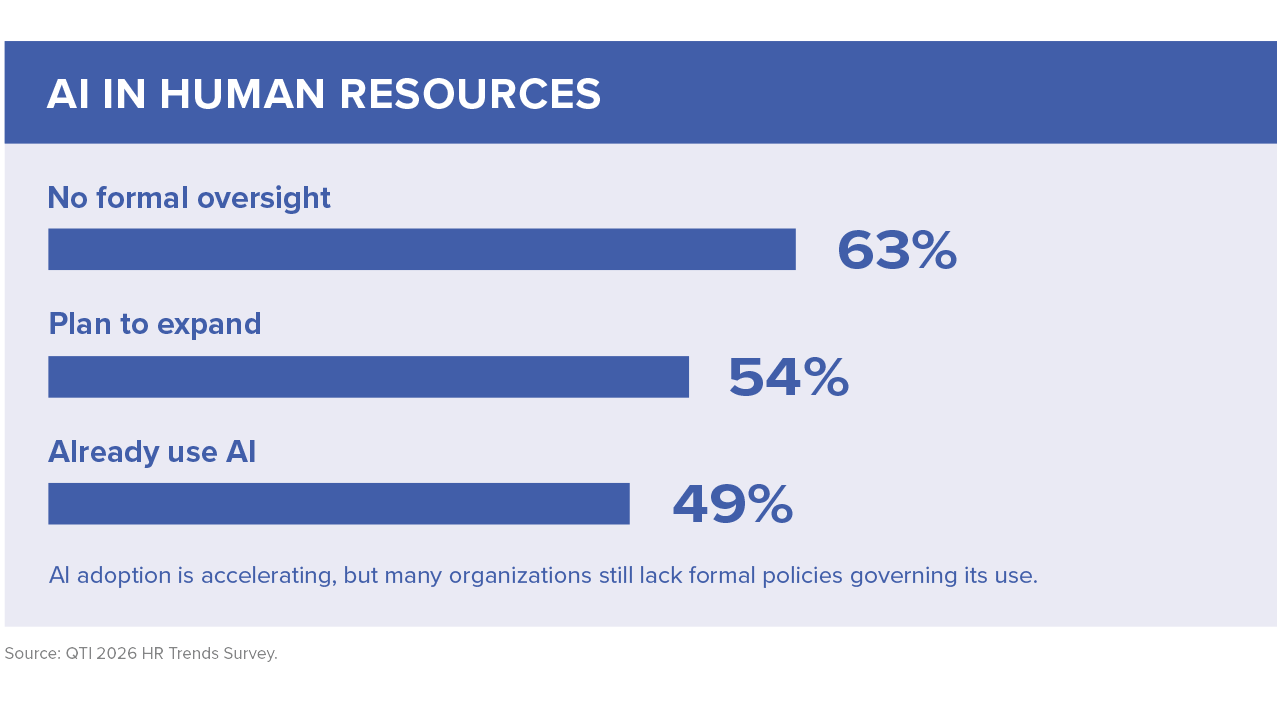
In recent annual surveys of GMASHRM members, artificial intelligence has topped the list of topics they’re most interested in learning more about — including how to effectively leverage the technology while doing the least damage.
“We’re not using AI at WHEDA,” Vanderpoel said. “We’re not naïve; we know we have to get on that train. We just need to have a better understanding of how we can use AI safely.”
Indeed, the blurring of artificial intelligence with human intelligence is fundamental to the evolving landscape of work. This is why GMASHRM regularly brings in speakers to share information and ideas with members.
“How can AI help us satisfy the labor shortage without it being threatening?” asked Vanderpoel. “There’s going to continue to be a greater shift to using AI and machines to do the lower-level work, but how can we use people’s talent to enhance the human portion of the work that needs to get done?”
“AI has reshaped the hiring landscape pretty drastically, and it’s going to continue to do so,” Liakos said, noting that while some traditional administrative jobs are being replaced by AI, the technology also is creating an increased need for employees who are proficient with AI and able to use it effectively in their day-to-day work. “We’re seeing more and more job requirements around AI proficiency in job descriptions where you might not even expect it, like finance, accounting, and marketing.”
Consider AI more as “augmented intelligence” and less as “artificial intelligence,” Lentz suggested, noting that AI is just one of the factors making HR professionals’ jobs more demanding — yet potentially also more exciting and rewarding — than ever.
“The new technologies we’re seeing, labor force trends, an evolution of employee expectations — all of these things are converging and transforming how work gets done, what skills employees really need to have, and what skills businesses are looking for,” Lentz concluded. “For us in workforce development, it’s not just about filling open job positions anymore; it’s about helping businesses anticipate what changes are coming, what skills they need, and how we can work with them in preparing workers to be adaptable and flexible.”

