
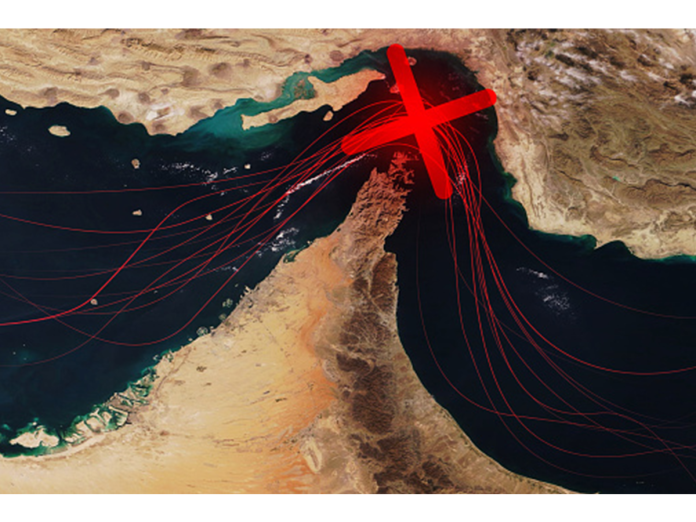

There are two schools of thought about the economic effects of the U.S. war against Iran.
The first holds that price hikes due to shortages, largely the result of Iran’s strategic response to block oil tankers from moving through the Strait of Hormuz, will cause a global recession — especially if the strait, through which 20% of the world’s supply of oil travels, is out of commission for a prolonged period.
The second school says it’s a temporary situation and that once the strait is reopened, energy prices will come back down to earth — perhaps even lower than they were before.
What the national average gasoline price was before the war began on Feb. 28 was $3 per gallon. By April 11, when there was a tentative cease fire and diplomatic efforts were underway to reopen the strait, and before the U.S. launched a naval blockade of that vital passageway, the national average price of gas had risen to $4.14.
Everything from gasoline at the pump to the nitrogen-based fertilizers used by farmers — near the start of spring planting — have been affected.

Most Wisconsin farmers finalized their seed contracts last fall, but some farmers must decide whether to buy new fertilizer, which would raise their input costs, or use less from last year’s depleted supply, which could negatively affect their yields, according to Peter Lukszys, a supply chain expert and distinguished lecturer at the Wisconsin School of Business.
Meanwhile, Lukszys said state manufacturers were hit on the supplier side because of the higher cost of diesel fuel.
“In Wisconsin, the supply chain runs on diesel basically,” Lukszys said on April 10. “Our diesel prices are up well over $1 per gallon, so they are hit on the supplier side because the suppliers are raising the cost of energy.”
With inflation rising 0.9% in March to a 3.3% annual rate, up from the 2.4% recorded in February, the situation had parallels with the 1970s patterns of oil price shocks, higher inflation and eventual recession.
This isn’t exactly what affordability-conscious consumers had in mind, especially after dealing with post-pandemic inflationary spikes and, more recently, the upward pressure on prices caused by higher tariffs.
Even if the Strait of Hormuz is reopened in a reasonable time frame, here are some of the key economic effects after the first month of the war:
1. Brent crude oil prices (a global benchmark) rose from $72.48 per barrel on Feb. 27 to as high as $119 per barrel on March 19 before settling at about $100 a barrel after strategic reserves were released. That brought the national average gasoline price to $4.11, or 30% higher, by the first week of April, according to motor club AAA.
2. Diesel fuel, which powers many trucks that transport goods, increased by 50%, or an average of $1.70 per gallon, above what it cost in March 2025, according to AAA.
3. Crude oil, which is refined into gasoline, isn’t the only thing that flows through the Middle East, as one-third of global trade also is shipped through the strait. For example, the war’s disruptions increased the cost of nitrogen-based urea fertilizer, one of the most commonly used fertilizers, by 49%, to $693 per ton, which will affect farmers’ input costs and global food prices, according to an April 1 report by the Center for Strategic and International Studies.
4. Other affected supply chain disruptions affect shipments of raw materials like aluminum (9% of the world’s supply comes from the Middle East) and helium (affecting one-third of the global supply). These commodities are used in electronics and semiconductors and by chip makers.
5. The resulting inflationary fears raised interest rates at a time when homebuyers were hoping for a reduction in the cost of borrowing. Fixed 30-year mortgage rates in the U.S. rose from 5.98% in late February to 6.46% in the first week of April, according to data from the government-sponsored Federal Home Loan Mortgage Corp., also known as Freddie Mac.

