
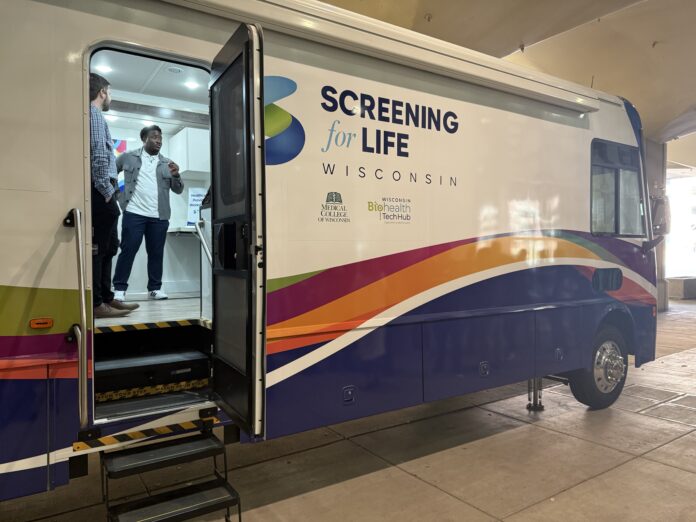

MILWAUKEE — The Wisconsin Biohealth Tech Hub is making headway in its drive to transform personalized medicine in cancer care, and the most visible signs of that progress are mobile screening vans.
The Tech Hub, which is supported by Wisconsin BioForward, was a focus of the 2026 Biohealth Summit, held Oct. 22 and 23 at the Baird Center here.
Three of its five projects were highlighted during the summit, as was its anticipated contribution to “theranostics,” the combination of therapy and diagnostics that is the focus of health systems.
Hubs and spokes
The Regional Technology and Innovation Hubs (Tech Hubs) program was established under the CHIPS and Science Act of 2022 and is managed by the U.S. Economic Development Administration.
Wisconsin’s hub is focused on positioning the state in personalized medicine — which customizes healthcare by tailoring treatments to an individual’s genetics — in cancer care.
It was one of 12 regional Tech Hubs funded during the Biden administration. Six more have been approved for funding during the Trump administration, an indication of bipartisan support.
In Wisconsin, the Tech Hub is led by breast cancer survivor Wendy Harris, who worked at GE Healthcare for 32 years.
Harris, who is the hub’s regional innovation officer, said that while the Tech Hub will advance medicine and science, it’s really an economic development program.
It is funded by the federal government’s economic development agency and advanced with the help of a consortium of 18 Wisconsin companies and a $7.5 million state government commitment.
The hub’s combination of diagnostics, data, imaging and therapy has a national interest motivation as well.
“A lot of the supply chain for theranostics specifically is outside the U.S.,” Harris said during the Biohealth Summit. “So, the Tech Hub is really about bringing some of that supply chain back to the U.S. and that’s one of the reasons we were designated as a Tech Hub.”
The Wisconsin hub’s five projects are centered on translating medical research into tailored healthcare. In the process, the hub hopes to improve outcomes and reduce costs.
The projects are to build the Wisconsin Health Data Hub, led by the University of Wisconsin-Madison, and compile data from key healthcare systems to improve population health data; address healthcare disparities with large, mobile vehicles that bring cancer screening to underserved communities (led by the Medical College of Wisconsin); and build image-guided personalized therapy to inform clinical treatment decisions (led by GE Healthcare).
Additional projects include workforce development programs to align talent pipelines with employer needs, led by Madison College and Milwaukee Area Technical College; and supporting entrepreneurs with lab space, attracting capital investment and otherwise facilitating the transition of innovations to market, led by BioForward Wisconsin.
Jomol Mathew, associate dean of informatics and information technology, and the inaugural chief of biomedical informatics at the UW School of Medicine and Public Health, said the goal of the Wisconsin Health Data Hub is to make sure clinicians are looking at the right data with the right methods so that they can reach the right conclusions.
Mathew said there are two problems the data hub project is trying to address. One challenge is that healthcare data is fragmented at an individual patient level because people move from place to place for their care. As a result, none of the state’s hospital systems have the entire view of patient data in a larger region.
So, the project is incorporating data from Wisconsin’s four major health systems — UW Health in Madison, the Medical College of Wisconsin in Milwaukee, Marshfield Clinic and Aurora Health Care in eastern Wisconsin — that cater to different areas.
“None of us have all the patients,” Mathew said. “So, for example, if you’re studying sickle cell anemia, we may not have an adequate number of patients in any of our single sites. It would be great if they could put it together, and so that’s the whole purpose of this Wisconsin Data Hub project.”
Combining data from those four health systems provides “pretty good coverage” of the state of Wisconsin, Mathew said.
The second objective is to be respectful about the privacy and security of the patient data and respect the fact that these are competing hospital systems.
To that end, Mathew said the data hub wants to make sure that it’s aggregating data only as necessary with a strong governance model and a common format for sharing data.
“So, the approach that we are taking is a hybrid approach,” she said. “We have a federated query, so if you’re an innovator and you want to see where the patients with a particular condition are, you will be able to run a query and see that the patients are either in the northern parts of Wisconsin or southern parts of Wisconsin.”
Mathew said there will also be public health datasets to help reveal some of the reasons why there is increased intensity of a disease in a particular area, plus tools including AI to analyze the data, enabling researchers to develop policies or programs to address the problem.
“If you’re a pharma company and you’re thinking about site identification, this may be a great resource,” Mathew said. “You can come and look at specific sites that you want to work with. Working with us will be much easier because we have a common format for sharing the data with you.”
Eventually, if data hub users want to study clinical deployment and look at post-market evaluation of drugs and study comparative effectiveness, the hub will also be a great pathway for that, she said.
“These are some ways you will be able to leverage the data, and we are hoping that by the end of next summer or before that, we will be piloting some projects,’ Mathew said.
Screening for Life
The Screening for Life program, officially known as CAREScan Mobile Screening, will use mobile screening fleets to deliver cancer screening to underserved communities in Wisconsin.
With equipment such as mammography, ultrasound and PET-CT imaging technologies, it will initially focus on screening for lung, colon, breast, prostate and liver cancers and expand to other conditions.
The first of three large mobile cancer screening vehicles was parked along Wells Street on Oct. 22 outside the Baird Center, which hosted the summit.
Mara Lord, chief strategy and growth officer for the Medical College of Wisconsin, said there are pockets of underserved areas that exist in both rural and urban areas.
“Screening for Life is intended to reach those individuals and to provide those individuals with the screening that they deserve, with the screening that is absolutely an essential right — for life,” she said.
Since mobile screening isn’t the norm, Lord said it’s essential to build trust with people in underserved communities, including Tribal Nations that could be as much as 90 minutes away from the nearest healthcare facility.
That means providing consistent service, not one-and-done visits, to achieve timely, appropriate care.
“Ultimately, we would love to build this into a decentralized clinical trial opportunity as well,” Lord said.
Vehicles with more advanced 3D mammography could be added to the fleet by next April, Lord said.
Image-guided therapy
Perhaps the most complex piece explored at the summit was the image-guided therapy project championed by GE Healthcare.
Corrine Brzeski, senior project manager for GE Healthcare, said it involves bringing several complex theranostic workflows into a state of operational efficiency.
Toward that end, Brzeski said the project is using a piece of GE software called Intelligent Radiation Therapy for theranostics. The software allows GE to bring together different kinds of informational needs that allows customized workflows for areas of care.
“For example, a care coordinator may manage a patient case load of 40 patients,” Brzeski said. “However, not everybody has something going on each day, and for a care coordinator, it’s really important to help that person know what to spend time on today. Where am I likely to see problems?
“And one of the promises of the IRT for the theranostics software is that it helps bring that information to the surface and helps make workflows more efficient,” she said.
It also allows people in different areas of care to see the same information, and they can also choose to see only those parts of the care pathway that pertain to them.
“It’s a pretty customizable package, so that’s the promise of the technology,” Brzeski said.
To apply that to the Tech Hub project, GE is using deployments at its partner healthcare sites, including UW Health, Froedtert and the Medical College of Wisconsin.
“We’re working with these… partners to deploy the software,” Brzeski said. “We’ll do baseline measurements on some key metrics, and then we’ll re-measure and see whether that hypothesis holds on how this software is able to move the needle.”
For example, one metric is how caregivers can shorten the time from referral to first infusion.
“Some of these people are very sick,” Brzeski said. “Taking a couple days off that … could really make a difference.
“We’ve selected our key metrics and we’re just about to finish our baseline measurements,” she said. “Our current focus is the data extraction that goes along with that.”
The real competition
Summit attendees also heard from leaders of regional Tech Hubs in Indiana and Kansas City, and it’s clear the focus was on their respective regional strengths — biomanufacturing for national security at Heartland Bioworks in Indiana and fermentation-based biomanufacturing with KC Biohub.
They stressed the importance of collaboration where possible because the true competition is not among regions of the U.S., but with the U.S. versus China.
Melissa Roberts Chapman, president and regional innovation officer for the KC Biohub, said 79% of U.S. biotechnology companies rely on Chinese bioservices to bring their products to market, and China controls 70% of global fermentation capacity, so onshoring these capabilities is a real focus of regional tech hubs.
“This is a real national challenge that we have to shape up and address,” Roberts Chapman said. “Our real competition is not with our neighboring communities, it’s with China.”