
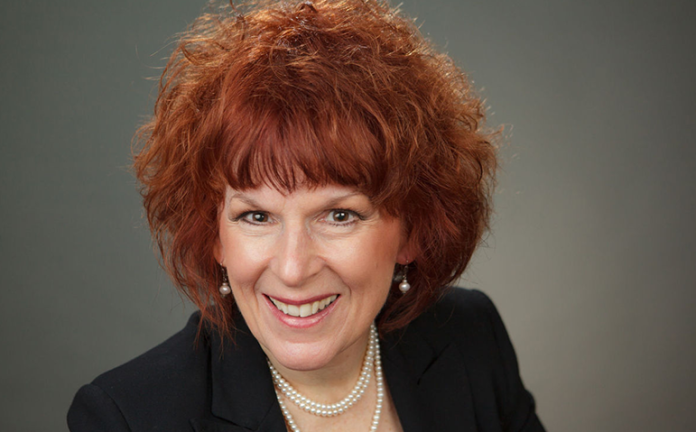
Ask Susan Schmitz about transportation needs, and she’ll tell you that Greater Madison is developing a much-needed spine. That’s spine as in the special (and faster) transit lanes for 60-passenger, articulated buses that are part of a proposed bus rapid transit or BRT system, which the city of Madison has taken initial steps to build as part of its Madison in Motion transportation plan.
In this Take Five interview, Schmitz, the retiring president of Downtown Madison Inc., explains why she’s so optimistic about the BRT concept, and she addresses the passions she’ll pursue during her “retirement” at year’s end.
IB: Why are you so enthusiastic about bringing bus rapid transit to Madison?
Schmitz: It’s the beginning of forming a regional transit system. We’ve needed this for decades. Madison and the Greater Madison area, including other parts of Dane County, badly need those connections and you have to start somewhere. We already have a good Metro Transit system, but we need more than that, and the bus rapid transit provides those connections and “spines.” I mean spines that take us from the east side to the west side to the south side to the north side, and then you work off of those spines with other modes of transportation like bike share or improvements in walking, and then park and rides where people have a place to park and they can get on rapid transit.
So there are options to get to work, and it isn’t just one system — that’s where our hands have been tied a little bit with just Metro. People having to get from one side of the city to another, especially to their jobs or to the doctor or other important places they have to go, and it will take sometimes two hours right now. This way, you start creating a multimodal transportation system. In many cases, people might take two roads to get there, but it’s fast because there are connections. You have to start somewhere and that’s why BRT starts with those major spines going through the city and connecting eventually to the suburban cites like Middleton, Stoughton, and Sun Prairie, etc.
Whether those special lanes go to those other communities, who knows? At least it’s the beginning of a connected system because when we looked at a regional transit system prior to Gov. Walker, we were looking at connections for the majority of Dane County and connecting Waunakee and Sun Prairie and Stoughton and Fitchburg.
IB: Is there another community with a successful BRT model for Madison to follow?
Schmitz: There are. Eugene, Ore. has a successful BRT system. Part of Portland’s transportation system is bus rapid transit. In some larger communities where they’ve had regional transit systems for decades, BRT is one part of a system, especially in cities that don’t have a light rail system or don’t have the rail because this [BRT] is not on a rail line, which is sometimes not as popular. A BRT can, while it typically stays in its lane, take a turn off, and so they don’t need a rail line.
IB: Can this system be done without the state legislature allowing local municipalities to create regional transit authorities with taxing power, which would help cover the operating costs of a BRT system?
Schmitz: That’s a really good and important question. BRT systems, and that’s just the beginning of a wider transportation system, are not as expensive as rail systems. A lot of times with the buses, the vehicles themselves, you can apply for grants for them, and so that’s not as difficult. The challenge is going to be operating costs because, in most cases, that’s what regional transit authorities do — they pay for operating costs.
However, we do have tax incremental financing. That’s one tool, and it’s a great tool, that we could use because that TIF increment is allowed, according to the state statute, for the operation of public vehicles. So if the city looks strategically, which I know they are, at areas in the city where these spine will go, there could be TIF districts approved for those areas. It’s the increment that would help pay for operations, but once those designated areas are put in, very often the values for that area and the taxes — they go up because you get more development around the major stops. So you’ll get more development, whether it’s more housing or services or whatever. It’s good for those particular areas.
IB: Would East and West Washington Avenue be the most obvious areas for an east-west corridor?
Schmitz: Yes, and University Avenue is really big, and Park Street [after renovation work is done], but specifically University Avenue because of all the cars that come from the west going to the university, which has about 17,000 employees. To get a BRT in that direction would be really, really helpful because what we found out when we were looking at a regional transit system is that most people said they would take public transportation if it was available and if it didn’t take them an hour to get to work.
(Continued)
IB: The city’s initial plan is to start with an east-west corridor within three to five years and develop the full system within a decade once Park Street is redone. Does that approach make sense to you?
Schmitz: It sure does. When you look at the traffic flow right now and the possible development areas, that’s exactly where they should be. When they start working, it will become even clearer as to the connections because as development continues, the connections that are needed might be five or six blocks from your stop. That’s why something I heard relatively recently, about how bike-share programs are the fastest-growing mode of transportation in the world, is a positive development because instead of these bike-share programs being privately owned like BCycle and other brands that run these, they really could be part of a public transportation system, and some public funds could be put into that. That makes it easier to put those bikes in the right place. Also, these bike-share programs nowadays are looking at electric bikes because sometimes it’s hard for people to ride bikes.
IB: What’s your life going to be like after Jan. 1?
Schmitz: I don’t know but I hope it’s really busy. There are things that I’m very, very passionate about and the number one thing is transportation and biking and this BRT system. Having a regional transit system would just be so good for this community, so I hope to continue to work in that area. I would also love to see the Nolen Waterfront project happen in my lifetime. I would like to be involved in that because it’s pretty exciting.
Click here to sign up for the free IB ezine — your twice-weekly resource for local business news, analysis, voices, and the names you need to know. If you are not already a subscriber to In Business magazine, be sure to sign up for our monthly print edition here.

