
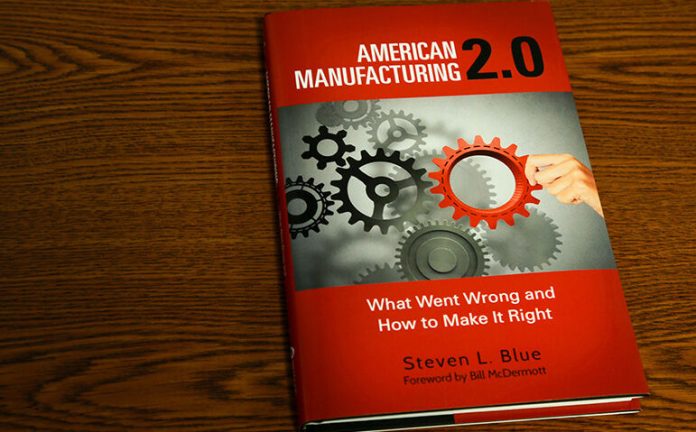

Steven Blue believes America is no longer a manufacturing powerhouse, and he has some pointed criticism for his fellow manufacturing executives for their pursuit of cheap labor abroad and their outdated attitudes toward business culture. Blue, who is CEO of the Winona, Minn.-based Miller Ingenuity, is the author of the new book titled American Manufacturing 2.0: What Went Wrong and How to Make it Right. As the title suggests, he can point the finger of blame and suggest solutions at the same time. Here are excerpts from IB’s recent interview with Blue.
IB: The title of the book is partly what went wrong? Why do you no longer consider America to be a manufacturing powerhouse?
Blue: You don’t have to look farther than the government statistics. Look at the trade deficit and look at the manufacturing losses in the last 10 or 15 years. That’s probably when it accelerated, but since the Second World War we were the manufacturing juggernaut of the planet, and now we’re mostly room service for the Chinese.
|
Steven Blue |
IB: What do you mean by room service?
Blue: There is plenty of data around to show the Chinese have much more manufacturing capacity and capability than we do, and by room service I mean we’re like the equivalent of room service. The Chinese won’t make whatever they don’t want to make, we’ll deliver whatever goods and services they don’t want to do, and we don’t in a sense get to pick so it’s a pretty deplorable situation.
IB: You also mentioned the trade deficit, which [in 2015] was more than $500 billion annually. How did we get there?
Blue: There are a lot of reasons for that, but one is that American manufacturing leadership gave up on the workforce quite a few years ago and said, ‘You know, they are expendable assets so we’ll just ship their jobs off to wherever we can get it made the cheapest,’ and they should have been looking at them, and they should look at them now, as renewable resources. So it started when American leadership decided it wasn’t worth holding onto and then it accelerated with these really crappy trade deals we have. The worst part of every trade deal we have, and I mean every single one, is that none of them address currency manipulation. If you want to know why Toyota is cheaper to buy than a Chevrolet, you don’t look any further than the currency manipulation.”
IB: Obviously, then, you think Mr. Trump is onto something.
Blue: As far as trade deals are concerned, that’s absolutely right. See the problem is guys like me and very few CEOs can do anything about these damned trade deals. Unless you’re Jeff Immelt [General Electric] or Warren Buffet [Berkshire Hathaway], you don’t get to be in the same room with the people who negotiate them. So I tell CEOs all the time when I give keynote speeches, ‘Don’t waste any of your time and don’t waste any of your money trying to get the trade deals changed yourself because you can’t do that. You can’t have much of an impact. You have to focus on what you can focus on, and that’s how to make your business better.’
Yes, certainly, he [Trump] is onto something with the trade deals, and that’s what’s causing the deficit right now.
IB: In terms of Chinese currency manipulation, what are our options? I thought the World Trade Organization served as a forum to address those kinds of disputes.
Blue: It’s supposed to and like a lot of other deals we have with other countries around the world, we hold up our end of the bargain, they don’t, and we don’t do anything about it because there is no teeth in the agreement. That’s the case in the World Trade Organization. There is no provision to do anything about currency manipulation. It’s the same thing with the Trans Pacific Partnership [TPP]. There is nothing in there about currency manipulation so there is nothing in there to do anything about it, so all we can do is sort of watch. (Editor’s note: Before Trump’s victory, some believed that TPP, negotiated by the Obama administration, would be acted on in the current lame duck session of Congress, but in light of Trump’s victory those plans have been scrapped).
IB: Should we not be negotiating these large, complex multinational trade deals, but more bilateral deals between the U.S. and one other trading partner at a time?
Blue: To me, that seems to be a more manageable process. When you look at the TPP, there are, I don’t know, 15 countries in the darned thing. China is not in that, but they get into it at some point in time. And then you look at all the side letters, the side deals. There are a bunch of them with Japan. There are a bunch of them with South Korea. There are many of them. Most side deals are with America. We didn’t get anything.
IB: Can you give me another compelling statistic that illustrates the point you make in the book?
Blue: I’ll give you one that Wisconsin should be worried about. The trade deficit in Wisconsin has gone up exponentially in the last two or three years. It wasn’t much of a deficit. In 2012, it was actually only a $79 million trade deficit. In 2015, the trade deficit in Wisconsin was $607 million. Guess where $450 million of that came from? Take a wild guess.
IB: China.
Blue: Yeah, that’s where it came from — $450 million of that trade deficit came from China. I know that Wisconsin likes to tout that they are a manufacturing hub and all that, and I’m sure you’re really good at manufacturing, but the biggest export that Wisconsin has is tractors and the biggest import, which is over half a billion dollars, is in sweaters. Why aren’t you guys making sweaters in Wisconsin?
IB: It’s not that the weather isn’t chilly enough.
Blue: I used to live in Milwaukee [and work for Allen-Bradley, since acquired by Rockwell Automation], so I know what the weather is like there.
IB: So while our governor is championing our trade deal with China, your point is that it comes with a cost.
Blue: Well, it does. I just hope somebody in Wisconsin is looking at that trade deficit because when I saw the numbers, it was astounding. I’m thinking, ‘Well, what’s the trade deficit in Wisconsin? Probably pretty good, pretty small.’ I’m reading all this stuff about how great they are, and they are. Don’t misunderstand me. I’m not saying they are not. Then I look at that trade deficit and if I’m somebody at the top, I’m saying where is that coming from and why?
IB: Is that simply a consequence of increased trade?
Blue: No, the consequences of expanded trade should be that the GDP [gross domestic product] of both trading partners goes up. Your exports go up. Your imports can go up but you maintain parity. When your imports are higher than your exports, obviously you’re shipping jobs to the country that doing the exporting back into your market. There is no getting around that. You’re shipping jobs that you could have and should have, but instead the importing country has them.
(Continued)
IB: You also explain how to make it right, or how to revitalize the manufacturing sector. Whereas Trump has threatened to slap a tariff on the products of companies who move jobs overseas, you seem to be addressing more about internal corporate culture than public policy. Is there any alignment between what you have proposed and what any of the presidential candidates offered during the campaign?
Blue: The presidential candidates offered things they may or may not be able to deliver on. It may or may not have any basis in reality. As I said, your garden-variety CEO can’t do a thing about it. I didn’t dedicate any of my book to government policy. I don’t have any influence over that. The book is entirely about what many CEOs won’t acknowledge — that it’s the culture, stupid. That’s what I tell people all the time. I just wrote a blog for Fortune magazine that was titled “Why smart manufacturing is a dumb idea.” When I talk to some CEOs, they say don’t talk to me about this culture stuff. Tell me about the hard stuff. How do I put a smart factory in somewhere? You can have the smartest factory in the world, but if you have the dumbest workforce in the world, it doesn’t seem like it’s going to work very well.
By the way, when people say to me that culture can’t possibly have that much of an impact, I have two words for them: Wells Fargo. Wells Fargo claimed they had a culture and they had ethical values of doing what’s right for the customer. This is what they said. Well, how could that have been the case when they created 2 million ghost accounts? No, their culture was not ethical and was not doing what’s right for the customer, but the CEO didn’t know that. He really actually thought that was the culture he had. The culture that he had, which destroyed him, was much different and now it’s an ungodly record of losses they are going to rack up, in the billions, because the culture they had was profits no matter what, profit at all cost. Of course companies are supposed to make a profit, but when that is the be-all and end-all, and the number one, two, three, and four things that you do, people start doing lazy things like they did at Wells Fargo. They start cooking the books, they start creating ghost accounts, and it just becomes a cultural cesspool.
Are you familiar with The 7 Habits of Highly Effective People? Well, in my book I outline the seven values of highly ingenious companies. I go through them one by one. There is a sequence in which they have to be installed, and there is a certain way they have to be installed. If you do it right, you achieve astonishing results due to creativity and innovation and the organization just explodes.
IB: In the book, you mention your experience at Allen-Bradley in Milwaukee and that you had a supervisor who didn’t treat people well and didn’t last very long.
Blue: I only had one bad supervisor at Allen-Bradley. I was there 13 years, and that was that plant manager, and Allen-Bradley didn’t put up with that. They had such a phenomenal culture of respect and value for the individual employee, and it was just unbelievable. I can remember tales of Harry Bradley, who used to live on the top floor — and that used to be an apartment he had — and about how he roamed the halls and factory during midnight shift, not to see if people were working because he knew they were working, but just to make sure they were all right. He would stop by and talk to them about their kids. And because of that cultural dimension, Rockwell bought Allen-Bradley, when they were privately held, for $1.65 billion in cash, and they had no debt. They had to be doing something right.
Click here to sign up for the free IB ezine – your twice-weekly resource for local business news, analysis, voices, and the names you need to know. If you are not already a subscriber to In Business magazine, be sure to sign up for our monthly print edition here.

