
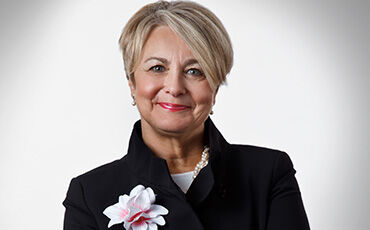
Deb Archer is marking her 20th anniversary as president and CEO of the Greater Madison Convention & Visitors Bureau with some perspective on Madison’s growth as a destination. The GMCVB has been promoting tourism since 1972, but it wasn’t until the mid-1990s that it became a sales and marketing, and destination-management, organization. That coincided not only with Archer’s arrival but also the addition of facilities like the Alliant Energy Center and Monona Terrace. With the CVB’s work now being more strategic, Part 1 of this “Take Five” interview with Archer explores how the organization has changed and discusses her favorite proposal for Judge Doyle Square.
IB: In 20 years, how have outside perceptions of Madison as a destination changed?
Archer: Pretty dramatically. When I got here, we didn’t have any serious event facilities except the Coliseum, but we were hosting World Dairy Expo, and we had the Drum Corps that took place at Camp Randall, and the WIAA tournaments, which were taking place at the UW Fieldhouse and other facilities at the University and in the community, but those were really the only large annual events.
| “[I] work very hard to ensure that what we call the ‘visitor voice’ is represented in conversations about public policy and product development.” — Deb Archer, president and CEO, Greater Madison Convention & Visitors Bureau |
The destination is now transformed; our organization is transformed. Regionally and nationally, in certain market sectors such as environmental organizations, we have really established ourselves as a convention destination. We are working to establish Madison as a sports destination. Not that it wasn’t already a popular sports destination, with UW sports and Big Ten athletics, but in terms of other amateur sports events, we have really grown in a lot of minds as a convention and sports destination.
Yet we’re not a household name, and that’s something we strive for every day in trying to establish awareness about everything the city has to offer, whether visitors are coming individually or coming [as part of a group] to an event.
IB: Just by having quality facilities like Monona Terrace, the Kohl Center, the Overture Center, and now the New Holland Pavilions that can attract more events, I would imagine the word is spread to some extent. You can’t just rely on that, but…
Archer: Absolutely not, but certainly our reputation grows as more people come here. Beyond what evolves from people sharing those experiences, we’re proactively positioning the destination strategically in certain market sectors. We know we have strengths in intellectual capital and in information, and also in the types of organizations we know will be attracted to this community in terms of our values and what we have to offer. We’re very strategic in how we approach business, which is very different than the way we approached it 20 years ago.
IB: Given all that, how has your role changed?
Archer: I was here about year, hired as VP of sales [in 1994] while we were transitioning the organization. It was about the time I took over that we had a fully formed Madison Festivals Inc. and spun off the Taste of Madison and the Madison Marathon, which we incubated, grew, and ran. We spun those off because we had to become a sales and marketing organization to support Monona Terrace, which was about to be under construction, and the Alliant Energy Center, which was about to be finished. The Exhibition Hall opened in 1995 and Monona Terrace opened in 1997, but they didn’t have established sales and marketing forces. There was actually a joint agreement between the city and the county to look for a third party — and it was our organization — to do the marketing and sales for those facilities. When I came in, we were just beginning that, so it was the formative time of becoming a sales and marketing and destination-management organization.
My role then was really establishing what we needed to do to sell this destination, and my role now is very different. When I was a new CEO, I very heavily involved in building our sales body and body of work. So now, in the leadership position, we’re a 30-plus staff member organization with 500 business partners, and my role is really to lead the vision for what the destination needs to be in the future and also, to be very candid, work very hard to ensure that what we call the ‘visitor voice’ is represented in conversations about public policy and product development. The other part of my role is to ensure the visitor economy, and what we do, is at the table when there are economic development conversations, because the visitor economy is such a big part of our economic status and future.
(Continued)
IB: Is that visitor’s voice represented in what you advocate for?
Archer: Yes. A couple of years ago, when there was talk about taxis on State Street, we made sure that people understood that visitors needed taxi service where they would likely be, which was on State Street. We were involved in the Airbnb conversation because the visitor wouldn’t normally be represented in those conversations, and we bring forward that information and that voice.
IB: Do you have a favorite among the various proposals for Judge Doyle Square, which all include a second convention hotel?
Archer: One proposal [the Vermilion Development plan for a 282-room Marriott brand hotel] comes close to the size, scope, and location that’s been recommended based on our information. None of the proposals really do address the recommendations for the hotel, and so it’s now incumbent upon us to stay engaged in these conversations so that information continues to be focused upon. The Vermilion proposal has the hotel on Block 88, which is closest to Monona Terrace, and it’s the largest hotel in terms of room numbers, but it still doesn’t reach the recommended level for the number of rooms.
IB: So you’ve got to work your will on the process, even though the city favors the Exact Sciences proposal.
Archer: We’re going to be very engaged. We’ve told George Austin [former planning and development director for the City of Madison and president of AVA Civic Enterprises] and city staff that we will always make ourselves available. We think it’s critical that the information that’s available to make decisions about the hotel are recognized and respected for what they are because those are the answers to what we need. We want to make sure that we keep presenting that information.
IB: Is there anything else you need for the hotel that the proposals don’t have?
Archer: Yes, in terms of the scope of the hotel, so that we have a hotel built that has the amenities that convention-goers would expect, and have them on-site, inside the property. You must have networking spaces, you must have some small meeting space for committee meetings, and you must have things like food outlets. So rather than have them in multiple locations, let’s make sure those amenities are in the hotel so it really is a convention hotel.
Click here to sign up for the free IB ezine – your twice-weekly resource for local business news, analysis, voices, and the names you need to know. If you are not already a subscriber to In Business magazine, be sure to sign up for our monthly print edition here.

