
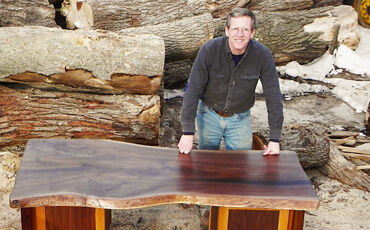

Paul Morrison might not have launched the sustainability movement but 15 years ago he founded a business that was custom-made for it.
Morrison runs The Wood Cycle of Wisconsin, a small custom woodworking shop that takes a somewhat unique approach to natural recycling. Almost everything The Wood Cycle does begins with a local tree that is coming down for one reason or another. In most cases Morrison and his staff of six full-time craftsmen will take a tree that had long been a family friend and transform it into a warm and inviting piece of furniture or cabinetry for that very same family (and in some cases, a business).
The business has grown right along with the sustainability movement in a community that fully embraces such business models. Yet there would have been nothing to embrace had woodworking and a corresponding appreciation for Wisconsin’s hardwoods not been ingrained in Morrison’s DNA. “I would say sustainability is a big part of it,” Morrison says, “but woodworking had been my hobby since I was a kid. I grew up using local woods just because my grandfather and his brother ran a sawmill.”
As Morrison examined the feasibility of such a business, he understood both the emotional and eco-interaction individuals have with their own trees — children building tree houses or swinging from tires affixed to backyard trees or adults gathering under shaded areas or incorporating trees as part of their residential landscapes. So he formed The Wood Cycle to focus on local woods.
Circular firing squad
For safety reasons, recycling and reusing urban hardwood is not something most commercial mills were interested in. Morrison notes that his sawmill, especially with the modern safety features, can work on urban wood, whereas the circular sawmill his grandfather had might as well have been a circular firing squad because of the increased danger of hitting a nail and sending it flying like shrapnel.
“They ran an old-style, circular mill where if something goes wrong, look out,” Morrison notes. “That’s why, if you look at the history of sawmills, nobody messed with urban trees because it’s just a given — somebody put up a tree fort or somebody hung a sign from it, whatever.”
With modern safety features in sawmills, he can take the chance because the safety hazard is pretty much gone “and the beauty of some of those trees is just something you can’t ignore,” he adds. “Some of the largest trees in the state are within municipalities.”
As a youth, Morrison assumed he would work with wood for a living, but his high school guidance counselor took one look at his exceptional math grades and suggested a career in mathematics or engineering. He pursued an engineering degree, graduated from UW–Madison, and enjoyed working for the state Department of Agriculture, Trade, and Consumer Protection on budgets and environmental policy related to groundwater contamination, including fertilizer and pesticide-related issues.
For 20 years, there was never a reason to look for another line of work, except that he continued to enjoy woodworking as a hobby. As Morrison forged a career in state government, he thought woodworking was something he’d do in “retirement.” Then he bought a sawmill and started generating more wood than he could use as a hobbyist, so he started doing side projects to use up the wood. The people he served in those side projects were so impressed with his work that they suggested he “quit the day job,” he says.
After taking their advice, The Wood Cycle has built impressive brand loyalty and can point to glowing testimonials from grateful clients. Morrison compared the recycling of urban wood to the so-called slow-food movement in that consumers began to demand a better, more sustainable process for food production and they covet the same thing for wood. The economic crisis of 2008 also helped nudge people in the buy-local direction, especially when it became clear that tree-harming pests like the Emerald Ash Borer came with wood imported from the other side of the planet.
“There are a lot of personal connections with individuals and their trees because many of our projects have actually been taking the clients’ own tree and putting it back in their home or putting it back in their business, and there is always a story and history related to that tree people have grown up around,” Morrison notes.
“If you look at the slow-food movement, we’ve gone through a global market where food just goes into a big system and comes out to individuals. A lot of people recognize that and they don’t like that. They like to know where they are getting their food. You’re starting to see that same thing happen in a variety of other economies and wood is one of those.”
(Continued)
Farming out work
Initially the company was self-funded but just when the economy headed south in 2007, Morrison was looking to expand his facilities, including a larger barn to serve as the sawmill. A rural neighbor offered an existing barn, which was moved with the help of the same investors who had advised Morrison to quit his day job. In that restored farmstead, located on the south end of Fish Hatchery Road, the company runs its own sawmill, drying kiln, and a full custom woodworking shop and gallery.
|
The Wood Cycle staff from left: Scott Petranek, Alex Stehle, Mathew McCoy, Andy Lynch, and Paul Morrison (seated). |
About 80% of its work is done for residential customers and 20% is done on behalf of commercial interests, including professions trying to shed their cold corporate images with warmer furnishings. “I’d say the commercial segment is probably held back more than anything by fact this whole urban wood concept still is a little bit too new,” Morrison says. “There are no good definitions or specifications that architects and designers are able to point to and define what we’re doing.”
As part of an urban wood organization, Morrison is working with architects and spec writers to better define urban wood. The concept is well aligned with Leadership in Energy and Environmental Design (LEED) standards, and there are local-sourcing categories where urban wood can garner LEED points, but the organization still hasn’t established a way to rank or qualify it.
Meanwhile, Morrison has dabbled in blogging and social media platforms like Pinterest and Instagram. While they have yet to produce clients, he knows The Wood Cycle must stick with social media because when the next generation of customers, the millennials, invest more in homes and are ready to use The Wood Cycle’s services, they are likely to be very receptive to its sustainable business model.
The Wood Cycle has worked on wood from a variety of tree species, including wood provided by people who had no use for their trees. In those situations, the company didn’t necessarily have a use for the wood either but Morrison hates to decline good wood so he partnered with Habitat for Humanity restores to prepare and supply wood for Habitat’s home-construction projects.
“It’s another option for people with trees they have to remove,” he explains. “We found out all the other hobby woodworkers around here are interested in this local lumber. At this point, we’re probably milling 1,000 board-feet a month just for other woodworkers in the area and then supplying it through the restores.”
Although Madison could be considered the birthplace of urban wood recycling, the practice has since spread to other cities. Seven years ago, one of the editors of Fine Woodworking, a publication for woodworking hobbyists, was in the Madison area and stopped by for a look at the shop. The editor remarked to Morrison that he had never seen this type of business model before and the resulting publicity helped spread the word. Similar businesses now exist in a dozen U.S. cities, including New York, Seattle, and St. Louis.
A bicycle built with wood
Perhaps one day, these imitators will copy The Wood Cycle when it comes to making all-wood bicycles. One of Morrison’s unfulfilled ambitions is to construct a functional bicycle using nothing but wood (including the tires), a concept that originated with his grandfather. When asked if one of the impediments is consumer reluctance about getting splinters from the bicycle seat (in an area where removing the splinters would be somewhat embarrassing and require help), Morrison provided a product guarantee.
“When it’s built, it will be smooth enough where it can be safely ridden on,” he asserts with a chuckle. “I haven’t abandoned the idea but I think I’d have to really retire in order to do that.”
Click here to sign up for the free IB ezine – your twice-weekly resource for local business news, analysis, voices, and the names you need to know. If you are not already a subscriber to In Business magazine, be sure to sign up for our monthly print edition here.

