

From the pages of In Business magazine.
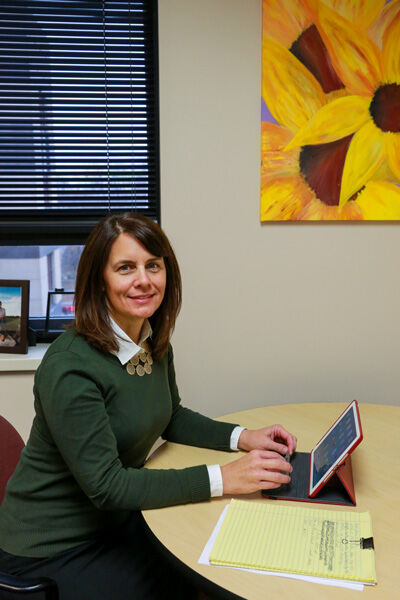
Michelle Somes-Booher, 46, the new director at the Small Business Development Center at UW–Madison, describes herself as a “multi-generation entrepreneur.” Born in Sault St. Marie, Mich., her great-grandfather, grandfather, and father all owned their own businesses in Michigan and the Upper Peninsula. “When you grow up around business, that’s what you live and breathe,” she states.
For as long as she can remember she aspired to be in business. After working in the high school products and yearbooks industry for over a decade, the Central Michigan University graduate started and ran a successful paint-your-own-pottery studio for five years before her husband’s job promotion in 2009 relocated the family to Middleton.
She taught business courses at UW–Baraboo/Sauk County and later in Madison at the SBDC before becoming a consulting manager. Recently she replaced Neil Lerner who left in August 2015 to become associate state director at the SBDC Network.
Now firmly at the helm, Somes-Booher recently shared some thoughts as she leads the SBDC into the future.
IB: You’re young into your new role, but what ideas can you implement?
Somes-Booher: This is a great opportunity to look at the classes we offer to make sure they’re relevant. We’re making some changes to meet the needs of the next generation of entrepreneurs. Online courses have been sitting in the wings and we’re pushing them forward, which is exciting. It’s a huge undertaking. I don’t think the spirit of entrepreneurship has changed through the years but the tools have.
IB: How does the SBDC help entrepreneurs?
Somes-Booher: Some people have great ideas but just aren’t cut out for business ownership; others are but don’t know where to begin. We can help them sort that out. It’s all about risk and tolerance, your idea, and your personal and financial readiness. Those are the key factors. We try to get entrepreneurs to the next step, whether that’s taking the next class, creating a prototype, or whatever.
IB: What does SBDC offer?
Somes-Booher: We provide noncredit business courses. Last year we hosted 85 courses attended by 1,300 people — everything from startup and financial management to HR to emerging leadership training. For large companies, we can help with frontline supervisors to the C-suite. We also provide no-cost, one-on-one consulting. This year (through mid-November) we’ve helped 350 clients start 30 new businesses that obtained $13.5 million in capital.
IB: Are there other services?
Somes-Booher: Our Business AnswerLine is free and available to anyone around the state. It’s staffed by highly experienced business people and can be a real time saver. So rather than Googling for answers, call the AnswerLine (800.940.7232). We get a lot of requests and not all are appropriate for one-on-one consulting or classes, but we’re also happy to refer people to other available resources.
IB: How is the SBDC funded?
Somes-Booher: The U.S. Small Business Administration funds the national SBDC network with a federal grant. The network includes almost all of the four-year state universities. The Madison SBDC focuses on Dane, Sauk, and Columbia counties. Locally, we also handle all curriculum and instruction for the Wisconsin Alumni Research Foundation’s (WARF) Upstart program, a minority and women’s entrepreneurship program.
IB: Who are your clients?
Somes-Booher: We work with people who want to grow businesses and create economic impact — from millennials to retirees, manufacturing clients, IT, biotech, clients who self-fund or those seeking angel, venture, or bank funding. It runs the gamut.
IB: What’s the challenge in working with business hopefuls?
Somes-Booher: Speaking the truth. Sometimes it’s not what the entrepreneur wants to hear. Some businesses don’t make it and that’s hard, but it’s not a failure if you’ve learned something. Chances are that you’ve grown personally and learned a lot. So long as we mitigated the risk along the way so when it’s finished you’re not in a horrible financial situation, you’ll probably be able to look back one day and say, ‘Yeah, I’m glad I did that even though it didn’t work out.’
IB: Your advice to future business owners?
Somes-Booher: Don’t be afraid to seek assistance. This is a resource-rich community. Any area providers can help. You don’t have to go it alone.
Click here to sign up for the free IB ezine — your twice-weekly resource for local business news, analysis, voices, and the names you need to know. If you are not already a subscriber to In Business magazine, be sure to sign up for our monthly print edition here.

